

MARINE TOXINS AND VENOMOUS AND POISONOUS MARINE ANIMALS
333
found in the Pacific area. Some families, such as the stingrays, weevers
and stargazers are chiefly benthonic, and may sometimes be found in
quite deep waters. The great majority of venomous piscines are nonmigratory and slow swimming. They tend to live in a protected habitat
in or around rocks, corals, kelp beds, or they spend much of their time
buried in the sand. Most species use their venom apparatus as a defensive weapon, chiefly against other fishes. Halstead and Mitchell (1963)
state that less than 5% of the venom organs of these piscines have been
described.
The venoms of these fishes differ markedly in their chemical and
toxicological properties from the toxins of the poisonous fishes, and
from the toxins of the other venomous animals. The most common
characteristic of the toxins of the venomous fishes is their relative
instability. Few of them are stable at room temperatures, and toxicity
appears to be lost or markedly reduced even on lyophilization of freshly
prepared crude extracts. I n many cases the spines or structures
containing the venom need to be stored at temperatures below -220°C
if stability must be assured. While no basic structure for the toxin of
any venomous fish has yet been established, or even proposed with any
degree of fervor, this author has suggested that there is sufficient
similarity in the zootoxicological properties of the venoms of the stingrays, weevers, scorpionfishes, and some of the others so far studied, to
indicate that their venoms may be similar, or at least have some
similar chemical components.
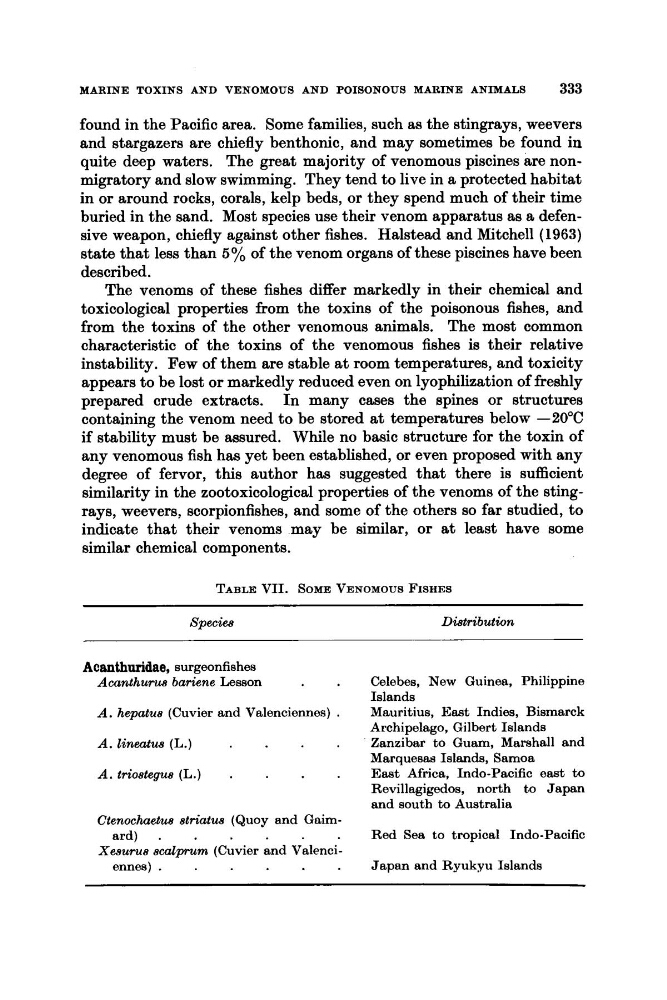
TABLE VII. SOME VENOMOUS FISHES
Speciea
Dktributwn
Acanthuridae, surgeonfishes
Acanthunce bariene Lesson
A . hepatus (Cuvier and Valenciennes) .
A . lineatua (L.)
.
Ctenochaetuo striatus (Quoy and GaimXesurue scalprum (Cuvier and Valenciard) .
ennes) .
Celebes, New Guinea, Philippine
Islands
Mauritius, East Indies, Bismarck
Archipelago, Gilbert Islands
Zanzibar to Guam, Marshall and
Marquesaa Islands, Samoa
East Africa, Indo-Pacific east to
Revillagigedos, north to Japan
and south to Australia
Red Sea to tropical Indo-Pacific
Japan and Ryukyu Islands
333
found in the Pacific area. Some families, such as the stingrays, weevers
and stargazers are chiefly benthonic, and may sometimes be found in
quite deep waters. The great majority of venomous piscines are nonmigratory and slow swimming. They tend to live in a protected habitat
in or around rocks, corals, kelp beds, or they spend much of their time
buried in the sand. Most species use their venom apparatus as a defensive weapon, chiefly against other fishes. Halstead and Mitchell (1963)
state that less than 5% of the venom organs of these piscines have been
described.
The venoms of these fishes differ markedly in their chemical and
toxicological properties from the toxins of the poisonous fishes, and
from the toxins of the other venomous animals. The most common
characteristic of the toxins of the venomous fishes is their relative
instability. Few of them are stable at room temperatures, and toxicity
appears to be lost or markedly reduced even on lyophilization of freshly
prepared crude extracts. I n many cases the spines or structures
containing the venom need to be stored at temperatures below -220°C
if stability must be assured. While no basic structure for the toxin of
any venomous fish has yet been established, or even proposed with any
degree of fervor, this author has suggested that there is sufficient
similarity in the zootoxicological properties of the venoms of the stingrays, weevers, scorpionfishes, and some of the others so far studied, to
indicate that their venoms may be similar, or at least have some
similar chemical components.
TABLE VII. SOME VENOMOUS FISHES
Speciea
Dktributwn
Acanthuridae, surgeonfishes
Acanthunce bariene Lesson
A . hepatus (Cuvier and Valenciennes) .
A . lineatua (L.)
.
Ctenochaetuo striatus (Quoy and GaimXesurue scalprum (Cuvier and Valenciard) .
ennes) .
Celebes, New Guinea, Philippine
Islands
Mauritius, East Indies, Bismarck
Archipelago, Gilbert Islands
Zanzibar to Guam, Marshall and
Marquesaa Islands, Samoa
East Africa, Indo-Pacific east to
Revillagigedos, north to Japan
and south to Australia
Red Sea to tropical Indo-Pacific
Japan and Ryukyu Islands