

322
FINDLAY E. RUSSELL
of AgNO, and seems to have no toxic value.” They concluded that
all of the nitrogen of the toxin existed as amino nitrogen, and that the
toxin might well be an acyclic compound. It is obvious that these
investigators were working with very impure extracts of the poison.
Further studies on the crude toxin have been carried out by a number of workers, but it was not until 1950 that Yokoo reported on the
isolation of a very pure crystalline toxin, spheroidine, from the ovaries
of Sphoeroides rubripes. This toxin was given the formula CPH703N
(molecular weight 116), but the formula was subsequently revised to
C,,Hl7O1,,N, on the basis of further analyses and a cryoscopically
determined molecular weight of 335 (Yokoo, 1952). Subsequently,
Yokoo and Morosawa (1955) demonstrated the existence of two forms
of the toxin which differed in toxicity but which gave identical infrared
spectrograms and paper chromatograms. The spectrograms were almost
identical to those obtained by Tsuda and Kawamura (1953), who had
isolated tetrodotoxin from the same source, and who on the basis of
analytical data proposed the formula C,,H,,O,N,.
During the past several years a number of excellent studies on the
structure of this poison have been carried out by Tsuda et al. (1963),
Tomie et al. (1963), Goto et al. (1963a, b) and Mosher et al. (1964).
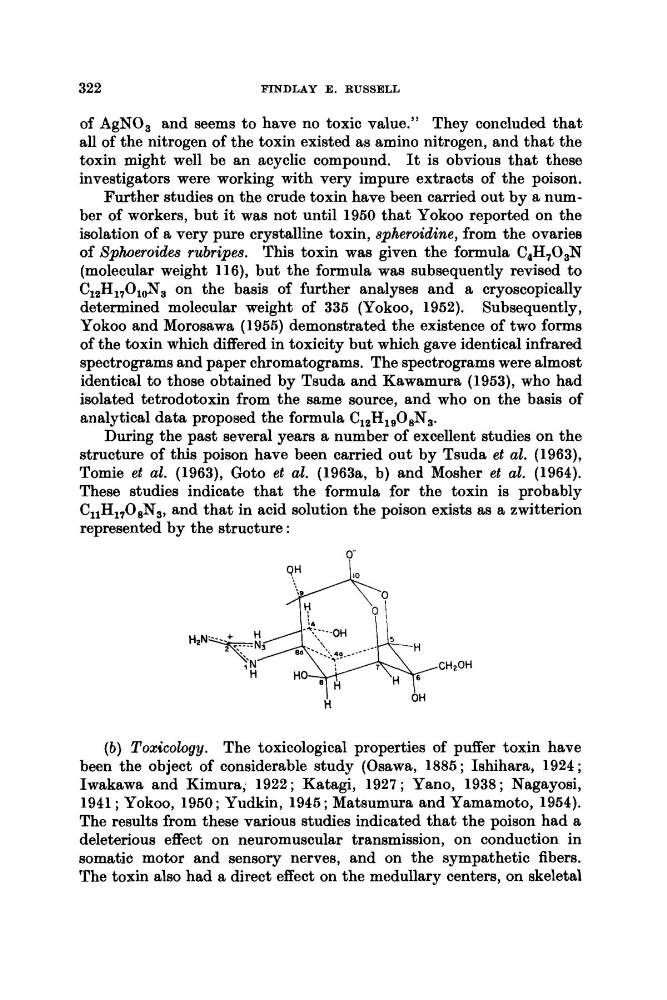
These studies indicate that the formula for the toxin is probably
C,,H,,O,N,, and that in acid solution the poison exists as a zwitterion
represented by the structure :
0( b ) Toxicology. The toxicological properties of puffer toxin have
been the object of considerable study (Osawa, 1885; Ishihara, 1924;
Iwakawa and Kimura; 1922; Katagi, 1927; Yano, 1938; Nagayosi,
1941 ; Yokoo, 1950 ; Yudkin, 1945 ; Matsumura and Yamamoto, 1954).
The results from these various studies indicated that the poison had a
deleterious effect on neuromuscular transmission, on conduction in
somatic motor and sensory nerves, and on the sympathetic fibers.
The toxin also had a direct effect on the medullary centers, on skeletal
FINDLAY E. RUSSELL
of AgNO, and seems to have no toxic value.” They concluded that
all of the nitrogen of the toxin existed as amino nitrogen, and that the
toxin might well be an acyclic compound. It is obvious that these
investigators were working with very impure extracts of the poison.
Further studies on the crude toxin have been carried out by a number of workers, but it was not until 1950 that Yokoo reported on the
isolation of a very pure crystalline toxin, spheroidine, from the ovaries
of Sphoeroides rubripes. This toxin was given the formula CPH703N
(molecular weight 116), but the formula was subsequently revised to
C,,Hl7O1,,N, on the basis of further analyses and a cryoscopically
determined molecular weight of 335 (Yokoo, 1952). Subsequently,
Yokoo and Morosawa (1955) demonstrated the existence of two forms
of the toxin which differed in toxicity but which gave identical infrared
spectrograms and paper chromatograms. The spectrograms were almost
identical to those obtained by Tsuda and Kawamura (1953), who had
isolated tetrodotoxin from the same source, and who on the basis of
analytical data proposed the formula C,,H,,O,N,.
During the past several years a number of excellent studies on the
structure of this poison have been carried out by Tsuda et al. (1963),
Tomie et al. (1963), Goto et al. (1963a, b) and Mosher et al. (1964).
These studies indicate that the formula for the toxin is probably
C,,H,,O,N,, and that in acid solution the poison exists as a zwitterion
represented by the structure :
0( b ) Toxicology. The toxicological properties of puffer toxin have
been the object of considerable study (Osawa, 1885; Ishihara, 1924;
Iwakawa and Kimura; 1922; Katagi, 1927; Yano, 1938; Nagayosi,
1941 ; Yokoo, 1950 ; Yudkin, 1945 ; Matsumura and Yamamoto, 1954).
The results from these various studies indicated that the poison had a
deleterious effect on neuromuscular transmission, on conduction in
somatic motor and sensory nerves, and on the sympathetic fibers.
The toxin also had a direct effect on the medullary centers, on skeletal