

320
FINDLAY E. RUSSELL
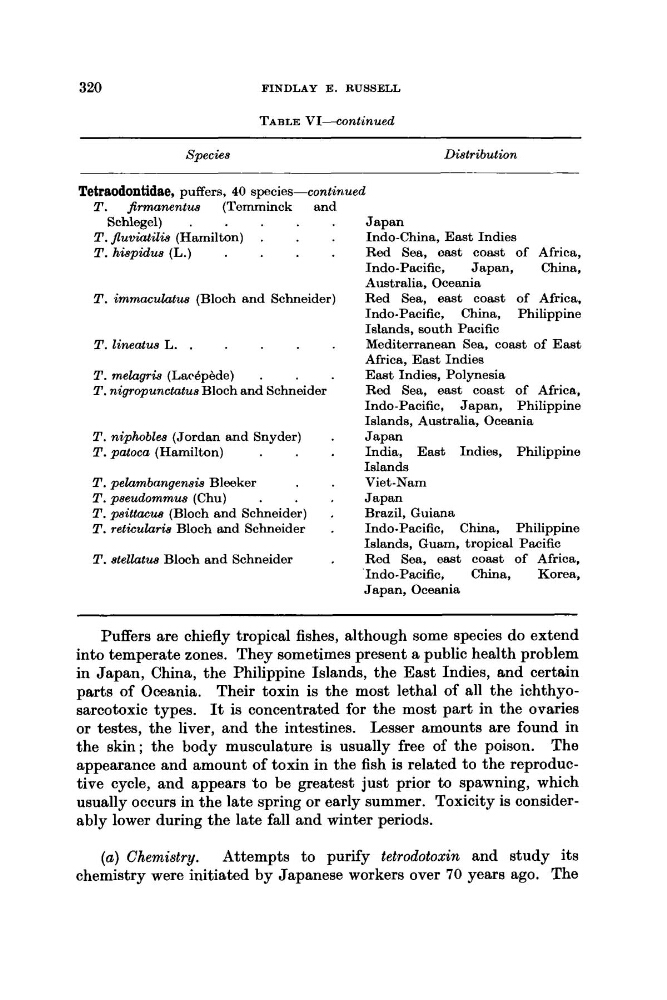
TABLE VI--continued
Species
Distribution
Tetraodontidae, puffers, 40 species-continued
T. Jirmanentwr (Temminck and
T. .fluviatilis (Hamilton) .
Schlegel)
.
T. hispidus (L.)
.
T. immaculatus (Bloch
T. lineatus L. .
T. melagris (LarBpBde)
and Schneider)
T. nigropunctatua Bloch and Schneider
T. niphobles (Jordan and Snyder)
T. patoca (Hamilton)
.
T. pelambangensis Bleeker
.
T. pseudommus (Chu)
.
T. psittacus (Bloch and Schneider)
T. reticularis Bloch and Schneider
.
.
.
T. stellatus Bloch and Schneider
Japan
Indo-China, East Indies
Red Sea, east coast of Africa,
Indo-Pacific,
Japan,
China,
Australia, Oceania
Red Sea, east coast of Africa,
Indo-Pacific, China, Philippine
Islands, south Pacific
Mediterranean Sea, coast of East
Africa, East Indies
East Indies, Polynesia
Red Sea, east coast of Africa,
Indo-Pacific, Japan, Philippine
Islands, Australia, Oceania
Japan
India, East Indies, Philippine
Islands
Viet-Nam
Japan
Brazil, Guiana
Indo-Pacific, China, Philippine
Islands, Guam, tropical Pacific
Red Sea, east coast of Africa,
'Indo-Pacific,
China,
Korea,
Japan, Oceania
Puffers are chiefly tropical fishes, although some species do extend
into temperate zones. They sometimes present a public health problem
in Japan, China, the Philippine Islands, the East Indies, and certain
parts of Oceania. Their toxin is the most lethal of all the ichthyosarcotoxic types. It is concentrated for the most part in the ovaries
or testes, the liver, and the intestines. Lesser amounts are found in
the skin; the body musculature is usually free of the poison. The
appearance and amount of toxin in the fish is related to the reproductive cycle, and appears t o be greatest just prior to spawning, which
usually occurs in the late spring or early summer. Toxicity is considerably lower during the late fall and winter periods.
(a) Chemistry. Attempts to purify tetrodotoxin and study its
chemistry were initiated by Japanese workers over 70 years ago. The
FINDLAY E. RUSSELL
TABLE VI--continued
Species
Distribution
Tetraodontidae, puffers, 40 species-continued
T. Jirmanentwr (Temminck and
T. .fluviatilis (Hamilton) .
Schlegel)
.
T. hispidus (L.)
.
T. immaculatus (Bloch
T. lineatus L. .
T. melagris (LarBpBde)
and Schneider)
T. nigropunctatua Bloch and Schneider
T. niphobles (Jordan and Snyder)
T. patoca (Hamilton)
.
T. pelambangensis Bleeker
.
T. pseudommus (Chu)
.
T. psittacus (Bloch and Schneider)
T. reticularis Bloch and Schneider
.
.
.
T. stellatus Bloch and Schneider
Japan
Indo-China, East Indies
Red Sea, east coast of Africa,
Indo-Pacific,
Japan,
China,
Australia, Oceania
Red Sea, east coast of Africa,
Indo-Pacific, China, Philippine
Islands, south Pacific
Mediterranean Sea, coast of East
Africa, East Indies
East Indies, Polynesia
Red Sea, east coast of Africa,
Indo-Pacific, Japan, Philippine
Islands, Australia, Oceania
Japan
India, East Indies, Philippine
Islands
Viet-Nam
Japan
Brazil, Guiana
Indo-Pacific, China, Philippine
Islands, Guam, tropical Pacific
Red Sea, east coast of Africa,
'Indo-Pacific,
China,
Korea,
Japan, Oceania
Puffers are chiefly tropical fishes, although some species do extend
into temperate zones. They sometimes present a public health problem
in Japan, China, the Philippine Islands, the East Indies, and certain
parts of Oceania. Their toxin is the most lethal of all the ichthyosarcotoxic types. It is concentrated for the most part in the ovaries
or testes, the liver, and the intestines. Lesser amounts are found in
the skin; the body musculature is usually free of the poison. The
appearance and amount of toxin in the fish is related to the reproductive cycle, and appears t o be greatest just prior to spawning, which
usually occurs in the late spring or early summer. Toxicity is considerably lower during the late fall and winter periods.
(a) Chemistry. Attempts to purify tetrodotoxin and study its
chemistry were initiated by Japanese workers over 70 years ago. The