

MARINE TOXINS AND VENOMOUS AND POISONOUS MARINE ANIMALS
311
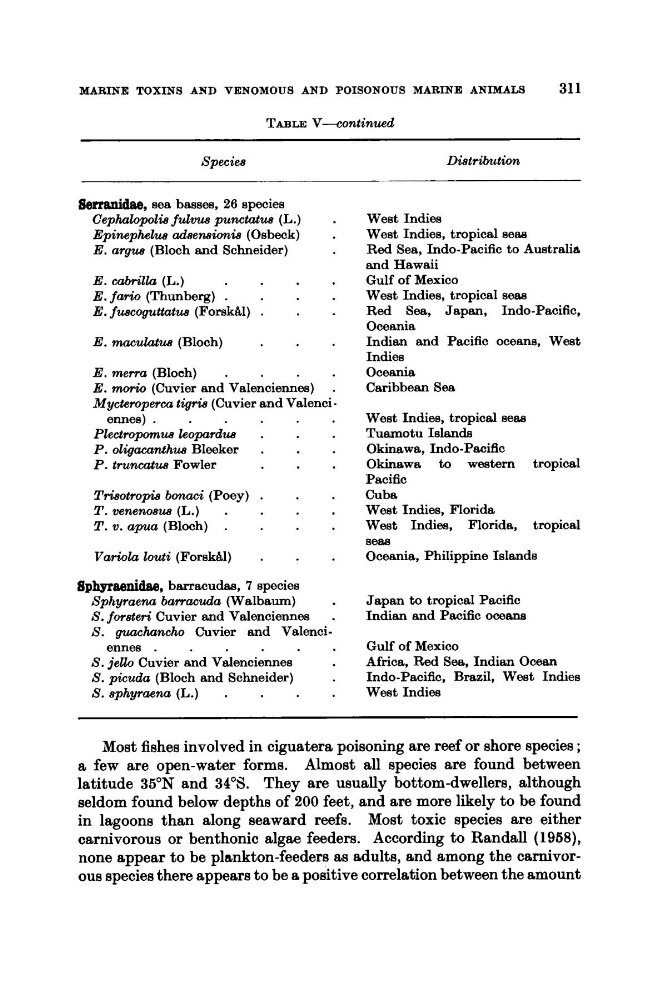
TABLE V-continued
Species
Distribution
Serranidae, sea basses, 26 species
Cephalopolis fulvua punctatua (L.) .
Epinephelua adaenaionk (Osbeck)
.
E. argua (Bloch and Schneider)
E . cabrilla (L.)
E. fa& (Thunberg) .
E. fuacoguttatua (ForskAl) .
E . maculatw (Bloch)
.
E . merra (Bloch)
.
E . morio (Cuvier and Valenciennes) .
Mycteroperca tigris (Cuvier and ValenciPlectropmua leopardua
.
P . oligacandhua Bleeker
.
P . truncatua Fowler
ennes) .
Trbootropia bonaci (Poey) .
T. venenoaua (L.) .
T . v. apua (Bloch) .
Variola louti (Forskhl)
.
West Indies
West Indies, tropical seas
Red Sea, Indo-Pacific to Australia
and Hawaii
Gulf of Mexico
West Indies, tropical seas
Red Sea, Japan, Indo-Pacific,
Oceania
Indian and Pacific oceans, West
Indies
Oceania
Caribbean Sea
West Indies, tropical seas
Tuamotu Islands
Okinawa, Indo-Pacific
Okinawa to western tropical
Pacific
Cuba
West Indies, Florida
West Indies, Florida, tropical
Oceania, Philippine Islands
SBW
Sphyraenidae, barracudas, 7 species
Sphyraena barracuda (Walbaum)
. Japan to tropical Pacific
S. forateri Cuvier and Valenciennes . Indian and Pacific oceane
S. qumhancho Cuvier and ValenciS . jeUo Cuvier and Valenciennes
.
S. picuda (Bloch and Schneider)
.
Indo-Pacific, Brazil, West Indies
S. aphyraena (L.)
.
. West Indies
ennes .
. Gulf of Mexico
Africa, Red Sea, Indian Ocean
Most fishes involved in ciguatera poisoning are reef or shore species ;
a few are open-water forms. Almost all species are found between
latitude 36"N and 34"s. They are usually bottom-dwellers, although
seldom found below depths of 200 feet, and are more likely to be found
in lagoons than along seaward reefs. Most toxic species are either
carnivorous or benthonic algae feeders. According to Randall (1968),
none appear to be plankton-feeders as adults, and among the carnivorous species there appears to be a positive correlation between the amount
311
TABLE V-continued
Species
Distribution
Serranidae, sea basses, 26 species
Cephalopolis fulvua punctatua (L.) .
Epinephelua adaenaionk (Osbeck)
.
E. argua (Bloch and Schneider)
E . cabrilla (L.)
E. fa& (Thunberg) .
E. fuacoguttatua (ForskAl) .
E . maculatw (Bloch)
.
E . merra (Bloch)
.
E . morio (Cuvier and Valenciennes) .
Mycteroperca tigris (Cuvier and ValenciPlectropmua leopardua
.
P . oligacandhua Bleeker
.
P . truncatua Fowler
ennes) .
Trbootropia bonaci (Poey) .
T. venenoaua (L.) .
T . v. apua (Bloch) .
Variola louti (Forskhl)
.
West Indies
West Indies, tropical seas
Red Sea, Indo-Pacific to Australia
and Hawaii
Gulf of Mexico
West Indies, tropical seas
Red Sea, Japan, Indo-Pacific,
Oceania
Indian and Pacific oceans, West
Indies
Oceania
Caribbean Sea
West Indies, tropical seas
Tuamotu Islands
Okinawa, Indo-Pacific
Okinawa to western tropical
Pacific
Cuba
West Indies, Florida
West Indies, Florida, tropical
Oceania, Philippine Islands
SBW
Sphyraenidae, barracudas, 7 species
Sphyraena barracuda (Walbaum)
. Japan to tropical Pacific
S. forateri Cuvier and Valenciennes . Indian and Pacific oceane
S. qumhancho Cuvier and ValenciS . jeUo Cuvier and Valenciennes
.
S. picuda (Bloch and Schneider)
.
Indo-Pacific, Brazil, West Indies
S. aphyraena (L.)
.
. West Indies
ennes .
. Gulf of Mexico
Africa, Red Sea, Indian Ocean
Most fishes involved in ciguatera poisoning are reef or shore species ;
a few are open-water forms. Almost all species are found between
latitude 36"N and 34"s. They are usually bottom-dwellers, although
seldom found below depths of 200 feet, and are more likely to be found
in lagoons than along seaward reefs. Most toxic species are either
carnivorous or benthonic algae feeders. According to Randall (1968),
none appear to be plankton-feeders as adults, and among the carnivorous species there appears to be a positive correlation between the amount