

WINE
TOXINS AND VENOMOUS AND POISONOUS MARINE ANIMALS
307
1. Ciguutera
The word ciguatera was perhaps first applied to a poisoning caused
by the ingestion of the marine snail Livom pica (" cigua "), a staple
seafood found throughout the Caribbean (Poey, 1866). The word is now
commonly used to indicate that type of fish poisoning characterized
by certain gastrointestinal-neurological manifestations. It may occur
following the ingestion of certain tropical reef and semi-pelagic marine
species such aa the barracudas, groupers, sea baases, snappers, surgeonfishes, parrotfishes, jacks, wrasses, and perhaps certain gastropods.
Randall (1968) suggests that gymnothoraz poisoning should not be
separated from ciguatera poisoning. Dr. Paul Scheuer of the Hawaii
Marine Laboratory reports that ciguatera toxin and moray eel
(Gymnothorax javanicus) toxin are the same. Homogeneity has been
established by thin-layer chromatography, paper electrophoresis, and
by counter-current distribution (Helfrich, personal communication,
1966).
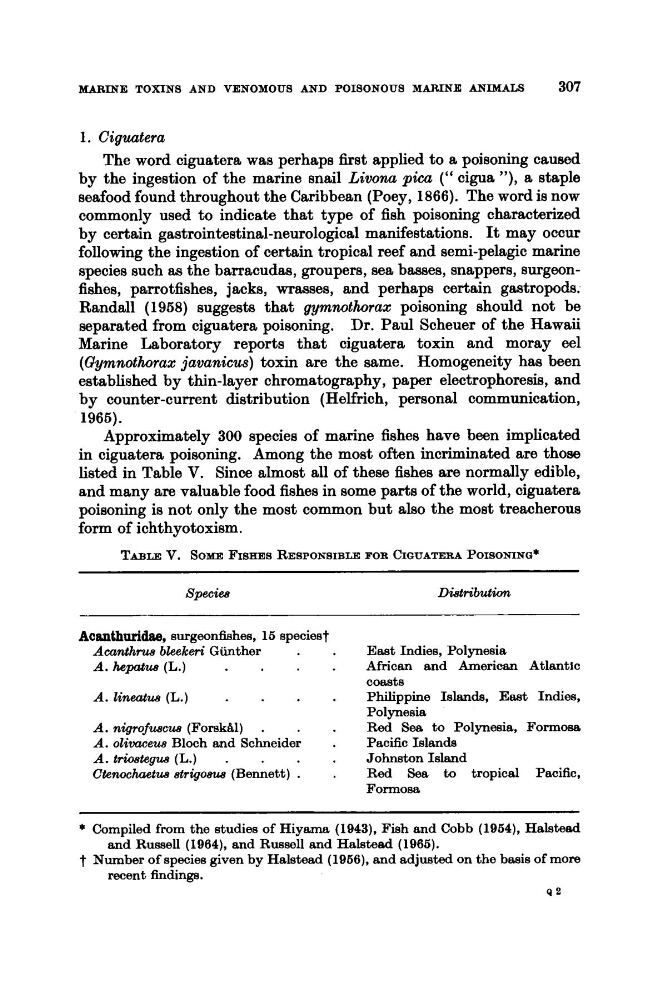
Approximately 300 species of marine fishes have been implicated
in ciguatera poisoning. Among the most often incriminated are those
listed in Table V. Since almost all of these fishes me normally edible,
and many are valuable food fishes in some parts of the world, ciguatera
poisoning is not only the most common but also the most treacherous
form of ichthyotoxism.
TABLE V. SOME FISHES RESPONSIBLE FOR CIGUATERA POISONING*
Speciea
Distribution
Acanthnridae, surgeonfishes, 15 speciest
Acanthrus bleekeri Giinther
.
A.hepak4 (L.)
.
A . lineatwr (L.)
.
A . nigrofuscwl (ForskB1) .
A . olivaceus Bloch and Schneider
A . tl-ioetegwl (L.)
.
Ctenochaetwr s t r i g o m (Bennett) .
.
East Indies, Polynesia
African and American Atlantic
coasts
Philippine Islands, East Indies,
Polynesia
Red Sea to Polynesia, Formosa
Pacific Islands
Johnston Island
Red Sea to tropical Pacific,
Formosa
* Compiled from the studies of Hiyama (1943), Fish and Cobb (1964), Halstead
t Number of species given by Halstead (1956), and adjusted on the basis of more
and Russell (1964), and Russell and Halstead (1965).
recent findings.
0 2
TOXINS AND VENOMOUS AND POISONOUS MARINE ANIMALS
307
1. Ciguutera
The word ciguatera was perhaps first applied to a poisoning caused
by the ingestion of the marine snail Livom pica (" cigua "), a staple
seafood found throughout the Caribbean (Poey, 1866). The word is now
commonly used to indicate that type of fish poisoning characterized
by certain gastrointestinal-neurological manifestations. It may occur
following the ingestion of certain tropical reef and semi-pelagic marine
species such aa the barracudas, groupers, sea baases, snappers, surgeonfishes, parrotfishes, jacks, wrasses, and perhaps certain gastropods.
Randall (1968) suggests that gymnothoraz poisoning should not be
separated from ciguatera poisoning. Dr. Paul Scheuer of the Hawaii
Marine Laboratory reports that ciguatera toxin and moray eel
(Gymnothorax javanicus) toxin are the same. Homogeneity has been
established by thin-layer chromatography, paper electrophoresis, and
by counter-current distribution (Helfrich, personal communication,
1966).
Approximately 300 species of marine fishes have been implicated
in ciguatera poisoning. Among the most often incriminated are those
listed in Table V. Since almost all of these fishes me normally edible,
and many are valuable food fishes in some parts of the world, ciguatera
poisoning is not only the most common but also the most treacherous
form of ichthyotoxism.
TABLE V. SOME FISHES RESPONSIBLE FOR CIGUATERA POISONING*
Speciea
Distribution
Acanthnridae, surgeonfishes, 15 speciest
Acanthrus bleekeri Giinther
.
A.hepak4 (L.)
.
A . lineatwr (L.)
.
A . nigrofuscwl (ForskB1) .
A . olivaceus Bloch and Schneider
A . tl-ioetegwl (L.)
.
Ctenochaetwr s t r i g o m (Bennett) .
.
East Indies, Polynesia
African and American Atlantic
coasts
Philippine Islands, East Indies,
Polynesia
Red Sea to Polynesia, Formosa
Pacific Islands
Johnston Island
Red Sea to tropical Pacific,
Formosa
* Compiled from the studies of Hiyama (1943), Fish and Cobb (1964), Halstead
t Number of species given by Halstead (1956), and adjusted on the basis of more
and Russell (1964), and Russell and Halstead (1965).
recent findings.
0 2