

BURINE TOXINS AND VENOMOUS AND POISONOUS MARJNE ANIMALS
291
of molluscs: Gastropoda, Pelecypoda and Cephalopoda. While it is
not within the confines of this review to discuss all of these animals and
their toxins, attention is given to the more dangerous species.
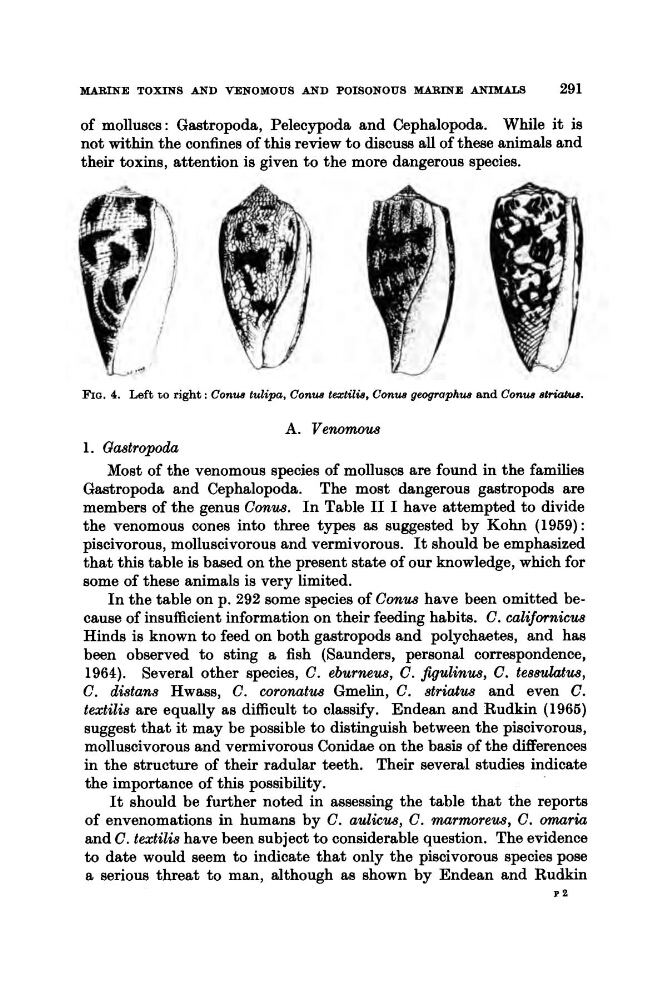
FIO. 4. Left 00 right : Conua tulipa, Conua textilia, Conua geographua and Conwr atriotus.
A. Venomous
1. Gastropoda
Most of the venomous species of molluscs are found in the families
Gmtropoda and Cephalopoda. The most dangerous gastropods are
members of the genus Conus. I n Table I1 I have attempted to divide
the venomous cones into three types m suggested by Kohn (1959) :
piscivorous, molluscivorous and vermivorous. It should be emphasized
that this table is based on the present state of our knowledge, which for
some of these animals is very limited.
In the table on p. 292 some species of Conus have been omitted because of insufficient information on their feeding habits. C. califmnicus
Hinds is known to feed on both gastropods and polychaetes, and has
been observed to sting a fish (Saunders, personal correspondence,
1964). Several other species, C. eburneus, C. Jigulinus, C . tessuhtus,
C . distans Hwass, C . coronutus Gmelin, C . striatus and even C .
textilis are equally as difficult to classify. Endean and Rudkin (1965)
suggest that it may be possible to distinguish between the piscivorous,
molluscivorous and vermivorous Conidae on the basis of the differences
in the structure of their radular teeth. Their several studies indicate
the importance of this possibility.
It should be further noted in assessing the table that the reports
of envenomations in humans by C. aulicus, C. marmoreus, C . m a r i a
and C . textilis have been subject to considerable question. The evidence
to date would seem to indicate that only the piscivorous species pose
a serious threat to man, although as shown by Endean and Rudkin
P 2
291
of molluscs: Gastropoda, Pelecypoda and Cephalopoda. While it is
not within the confines of this review to discuss all of these animals and
their toxins, attention is given to the more dangerous species.
FIO. 4. Left 00 right : Conua tulipa, Conua textilia, Conua geographua and Conwr atriotus.
A. Venomous
1. Gastropoda
Most of the venomous species of molluscs are found in the families
Gmtropoda and Cephalopoda. The most dangerous gastropods are
members of the genus Conus. I n Table I1 I have attempted to divide
the venomous cones into three types m suggested by Kohn (1959) :
piscivorous, molluscivorous and vermivorous. It should be emphasized
that this table is based on the present state of our knowledge, which for
some of these animals is very limited.
In the table on p. 292 some species of Conus have been omitted because of insufficient information on their feeding habits. C. califmnicus
Hinds is known to feed on both gastropods and polychaetes, and has
been observed to sting a fish (Saunders, personal correspondence,
1964). Several other species, C. eburneus, C. Jigulinus, C . tessuhtus,
C . distans Hwass, C . coronutus Gmelin, C . striatus and even C .
textilis are equally as difficult to classify. Endean and Rudkin (1965)
suggest that it may be possible to distinguish between the piscivorous,
molluscivorous and vermivorous Conidae on the basis of the differences
in the structure of their radular teeth. Their several studies indicate
the importance of this possibility.
It should be further noted in assessing the table that the reports
of envenomations in humans by C. aulicus, C. marmoreus, C . m a r i a
and C . textilis have been subject to considerable question. The evidence
to date would seem to indicate that only the piscivorous species pose
a serious threat to man, although as shown by Endean and Rudkin
P 2