

MARINE TOXINS AND VENOMOUS AND POISONOUS MARINE m m s
285
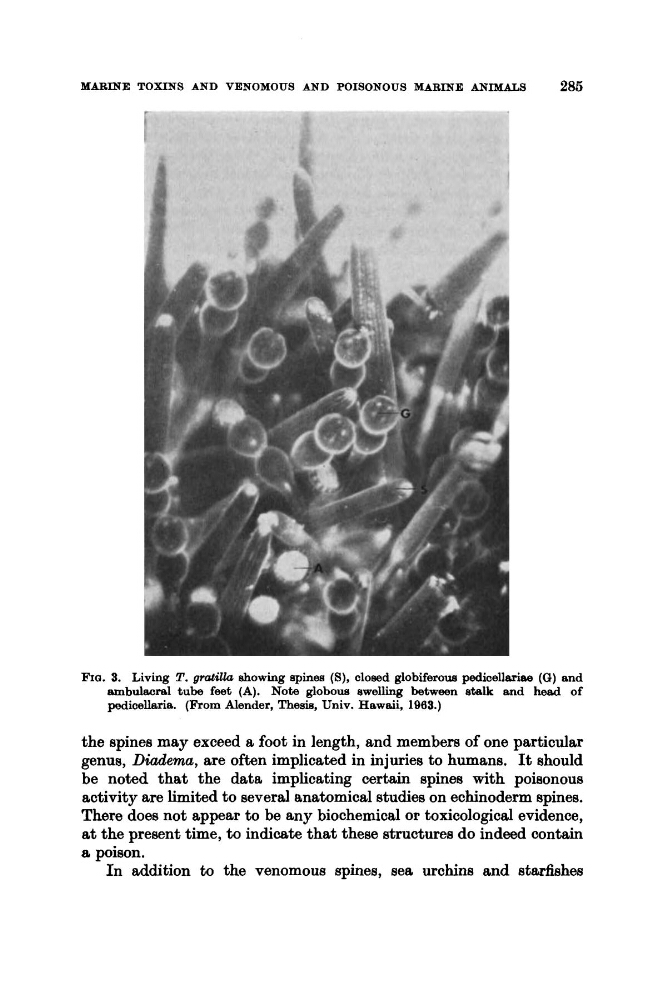
Fro. 3. Living T. grcltilla showing spines (S), closed globiferous pedicelleriae (a) and
ambulacral tube feet (A). Note globoua swelling between stalk end head of
pedicellaria. (From Alender, Thesis, Univ. Hawaii, 1963.)
the spines may exceed a foot in length, and members of one particular
genus, Diadema, are often implicated in injuries to humans. It should
be noted that the data implicating certain spines with poisonous
activity are limited to several anatomical studies on echinoderm spines.
There does not appear to be any biochemical or toxicological evidence,
at the present time, to indicate that these structures do indeed contain
a poison.
In addition to the venomous spines, sea urchins and starfishes
285
Fro. 3. Living T. grcltilla showing spines (S), closed globiferous pedicelleriae (a) and
ambulacral tube feet (A). Note globoua swelling between stalk end head of
pedicellaria. (From Alender, Thesis, Univ. Hawaii, 1963.)
the spines may exceed a foot in length, and members of one particular
genus, Diadema, are often implicated in injuries to humans. It should
be noted that the data implicating certain spines with poisonous
activity are limited to several anatomical studies on echinoderm spines.
There does not appear to be any biochemical or toxicological evidence,
at the present time, to indicate that these structures do indeed contain
a poison.
In addition to the venomous spines, sea urchins and starfishes