

16
M. S. WELLS
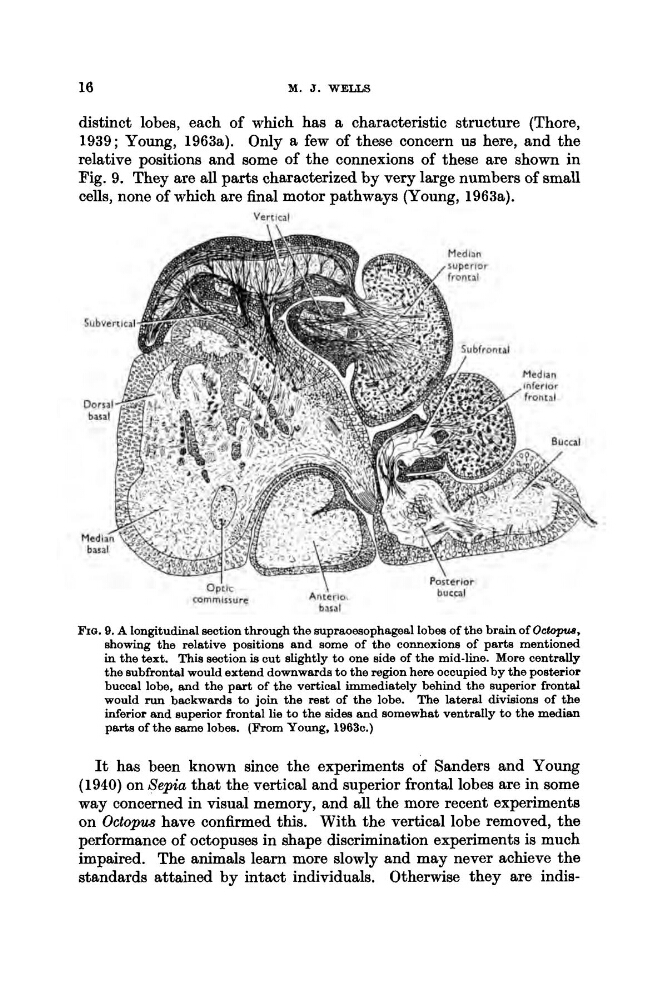
distinct lobes, each of which has a characteristic structure (Thore,
1939; Young, 1963a). Only a few of these concern us here, and the
relative positions and some of the connexions of these are shown in
Fig. 9. They are all parts characterized by very large numbers of small
cells, none of which are h a 1 motor pathways (Young, 1963a).
FIQ. 0. A longitudinal section through the supraoesophageal lobes of the brain of Octqnu,
showing the relative positions and some of the connexions of parts mentioned
in the text. This section is cut slightly to one side of the mid-line. More centrally
the subfrontal would extend downwards to the region here occupied by the posterior
buccal lobe, and the part of the vertical immediately behind the superior frontal
would run backwards to join the rest of the lobe. The later61 divisions of the
inferior and superior frontal lie to the sides and somewhat ventrally to the medim
parts of the same lobes. (From Young, 19830.)
It has been known since the experiments of Sanders and Young
(1940) on Sepia that the vertical and superior frontal lobes are in some
way concerned in visual memory, and all the more recent experiments
on Octopus have confirmed this. With the vertical lobe removed, the
performance of octopuses in shape discrimination experiments is much
impaired. The animals learn more slowly and may never achieve the
standards attained by intact individuals. Otherwise they are indis-
M. S. WELLS
distinct lobes, each of which has a characteristic structure (Thore,
1939; Young, 1963a). Only a few of these concern us here, and the
relative positions and some of the connexions of these are shown in
Fig. 9. They are all parts characterized by very large numbers of small
cells, none of which are h a 1 motor pathways (Young, 1963a).
FIQ. 0. A longitudinal section through the supraoesophageal lobes of the brain of Octqnu,
showing the relative positions and some of the connexions of parts mentioned
in the text. This section is cut slightly to one side of the mid-line. More centrally
the subfrontal would extend downwards to the region here occupied by the posterior
buccal lobe, and the part of the vertical immediately behind the superior frontal
would run backwards to join the rest of the lobe. The later61 divisions of the
inferior and superior frontal lie to the sides and somewhat ventrally to the medim
parts of the same lobes. (From Young, 19830.)
It has been known since the experiments of Sanders and Young
(1940) on Sepia that the vertical and superior frontal lobes are in some
way concerned in visual memory, and all the more recent experiments
on Octopus have confirmed this. With the vertical lobe removed, the
performance of octopuses in shape discrimination experiments is much
impaired. The animals learn more slowly and may never achieve the
standards attained by intact individuals. Otherwise they are indis-