

182
A. D. BONEY
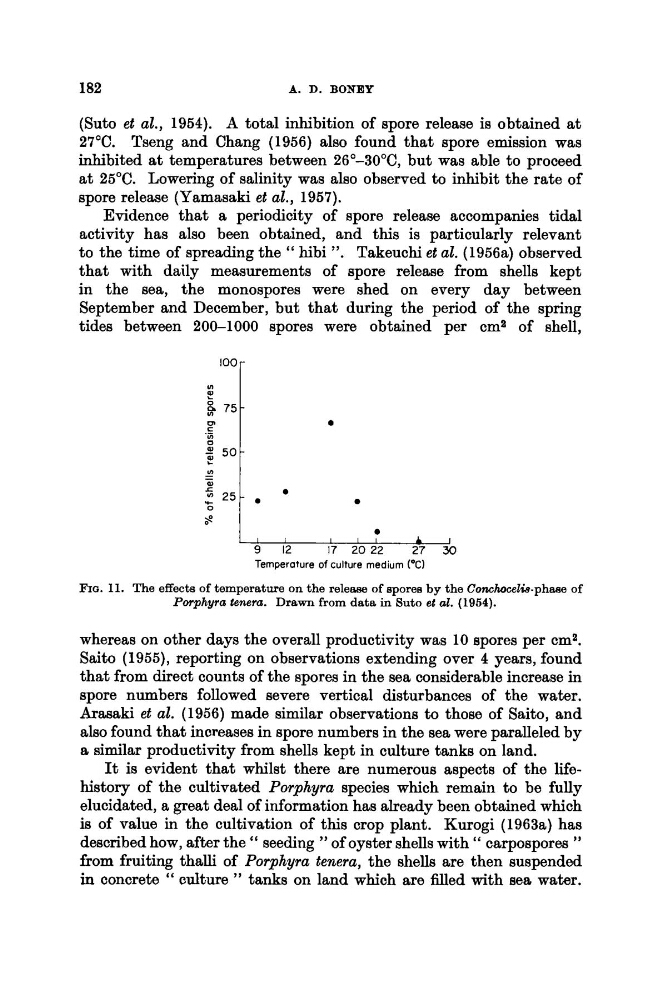
(Suto et al., 1954). A total inhibition of spore release is obtained at
27°C. Tseng and Chang (1956) also found that spore emission was
inhibited at temperatures between 260-30°C, but was able to proceed
at 25°C. Lowering of salinity was also observed to inhibit the rate of
spore release (Yamasaki et al., 1967).
Evidence that a periodicity of spore release accompanies tidal
activity has also been obtained, and this is particularly relevant
to the time of spreading the " hibi ". Takeuchi et al. (1956a) observed
that with daily measurements of spore release from shells kept
in the sea, the monospores were shed on every day between
September and December, but that during the period of the spring
tides between 200-1000 spores were obtained per cma of shell,
I
,
I
I
,
A
1
9
12
17 20 22
27
30
Temperature of culture medium ("C)
FIG. 11. The effects of temperature on the release of spores by the Conohocelia-phase of
Porphyra tenera. Drawn from data in Suto et aZ. (1964).
whereas on other days the overall productivity was 10 spores per cm2.
Saito (1955), reporting on observations extending over 4 years, found
that from direct counts of the spores in the sea considerable increase in
spore numbers followed severe vertical disturbances of the water.
Arasaki et al. (1956) made similar observations to those of Saito, and
also found that increases in spore numbers in the sea were paralleled by
a similar productivity from shells kept in culture tanks on land.
It is evident that whilst there are numerous aspects of the lifehistory of the cultivated Porphyra species which remain to be fully
elucidated, a great deal of information has already been obtained which
is of value in the cultivation of this crop plant. Kurogi (1963a) has
described how, after the " seeding " of oyster shells with " carpospores "
from fruiting thalli of Porphyra tenera, the shells are then suspended
in concrete " culture '' tanks on land which are filled with sea water.
A. D. BONEY
(Suto et al., 1954). A total inhibition of spore release is obtained at
27°C. Tseng and Chang (1956) also found that spore emission was
inhibited at temperatures between 260-30°C, but was able to proceed
at 25°C. Lowering of salinity was also observed to inhibit the rate of
spore release (Yamasaki et al., 1967).
Evidence that a periodicity of spore release accompanies tidal
activity has also been obtained, and this is particularly relevant
to the time of spreading the " hibi ". Takeuchi et al. (1956a) observed
that with daily measurements of spore release from shells kept
in the sea, the monospores were shed on every day between
September and December, but that during the period of the spring
tides between 200-1000 spores were obtained per cma of shell,
I
,
I
I
,
A
1
9
12
17 20 22
27
30
Temperature of culture medium ("C)
FIG. 11. The effects of temperature on the release of spores by the Conohocelia-phase of
Porphyra tenera. Drawn from data in Suto et aZ. (1964).
whereas on other days the overall productivity was 10 spores per cm2.
Saito (1955), reporting on observations extending over 4 years, found
that from direct counts of the spores in the sea considerable increase in
spore numbers followed severe vertical disturbances of the water.
Arasaki et al. (1956) made similar observations to those of Saito, and
also found that increases in spore numbers in the sea were paralleled by
a similar productivity from shells kept in culture tanks on land.
It is evident that whilst there are numerous aspects of the lifehistory of the cultivated Porphyra species which remain to be fully
elucidated, a great deal of information has already been obtained which
is of value in the cultivation of this crop plant. Kurogi (1963a) has
described how, after the " seeding " of oyster shells with " carpospores "
from fruiting thalli of Porphyra tenera, the shells are then suspended
in concrete " culture '' tanks on land which are filled with sea water.