

4
M. J. WELLS
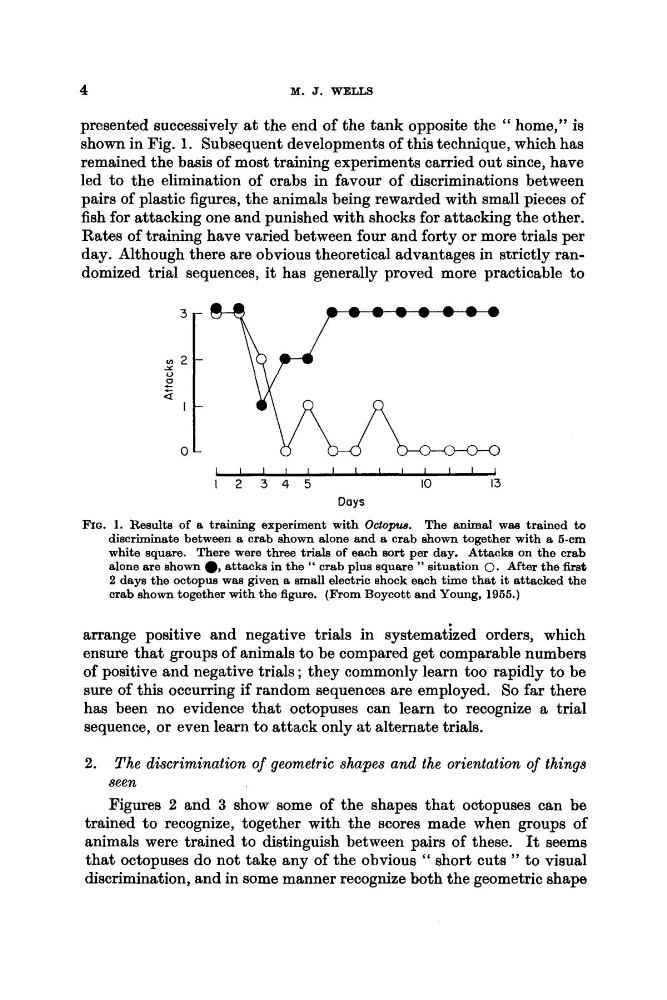
presented successively at the end of the tank opposite the " home," is
shown in Fig. 1. Subsequent developments of this technique, which has
remained the basis of most training experiments carried out since, have
led to the elimination of crabs in favour of discriminations between
pairs of plastic figures, the animals being rewarded with small pieces of
fish for attacking one and punished with shocks for attacking the other.
Rates of training have varied between four and forty or more trials per
day. Although there are obvious theoretical advantages in strictly randomized trial sequences, it has generally proved more practicable to
Days
The animal waa trained to
discriminate between a crab shown alone and a crab shown together with a 5-cm
white square. There were three trials of each sort per day. Attacks on the crab
alone are shown 0, attacks in the " crab plus square " situation 0. After the &st
2 days the octopus was given a small electric shock each time that it attacked the
crab shown together with the figure. (From Boycott and Young, 1955.)
FIQ. 1. Results of a training experiment with Octopua.
arrange positive and negative trials in systematized orders, which
ensure that groups of animals to be compared get comparable numbers
of positive and negative trials ; they commonly learn too rapidly to be
sure of this occurring if random sequences are employed. So far there
has been no evidence that octopuses can learn to recognize a trial
sequence, or even learn to attack only a t alternate trials.
2. The discrimination of geometric shapes and the orientation of things
seen
Figures 2 and 3 show some of the shapes that octopuses can be
trained to recognize, together with the scores made when groups of
animals were trained to distinguish between pairs of these. It seems
that octopuses do not take any of the obvious " short cuts " to visual
discrimination, and in some manner recognize both the geometric shape
M. J. WELLS
presented successively at the end of the tank opposite the " home," is
shown in Fig. 1. Subsequent developments of this technique, which has
remained the basis of most training experiments carried out since, have
led to the elimination of crabs in favour of discriminations between
pairs of plastic figures, the animals being rewarded with small pieces of
fish for attacking one and punished with shocks for attacking the other.
Rates of training have varied between four and forty or more trials per
day. Although there are obvious theoretical advantages in strictly randomized trial sequences, it has generally proved more practicable to
Days
The animal waa trained to
discriminate between a crab shown alone and a crab shown together with a 5-cm
white square. There were three trials of each sort per day. Attacks on the crab
alone are shown 0, attacks in the " crab plus square " situation 0. After the &st
2 days the octopus was given a small electric shock each time that it attacked the
crab shown together with the figure. (From Boycott and Young, 1955.)
FIQ. 1. Results of a training experiment with Octopua.
arrange positive and negative trials in systematized orders, which
ensure that groups of animals to be compared get comparable numbers
of positive and negative trials ; they commonly learn too rapidly to be
sure of this occurring if random sequences are employed. So far there
has been no evidence that octopuses can learn to recognize a trial
sequence, or even learn to attack only a t alternate trials.
2. The discrimination of geometric shapes and the orientation of things
seen
Figures 2 and 3 show some of the shapes that octopuses can be
trained to recognize, together with the scores made when groups of
animals were trained to distinguish between pairs of these. It seems
that octopuses do not take any of the obvious " short cuts " to visual
discrimination, and in some manner recognize both the geometric shape