

BIOLOGY O F SEAWEEDS OF ECONOMIC IMPORTANCE
129
extractive furcellaran (Schachat and Glicksman, 1959). Harvesting is
restricted to a single locality in the Central Kattegat off the north coast
of the Djursland Peninsula. To date there appears to be no marked
change in the standing crop, although it would seem that only in recent
years have heavy demands been made.
Data concerning the quantities of Chondrus crispus collected on
the shores of the Maritime Provinces of Canada over a period of 21
years have been recently given by MacFarlane (1964). The quantities
F
18,000
16,000
14.000 -
.?
2
h
E 12,000 -
O 10,000r:
8,000 -
5
?
o)
6,000.c
ol
0
._
c
ol
c C
4,000 -
2*ooo t
1946 1948 1950 1952 1954 1956 1958
Year
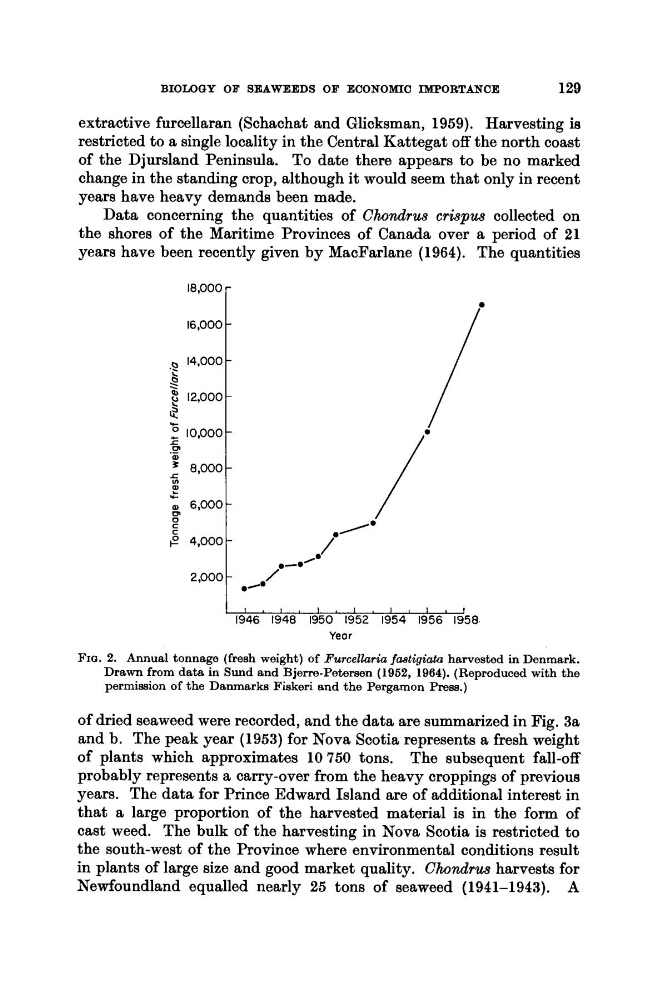
FIG. 2. Annual tonnage (fresh weight) of Furcellaria fastigiata harvested i n Denmark.
Drawn from data in Sund and Bjerre-Petersen (1962, 1964). (Reproduced with the
permission of the Danmarks Fiskeri and the Pergamon Press.)
of dried seaweed were recorded, and the data are summarized in Fig. 3a
and b. The peak year (1953) for Nova Scotia represents a fresh weight
of plants which approximates 10 750 tons. The subsequent fall-off
probably represents a carry-over from the heavy croppings of previous
years. The data for Prince Edward Island are of additional interest in
that a large proportion of the harvested material is in the form of
cast weed. The bulk of the harvesting in Nova Scotia is restricted to
the south-west of the Province where environmental conditions result
in plants of large size and good market quality. Chondrus harvests for
Newfoundland equalled nearly 25 tons of seaweed (1941-1943). A
129
extractive furcellaran (Schachat and Glicksman, 1959). Harvesting is
restricted to a single locality in the Central Kattegat off the north coast
of the Djursland Peninsula. To date there appears to be no marked
change in the standing crop, although it would seem that only in recent
years have heavy demands been made.
Data concerning the quantities of Chondrus crispus collected on
the shores of the Maritime Provinces of Canada over a period of 21
years have been recently given by MacFarlane (1964). The quantities
F
18,000
16,000
14.000 -
.?
2
h
E 12,000 -
O 10,000r:
8,000 -
5
?
o)
6,000.c
ol
0
._
c
ol
c C
4,000 -
2*ooo t
1946 1948 1950 1952 1954 1956 1958
Year
FIG. 2. Annual tonnage (fresh weight) of Furcellaria fastigiata harvested i n Denmark.
Drawn from data in Sund and Bjerre-Petersen (1962, 1964). (Reproduced with the
permission of the Danmarks Fiskeri and the Pergamon Press.)
of dried seaweed were recorded, and the data are summarized in Fig. 3a
and b. The peak year (1953) for Nova Scotia represents a fresh weight
of plants which approximates 10 750 tons. The subsequent fall-off
probably represents a carry-over from the heavy croppings of previous
years. The data for Prince Edward Island are of additional interest in
that a large proportion of the harvested material is in the form of
cast weed. The bulk of the harvesting in Nova Scotia is restricted to
the south-west of the Province where environmental conditions result
in plants of large size and good market quality. Chondrus harvests for
Newfoundland equalled nearly 25 tons of seaweed (1941-1943). A