

BIOLOGY O F SEAWEEDS O F EOONOMIC IMPORTANCE
115
conservative estimates, with sometimes a tendency to underestimate
the biomass involved.
1. Intertidal surveys
Two principal methods of large-scale survey have been utilized
(Baardseth, 1955a), i.e. (1) in which the fresh weight of the plants per
unit area (the mean density) is multiplied by the area of the beds and
a
b
Shore m e
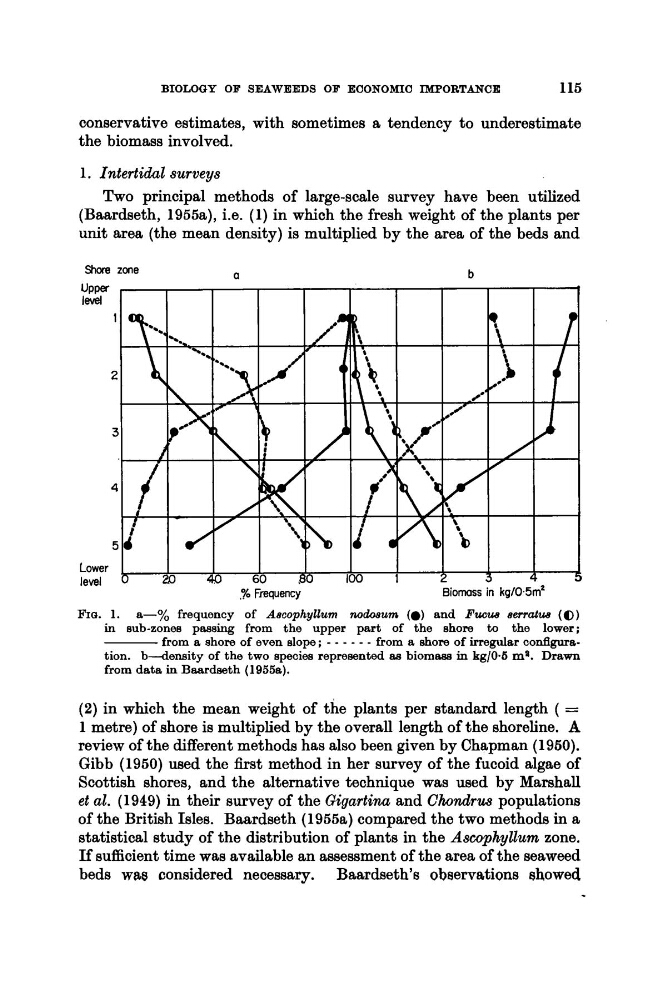
Fro. 1. &-yo frequency of Aecophyllum nodosum (0) and F w w aerratw, ( Q )
in sub-zones passing from the upper part of the shore to the lower;
from a shore of even slope; - - - - - - from a shore of irregular codguration. b-denaity of the two species represented &B biomass in kg/0-6 ma. Drawn
from data in Baardseth (1955a).
(2) in which the mean weight of the plants per standard length ( =
1 metre) of shore is multiplied by the overall length of the shoreline. A
review of the different methods has also been given by Chapman (1960).
Gibb (1950) used the first method in her survey of the fucoid algae of
Scottish shores, and the alternative technique was used by Marshall
et al. (1949) in their survey of the Cigartinu and Chorulrus populations
of the British Isles. Baardseth (1955a) compared the two methods in a
statistical study of the distribution of plants in the Ascophyllum zone.
If sufficient time was available an assessment of the area of the seaweed
beds was considered necessary. Baardseth's obaervations showed
115
conservative estimates, with sometimes a tendency to underestimate
the biomass involved.
1. Intertidal surveys
Two principal methods of large-scale survey have been utilized
(Baardseth, 1955a), i.e. (1) in which the fresh weight of the plants per
unit area (the mean density) is multiplied by the area of the beds and
a
b
Shore m e
Fro. 1. &-yo frequency of Aecophyllum nodosum (0) and F w w aerratw, ( Q )
in sub-zones passing from the upper part of the shore to the lower;
from a shore of even slope; - - - - - - from a shore of irregular codguration. b-denaity of the two species represented &B biomass in kg/0-6 ma. Drawn
from data in Baardseth (1955a).
(2) in which the mean weight of the plants per standard length ( =
1 metre) of shore is multiplied by the overall length of the shoreline. A
review of the different methods has also been given by Chapman (1960).
Gibb (1950) used the first method in her survey of the fucoid algae of
Scottish shores, and the alternative technique was used by Marshall
et al. (1949) in their survey of the Cigartinu and Chorulrus populations
of the British Isles. Baardseth (1955a) compared the two methods in a
statistical study of the distribution of plants in the Ascophyllum zone.
If sufficient time was available an assessment of the area of the seaweed
beds was considered necessary. Baardseth's obaervations showed