

64
J. E. SRELBOURNE
food, but a further twenty died; the remainder, now stage 4,
completed metamorphosis qormally. This compares with
28 days to starve 50% of 6-month-old hatchery-reared plaice.
VII. SOME CHARACTERISTICS OF TANK-REARED PLAICE
POPULATIONS
After eaoh experiment, surviving stocks of young plaice were killed
and preserved. Subsequent analysis showed consistent trends within
tank populations, particularly in respect of size distribution, the
incidence of bitten fins and pigment peculiarities.
A. Size distribution of survivors
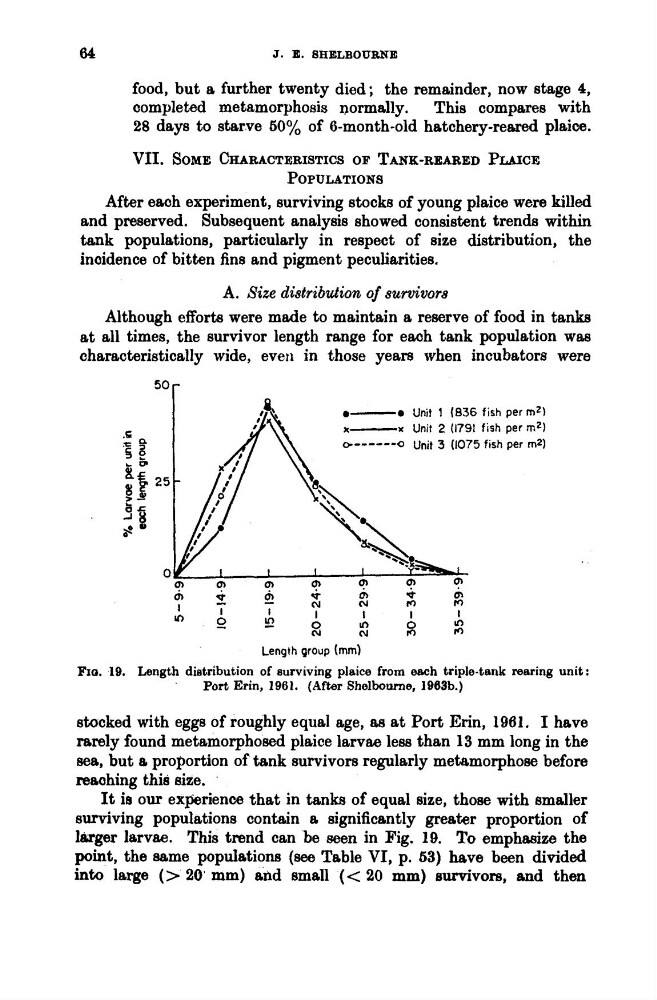
Although efforts were made to maintain a reserve of food in tanks
at all times, the survivor length range for each tank population was
aharacteristically wide, even in those years when incubators were
0-0
Unit 1 (836 fish
x -
x
Unit 2 (I791 fish
0 Unit 3 (1075 fish
I
: 0
I
: 0
v cp
d
?
S
E
N
hl
m A . ,
In
E
N
C
?
cp
l
o
8
m
I
I
I
-
per m2)
per m2)
per m2)
Length qroup (mm)
Fro. 19. Length distribution of surviving plaice from each triple-tank rearing unit:
Port Erin, 1961. (After Shelbourne, 1983b.)
stocked with eggs of roughly equal age, as at Port Erin, 1961. I have
r m l y found metamorphosed plaice larvae less than 13 mm long in the
sea, but a proportion of tank survivors regularly metamorphose before
reaohing this size.
It is our experience that in tanks of equal size, those with smaller
surviving populations contain a significantly greater proportion of
larger larvae. This trend can be seen in Fig. 10. To emphasize the
point, the same populations (see Table VI, p. 63) have been divided
into large (> 20' mm) and small (< 20 mm) ~urvivom, and then
J. E. SRELBOURNE
food, but a further twenty died; the remainder, now stage 4,
completed metamorphosis qormally. This compares with
28 days to starve 50% of 6-month-old hatchery-reared plaice.
VII. SOME CHARACTERISTICS OF TANK-REARED PLAICE
POPULATIONS
After eaoh experiment, surviving stocks of young plaice were killed
and preserved. Subsequent analysis showed consistent trends within
tank populations, particularly in respect of size distribution, the
incidence of bitten fins and pigment peculiarities.
A. Size distribution of survivors
Although efforts were made to maintain a reserve of food in tanks
at all times, the survivor length range for each tank population was
aharacteristically wide, even in those years when incubators were
0-0
Unit 1 (836 fish
x -
x
Unit 2 (I791 fish
0 Unit 3 (1075 fish
I
: 0
I
: 0
v cp
d
?
S
E
N
hl
m A . ,
In
E
N
C
?
cp
l
o
8
m
I
I
I
-
per m2)
per m2)
per m2)
Length qroup (mm)
Fro. 19. Length distribution of surviving plaice from each triple-tank rearing unit:
Port Erin, 1961. (After Shelbourne, 1983b.)
stocked with eggs of roughly equal age, as at Port Erin, 1961. I have
r m l y found metamorphosed plaice larvae less than 13 mm long in the
sea, but a proportion of tank survivors regularly metamorphose before
reaohing this size.
It is our experience that in tanks of equal size, those with smaller
surviving populations contain a significantly greater proportion of
larger larvae. This trend can be seen in Fig. 10. To emphasize the
point, the same populations (see Table VI, p. 63) have been divided
into large (> 20' mm) and small (< 20 mm) ~urvivom, and then