

THE ARTIFICIAL PROPAOATION OF W N E FISH
61
A final survival of 66% is far removed from the former notion that
plaice could not be reared ashore (Petersen, 1894,) and narrows the
gap between expectations in marine and freshwater fish hatcheries.
There is no reliable evidenoe on the survival rate of plaice t o metamorphosis in the sea. Gross (1960b) produoed a figure of 0.1 to 0.2%
survival of newly-hatched fry liberated into a specially enriched area
of a Scottish sea-loch, but, M I he pointed out, his doulations did not
take into account the probable immigration of young plaice from
outside the loch. It is safe to aasume that the rearing technique
practised at Port Erin in 1962 can yield survivals of young plaice
at least several hundred times greater than normal survival rates in
the open sea.
6. Triak with Eayered rearing tanks: 1962
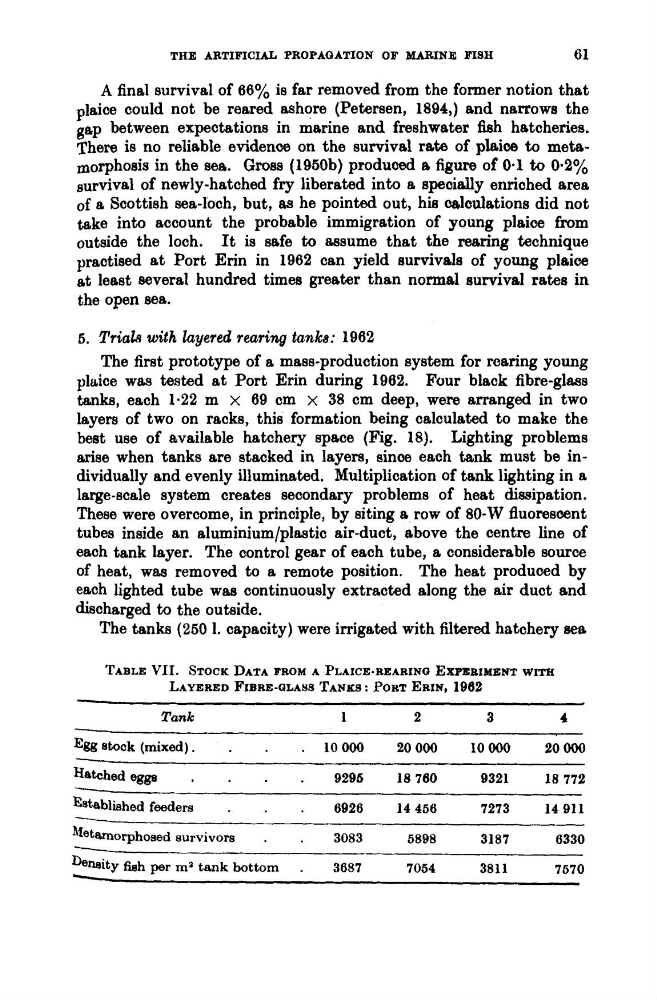
The first prototype of a mass-production system for rearing young
plaice w&s tested at Port Erin during 1962. Four bIack fibre-glass
tanks, each 1.22 m x 69 cm x 38 cm deep, were arranged in two
layers of two on racks, this formation being calculated to make the
best use of available hatchery space (Fig. 18). Lighting problems
raise when tanks are stacked in layers, sinoe each tank must be individually and evenly illuminrtted. Multiplication of tank lighting in a
large-scale system creates secondary problems of heat dissipation.
These were overcome, in principle, by siting a row of 80-W fluorescent
tubes inside an aluminium/plastic air-duct, above the centre line of
each tank layer. The control gear of each tube, a considerable source
of heat, waa removed to a remote position. The heat produced by
each lighted tube was continuously extracted along the air duct and
discharged to the outside.
The tanks (260 1. capacity) were irrigated with filtered hatchery se&
TABLE VII. STOCK DATA FROM A PLAICE-REARING EXPEBIYENT WITH
LAYERED FIBRE-aLA8S TANKS : PORT ERIN, 1962
Tank
1
2
3
4
Egg stock (mixed).
.
. 10000 20000 1oOoo 20000
Hatchedegga
.
. 9296 18760
9321
16772
Established feeders
.
. 6926 14466
7273
14 911
h%rnorphosed -
survivors
.
. 3083
6898
3187
6330
b m i t y 6eh per m2 tank bottom . 3687
7054
3811
7670
-
-
61
A final survival of 66% is far removed from the former notion that
plaice could not be reared ashore (Petersen, 1894,) and narrows the
gap between expectations in marine and freshwater fish hatcheries.
There is no reliable evidenoe on the survival rate of plaice t o metamorphosis in the sea. Gross (1960b) produoed a figure of 0.1 to 0.2%
survival of newly-hatched fry liberated into a specially enriched area
of a Scottish sea-loch, but, M I he pointed out, his doulations did not
take into account the probable immigration of young plaice from
outside the loch. It is safe to aasume that the rearing technique
practised at Port Erin in 1962 can yield survivals of young plaice
at least several hundred times greater than normal survival rates in
the open sea.
6. Triak with Eayered rearing tanks: 1962
The first prototype of a mass-production system for rearing young
plaice w&s tested at Port Erin during 1962. Four bIack fibre-glass
tanks, each 1.22 m x 69 cm x 38 cm deep, were arranged in two
layers of two on racks, this formation being calculated to make the
best use of available hatchery space (Fig. 18). Lighting problems
raise when tanks are stacked in layers, sinoe each tank must be individually and evenly illuminrtted. Multiplication of tank lighting in a
large-scale system creates secondary problems of heat dissipation.
These were overcome, in principle, by siting a row of 80-W fluorescent
tubes inside an aluminium/plastic air-duct, above the centre line of
each tank layer. The control gear of each tube, a considerable source
of heat, waa removed to a remote position. The heat produced by
each lighted tube was continuously extracted along the air duct and
discharged to the outside.
The tanks (260 1. capacity) were irrigated with filtered hatchery se&
TABLE VII. STOCK DATA FROM A PLAICE-REARING EXPEBIYENT WITH
LAYERED FIBRE-aLA8S TANKS : PORT ERIN, 1962
Tank
1
2
3
4
Egg stock (mixed).
.
. 10000 20000 1oOoo 20000
Hatchedegga
.
. 9296 18760
9321
16772
Established feeders
.
. 6926 14466
7273
14 911
h%rnorphosed -
survivors
.
. 3083
6898
3187
6330
b m i t y 6eh per m2 tank bottom . 3687
7054
3811
7670
-
-