

68
J. E. SHELBOUELNE
wsaons. In the absence of bacterial control, an incubator acts as a
'' sump " for incoming bacteria, which accumulate on the tank bottom
end attack debris to form an adhesive film, very difficult to remove.
Even a single dose of anti-biotics during incubation serves to mitigate
this condition; debris remains friable, and as consequence, tank
oleaning is much less laborious.
4. A temperature-controUed rearing experiment incorporating the w e of
The usefulness of penicillin-streptomycin treatment was also
demonstrated in a second experiment, originally planned as part of a
long-term study of temperature effects on plaice egg and larval survival.
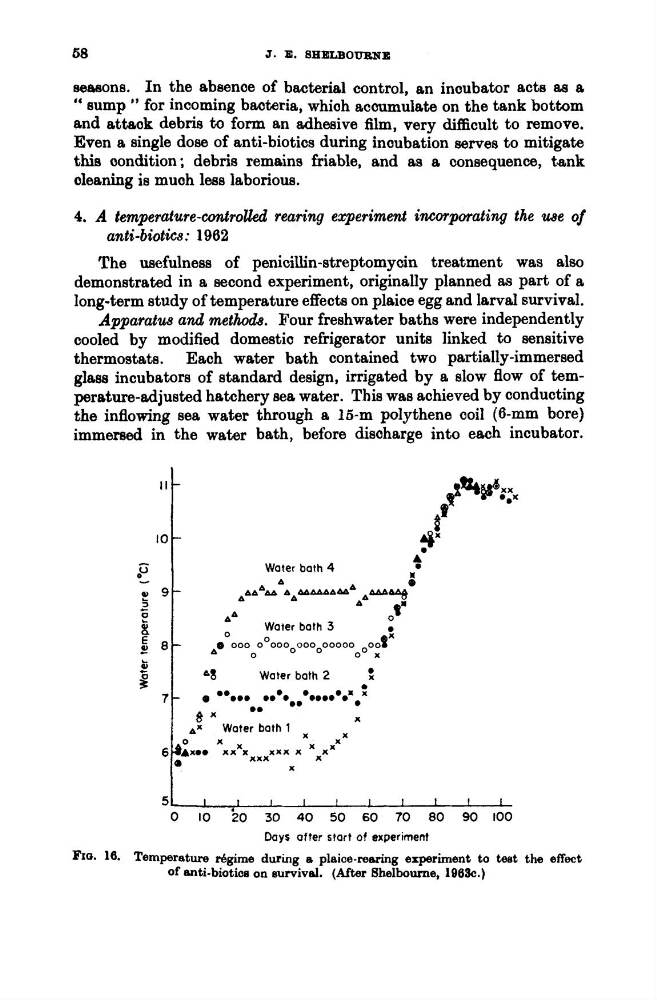
Apparatus and metho&. Four freshwater baths were independently
cooled by modified domestic refrigerator units linked to sensitive
thermostats. Each water bath contained two partially-immersed
glass incubators of standard design, irrigated by a slow flow of temperature-adjusted hatchery aea water. This was achieved by conducting
the inflowing sea water through a 16-m polythene coil (6-mm bore)
immersed in the water bath, before disoharge into each incubator.
anti-biotics: 1962
AA
Water bath 3
0
0 0 x
s 1 A8 Water bath 2
I
..
A X
Water both 1
xxx
I
I
I
I
I
I
I
1
I
I
0 1 0 >O 30 40 50 60 70 80 90 100
Days ofter start of experiment
FIG. 16. Temperature Agime during a plaice-rearing experiment to teet the effect
of anti-biotica on survival. (After Shelbome, 19830.)
J. E. SHELBOUELNE
wsaons. In the absence of bacterial control, an incubator acts as a
'' sump " for incoming bacteria, which accumulate on the tank bottom
end attack debris to form an adhesive film, very difficult to remove.
Even a single dose of anti-biotics during incubation serves to mitigate
this condition; debris remains friable, and as consequence, tank
oleaning is much less laborious.
4. A temperature-controUed rearing experiment incorporating the w e of
The usefulness of penicillin-streptomycin treatment was also
demonstrated in a second experiment, originally planned as part of a
long-term study of temperature effects on plaice egg and larval survival.
Apparatus and metho&. Four freshwater baths were independently
cooled by modified domestic refrigerator units linked to sensitive
thermostats. Each water bath contained two partially-immersed
glass incubators of standard design, irrigated by a slow flow of temperature-adjusted hatchery aea water. This was achieved by conducting
the inflowing sea water through a 16-m polythene coil (6-mm bore)
immersed in the water bath, before disoharge into each incubator.
anti-biotics: 1962
AA
Water bath 3
0
0 0 x
s 1 A8 Water bath 2
I
..
A X
Water both 1
xxx
I
I
I
I
I
I
I
1
I
I
0 1 0 >O 30 40 50 60 70 80 90 100
Days ofter start of experiment
FIG. 16. Temperature Agime during a plaice-rearing experiment to teet the effect
of anti-biotica on survival. (After Shelbome, 19830.)