

64
J. E. SHELBOURNE
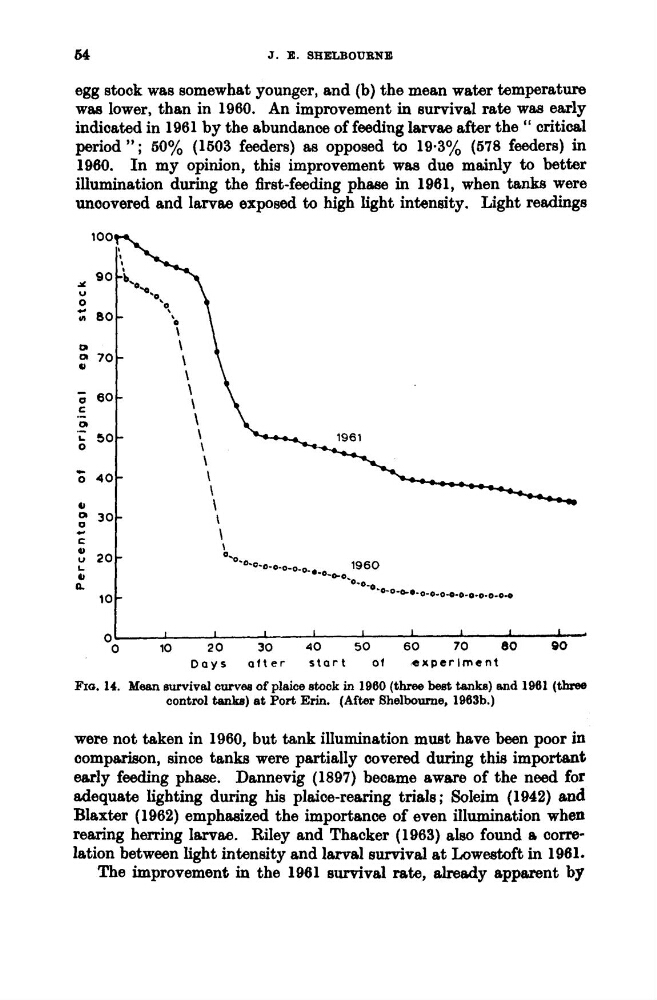
egg stook was somewhat younger, and (b) the mean water temperature
was lower, than in 1960. An improvement in survival rate was early
indicated in 1961 by the abundance of feeding larvae after the critical
period”; 60% (1603 feeders) aa opposed to 19.3% (678 feeders) in
1960. In my opinion, this improvement was due mainly to better
illumination during the first-feeding phaee in 1961, when tmks were
unoovered and larvae exposed to high light intensity. Light readings
1
I
I
I
1
1
I
I
I
.
0
1 0
2 0
30
4 0
50
60
70
60
90
D a y s
a f t e r
s t a r t
of
c x p e r l m c n t
control tanke) at Port Erin. (After Shelbourne, 1963b.)
F I ~ .
14. Mean e w i v d c w e a of plaice stock in 1960 (three beat tanks) end 1961 (three
were not taken in 1960, but tank illumination must have been poor in
o o m p h n , since tanks were partially oovered during thia important
early feeding phase. Dannevig (1897) became awme of the need for
adequate lighting during his plaice-rearing trials; Soleim (1942) and
Blaxter (1902) emphaeized the importance of even illumination when
rearing herring larvae. Riley and Thacker (1963) also found a correlation between light intensity and larval survival at Lowestoft in 1961.
The improvement in the 1961 eurvival rate, already apparent by
J. E. SHELBOURNE
egg stook was somewhat younger, and (b) the mean water temperature
was lower, than in 1960. An improvement in survival rate was early
indicated in 1961 by the abundance of feeding larvae after the critical
period”; 60% (1603 feeders) aa opposed to 19.3% (678 feeders) in
1960. In my opinion, this improvement was due mainly to better
illumination during the first-feeding phaee in 1961, when tmks were
unoovered and larvae exposed to high light intensity. Light readings
1
I
I
I
1
1
I
I
I
.
0
1 0
2 0
30
4 0
50
60
70
60
90
D a y s
a f t e r
s t a r t
of
c x p e r l m c n t
control tanke) at Port Erin. (After Shelbourne, 1963b.)
F I ~ .
14. Mean e w i v d c w e a of plaice stock in 1960 (three beat tanks) end 1961 (three
were not taken in 1960, but tank illumination must have been poor in
o o m p h n , since tanks were partially oovered during thia important
early feeding phase. Dannevig (1897) became awme of the need for
adequate lighting during his plaice-rearing trials; Soleim (1942) and
Blaxter (1902) emphaeized the importance of even illumination when
rearing herring larvae. Riley and Thacker (1963) also found a correlation between light intensity and larval survival at Lowestoft in 1961.
The improvement in the 1961 eurvival rate, already apparent by