

48
J. E. SHELBOURNE
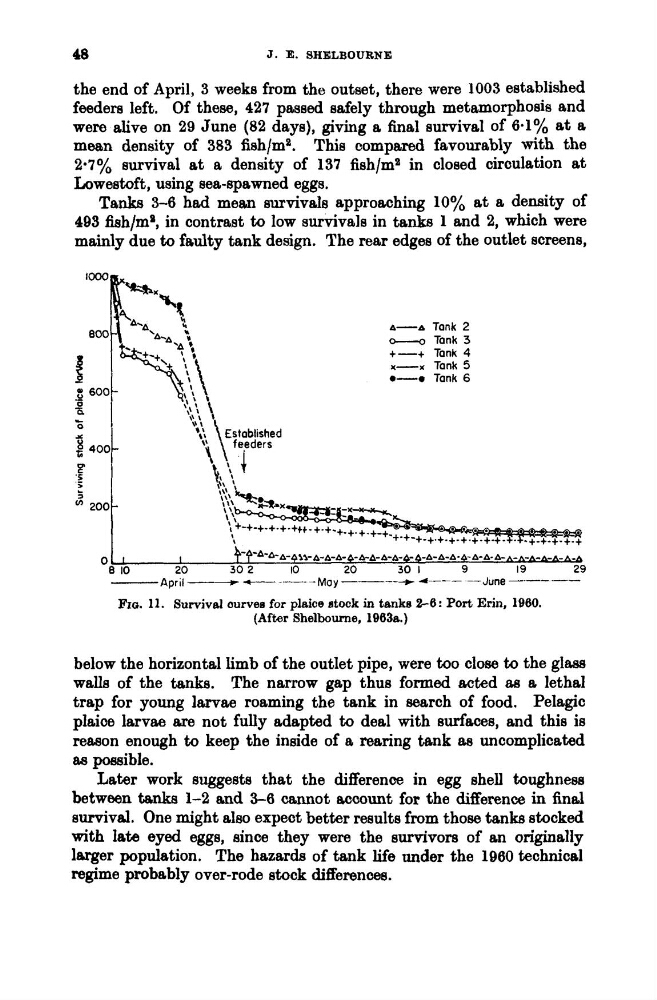
the end of April, 3 weeks from the outset, there were 1003 established
feeders left. Of these, 427 passed safely through metamorphosis and
were alive on 29 June (82 days), giving a final survival of 6.1% a t a
mean density of 383 fish/ma. This compared favourably with the
2.7% survival at a density of 137 fish/ma in closed circulation at
Loweatoft, using sea-spawned eggs.
Tanka 3-6 had mean survivals approaching 10% at a density of
403 fish/m*, in contrast to low survivals in tanks 1 and 2, which were
mainly due to faulty tank design. The rear edges of the outlet screens,
A-A
Tank 2
o-----o Tonk 3
+-+
Tank 4
x - ~
Tank 5
0-0
Tank 6
L
0
At
p 4002
a
.- P
L
200I
;,9r,[
-f-A-A-~-41%- A-A-A- 4-A-A-A-A-4- 4-A-A-A-4- A-A- A- *- -
--.
.__--May ----+ 4---June - -- -9
19
29
06 I
8 1 0
20
30 2
1 0
20
30 I
FIG. 11. Survival ourves for plsice stock in t8nk.w 2-6: Port Erin, 1960.
(After Shelbourne, 10638.)
below the horizontal limb of the outlet pipe, were too close to the glass
walls of the tanks. The narrow gap thus formed acted as a lethal
trap for young larvae roaming the tank in search of food. Pelagic
plaioe larvae are not fully adapted to deal with surfaces, and this is
reason enough to keep the inside of a rearing tank as uncomplicated
m possible.
Later work suggests that the difference in egg shell toughness
between tanks 1-2 and 3-6 cannot account for the difference in final
survival. One might also expect better results from those tanks stocked
with Iate eyed eggs, since they were the survivors of an originally
larger population. The hazards of tank life under the 1060 technical
regime probably over-rode stock differences.
J. E. SHELBOURNE
the end of April, 3 weeks from the outset, there were 1003 established
feeders left. Of these, 427 passed safely through metamorphosis and
were alive on 29 June (82 days), giving a final survival of 6.1% a t a
mean density of 383 fish/ma. This compared favourably with the
2.7% survival at a density of 137 fish/ma in closed circulation at
Loweatoft, using sea-spawned eggs.
Tanka 3-6 had mean survivals approaching 10% at a density of
403 fish/m*, in contrast to low survivals in tanks 1 and 2, which were
mainly due to faulty tank design. The rear edges of the outlet screens,
A-A
Tank 2
o-----o Tonk 3
+-+
Tank 4
x - ~
Tank 5
0-0
Tank 6
L
0
At
p 4002
a
.- P
L
200I
;,9r,[
-f-A-A-~-41%- A-A-A- 4-A-A-A-A-4- 4-A-A-A-4- A-A- A- *- -
--.
.__--May ----+ 4---June - -- -9
19
29
06 I
8 1 0
20
30 2
1 0
20
30 I
FIG. 11. Survival ourves for plsice stock in t8nk.w 2-6: Port Erin, 1960.
(After Shelbourne, 10638.)
below the horizontal limb of the outlet pipe, were too close to the glass
walls of the tanks. The narrow gap thus formed acted as a lethal
trap for young larvae roaming the tank in search of food. Pelagic
plaioe larvae are not fully adapted to deal with surfaces, and this is
reason enough to keep the inside of a rearing tank as uncomplicated
m possible.
Later work suggests that the difference in egg shell toughness
between tanks 1-2 and 3-6 cannot account for the difference in final
survival. One might also expect better results from those tanks stocked
with Iate eyed eggs, since they were the survivors of an originally
larger population. The hazards of tank life under the 1060 technical
regime probably over-rode stock differences.