

THE ARTIFICIAL PROPAGATION OB M-E
FISH
43
The oligochaetes Enchytraeus albidm and E. bwholzii were also
used to fatten metamorphosed fish. They are grown on a damp peatloam mixture enriched with pre-cooked oatmeal (after Blount, 1937).
The worms should be washed and separated before feeding to fish.
Whereas individual worms are readily eaten, worm clumps seem less
attractive to plaice larvae.
4. Rmulta at Lowestoft, 1967-61
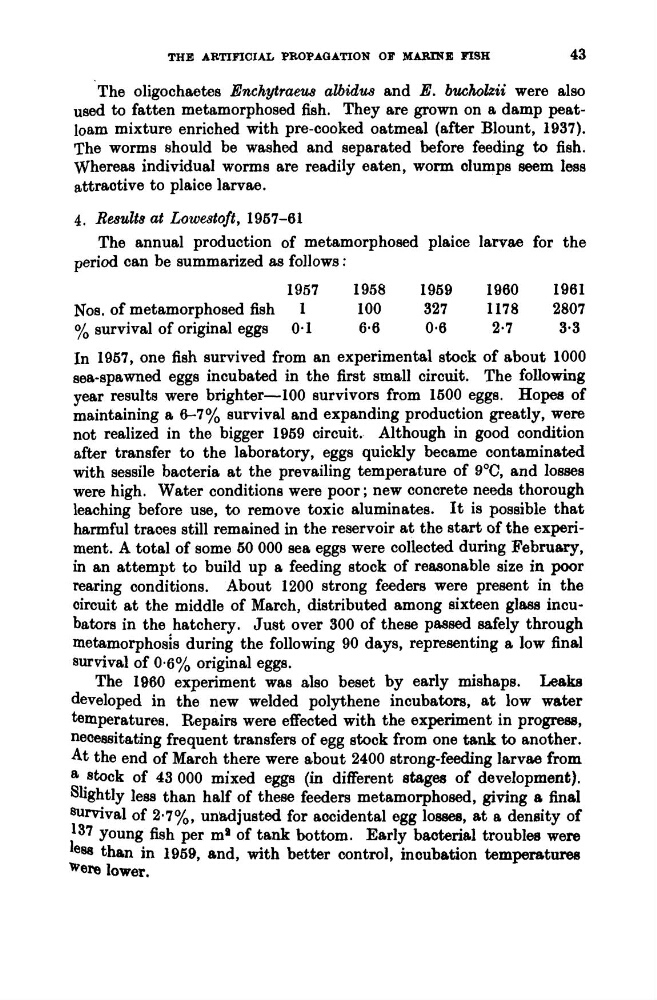
The annual production of metamorphosed plaice larvae for the
period can be summarized as follows ;
1957
1958
1969
1960
I961
Nos. of metamorphosed fish 1
100
327
1178
2807
In 1967, one fish survived from an experimental stock of about 1000
sea-spawned eggs incubated in the first small circuit, The following
year results were brighter-I00 survivors from 1600 eggs. H o p of
maintaining a 6-7% survival and expanding production greatly, were.
not realized in the bigger 1969 circuit. Although in good condition
after transfer to the laboratory, eggs quickly became contaminated
with sessile bacteria at the prevailing temperature of 9"C, and losses
were high. Water conditions were poor ; new concrete needs thorough
leaching before use, to remove toxic aluminates. It is possible that
harmful traces still remained in the reservoir at the start of the experiment. A total of some 60 000 sea eggs were collected during February,
in an attempt to build up a feeding stock of reasonable size in poor
rearing conditions. About 1200 strong feeders were present in the
circuit at the middle of March, distributed among sixteen glasa incubators in the hatchery. Just over 300 of these passed safely through
metamorphosis during the following 90 days, representing a low final
survival of 0.6y0 original eggs.
Leaks
developed in the new welded polythene incubators, at low water
temperatures. Repairs were effected with the experiment in progress,
necessitating frequent transfers of egg stock from one tank to another.
At the end of March there were about 2400 strong-feeding larvae from
8 stock of 43 000 mixed eggs (in different etagea of development).
Slightly less than half of these feeders metamorphosed, giving a final
suI'ViVd of 2*7%, un'adjusted for accidental egg lo-,
at a density of
137 young fish per ma of tank bottom. Early baoterial troublea were
lea than in 1969, and, with better control, inoubation temperatures
% survival of original eggs 0-1
6.6
0.6
2.7
3.3
The 1960 experiment was also beset by early mishaps.
lower.
FISH
43
The oligochaetes Enchytraeus albidm and E. bwholzii were also
used to fatten metamorphosed fish. They are grown on a damp peatloam mixture enriched with pre-cooked oatmeal (after Blount, 1937).
The worms should be washed and separated before feeding to fish.
Whereas individual worms are readily eaten, worm clumps seem less
attractive to plaice larvae.
4. Rmulta at Lowestoft, 1967-61
The annual production of metamorphosed plaice larvae for the
period can be summarized as follows ;
1957
1958
1969
1960
I961
Nos. of metamorphosed fish 1
100
327
1178
2807
In 1967, one fish survived from an experimental stock of about 1000
sea-spawned eggs incubated in the first small circuit, The following
year results were brighter-I00 survivors from 1600 eggs. H o p of
maintaining a 6-7% survival and expanding production greatly, were.
not realized in the bigger 1969 circuit. Although in good condition
after transfer to the laboratory, eggs quickly became contaminated
with sessile bacteria at the prevailing temperature of 9"C, and losses
were high. Water conditions were poor ; new concrete needs thorough
leaching before use, to remove toxic aluminates. It is possible that
harmful traces still remained in the reservoir at the start of the experiment. A total of some 60 000 sea eggs were collected during February,
in an attempt to build up a feeding stock of reasonable size in poor
rearing conditions. About 1200 strong feeders were present in the
circuit at the middle of March, distributed among sixteen glasa incubators in the hatchery. Just over 300 of these passed safely through
metamorphosis during the following 90 days, representing a low final
survival of 0.6y0 original eggs.
Leaks
developed in the new welded polythene incubators, at low water
temperatures. Repairs were effected with the experiment in progress,
necessitating frequent transfers of egg stock from one tank to another.
At the end of March there were about 2400 strong-feeding larvae from
8 stock of 43 000 mixed eggs (in different etagea of development).
Slightly less than half of these feeders metamorphosed, giving a final
suI'ViVd of 2*7%, un'adjusted for accidental egg lo-,
at a density of
137 young fish per ma of tank bottom. Early baoterial troublea were
lea than in 1969, and, with better control, inoubation temperatures
% survival of original eggs 0-1
6.6
0.6
2.7
3.3
The 1960 experiment was also beset by early mishaps.
lower.