

THE ARTIPICIAL PROPAGATION OF MARINE FISH
36
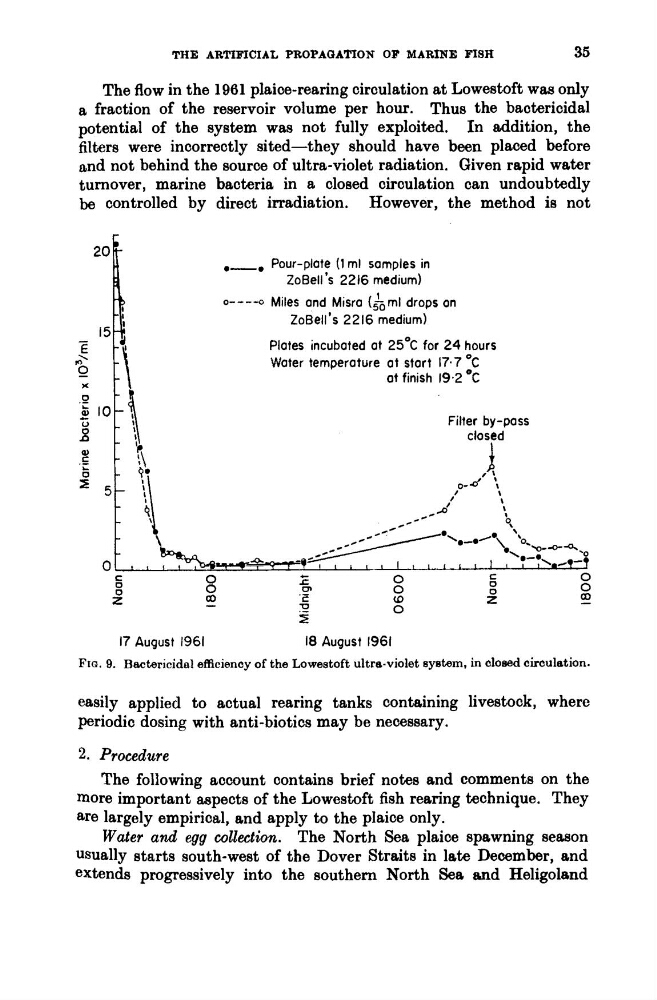
The flow in the 1961 plaice-rearing circulation at Lowestoft was only
a fraction of the reservoir volume per hour. Thus the bacterioidal
potential of the system was not fully exploited. In addition, the
filters were incorrectly sited-they should have been placed before
and not behind the source of ultra-violet radiation. Given rapid water
turnover, marine bacteria in a closed oirculation can undoubtedly
be controlled by direct irradiation. However, the method is not
20
.-. Pour-plote (1 ml samples in
o----o
Miles and Misro (&ml drops on
ZoBell's 2216 medium)
ZoBell's 2216 medium)
15
Plates incubated ot 25OC for 24 hours
Woter temperoiure ot start 17.7 "C
ot finish 19.2 OC
-
E
*
'
0
x
0
.Filter by-poss
c 2 10
i
= 5
0 )
c
.6
c
0
0
E
0
0
0
0
0
' D
0
(D
z
E
.- C
8
C
0
0
0
2
s!
c
L
1 7 August 1961
1 8 August 1961
FIQ. 9. Bactericidal efficiency of the Lowestoft ultra-violet system, in closed circulation.
easily applied to actual rearing tanks containing livestock, where
periodic dosing with anti-biotics may be necessary.
2. Procedure
The following account contains brief notes and comments on the
more important aspects of the Lowestoft fish rearing technique. They
are largely empirical, and apply to the plaice only.
The North Sea plaice spawning season
Usually starts south-west of the Dover Straits in late December, and
extends progressively into the southern North Sea and Heligoland
Water and egg collection.
36
The flow in the 1961 plaice-rearing circulation at Lowestoft was only
a fraction of the reservoir volume per hour. Thus the bacterioidal
potential of the system was not fully exploited. In addition, the
filters were incorrectly sited-they should have been placed before
and not behind the source of ultra-violet radiation. Given rapid water
turnover, marine bacteria in a closed oirculation can undoubtedly
be controlled by direct irradiation. However, the method is not
20
.-. Pour-plote (1 ml samples in
o----o
Miles and Misro (&ml drops on
ZoBell's 2216 medium)
ZoBell's 2216 medium)
15
Plates incubated ot 25OC for 24 hours
Woter temperoiure ot start 17.7 "C
ot finish 19.2 OC
-
E
*
'
0
x
0
.Filter by-poss
c 2 10
i
= 5
0 )
c
.6
c
0
0
E
0
0
0
0
0
' D
0
(D
z
E
.- C
8
C
0
0
0
2
s!
c
L
1 7 August 1961
1 8 August 1961
FIQ. 9. Bactericidal efficiency of the Lowestoft ultra-violet system, in closed circulation.
easily applied to actual rearing tanks containing livestock, where
periodic dosing with anti-biotics may be necessary.
2. Procedure
The following account contains brief notes and comments on the
more important aspects of the Lowestoft fish rearing technique. They
are largely empirical, and apply to the plaice only.
The North Sea plaice spawning season
Usually starts south-west of the Dover Straits in late December, and
extends progressively into the southern North Sea and Heligoland
Water and egg collection.