

248
N. A. HOLME
deficiency ”. Possibly the “ edge-effect ” mentioned above is
responsible.
Other values for the test of significance are given by Greig-Smith
(1957, pp. 58--59), who emphasizes that the test is dependent only on
the number of samples and not on the density of individuals. However,
M. L. Jones (1961) has pointed out that the test for significance given
above may not be satisfactory where the expected number per sample
is less than five.
A re-examinlttion of the technique as applied to sparse benthic
populations appews to be celled for.
I
I
I I
I
I
I I
I
I
1 . h
0
0
.
0
0
0
0
I -
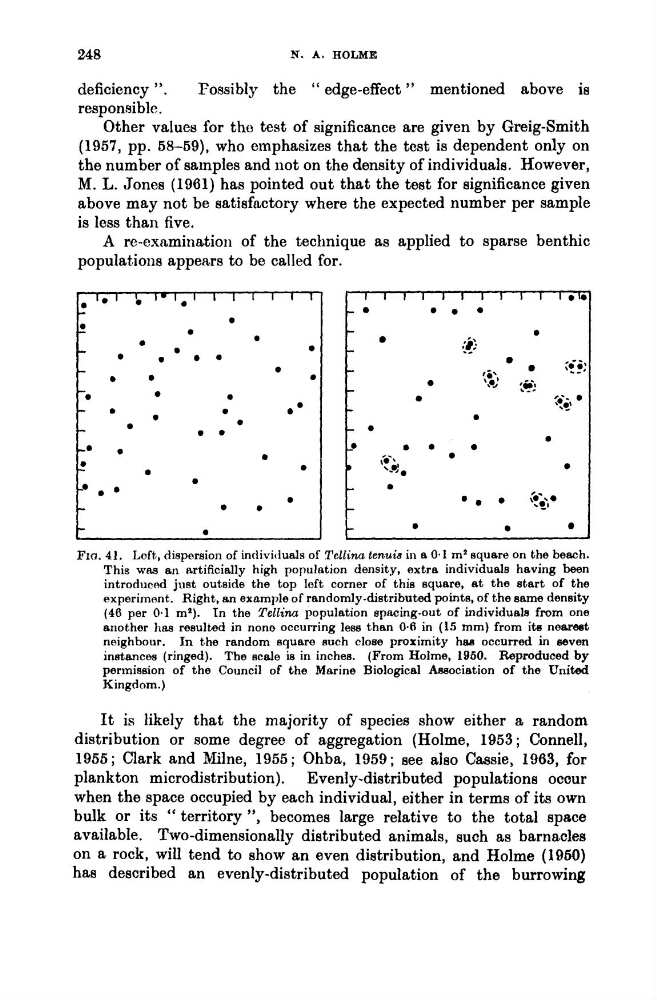
FIG. 41. Loft, dispersion of individuals of Tellina ten& in a 0.1 m* square on the beach.
This wm an artificially high population density, extra individuals having been
introduced just outside the top loft corner of this square, a t the start of the
experiment. Right, an example of randomly-distributed points, of the same density
(40 per 0.1 m*). I n the TeZZina population spacing-out of individuals from one
another has resulted in nono occurring less than 0.6 in (15 mm) from its neerest
neighbour. In the random equare such close proximity haa occurred in seven
instances (ringed). The scale is in inches. (From Holme, 1960. Reproduced by
permission of the Council of the Marine Biological h o c i a t i o n of the United
Kingdom.)
It is likely that the majority of species show either a random
distribution or some degree of aggregation (Holme, 1953 ; Connell,
1955; Clark and Milne, 1955; Ohba, 1959; see also Cassie, 1963, for
plankton microdistribution). Evenly-distributed populations occur
when the space occupied by each individual, either in terms of its own
bulk or its “territory ”, becomes large relative to the total space
available. Two-dimensionally distributed animals, such as barnacles
on a rock, will tend to show an even distribution, and Holme (1960)
has described an evenly-distributed population of the burrowing
N. A. HOLME
deficiency ”. Possibly the “ edge-effect ” mentioned above is
responsible.
Other values for the test of significance are given by Greig-Smith
(1957, pp. 58--59), who emphasizes that the test is dependent only on
the number of samples and not on the density of individuals. However,
M. L. Jones (1961) has pointed out that the test for significance given
above may not be satisfactory where the expected number per sample
is less than five.
A re-examinlttion of the technique as applied to sparse benthic
populations appews to be celled for.
I
I
I I
I
I
I I
I
I
1 . h
0
0
.
0
0
0
0
I -
FIG. 41. Loft, dispersion of individuals of Tellina ten& in a 0.1 m* square on the beach.
This wm an artificially high population density, extra individuals having been
introduced just outside the top loft corner of this square, a t the start of the
experiment. Right, an example of randomly-distributed points, of the same density
(40 per 0.1 m*). I n the TeZZina population spacing-out of individuals from one
another has resulted in nono occurring less than 0.6 in (15 mm) from its neerest
neighbour. In the random equare such close proximity haa occurred in seven
instances (ringed). The scale is in inches. (From Holme, 1960. Reproduced by
permission of the Council of the Marine Biological h o c i a t i o n of the United
Kingdom.)
It is likely that the majority of species show either a random
distribution or some degree of aggregation (Holme, 1953 ; Connell,
1955; Clark and Milne, 1955; Ohba, 1959; see also Cassie, 1963, for
plankton microdistribution). Evenly-distributed populations occur
when the space occupied by each individual, either in terms of its own
bulk or its “territory ”, becomes large relative to the total space
available. Two-dimensionally distributed animals, such as barnacles
on a rock, will tend to show an even distribution, and Holme (1960)
has described an evenly-distributed population of the burrowing