

METHOD8 OF SAMPLING TEE BENTHOS
241
specimen weighs perhaps 80 g, and on evaporation to dryness it weighs
12 g. The remaining 8 g dry weight is recovered on evaporation of the
alcohol, making again a total of 20 g. Now, using Petersen and Boyson
Jensen's method, the conversion factor alcohol weight to dry weight is
&j x 100 = 15%) and to the figure obtained is added the weight of dry
material in the alcohol residue. Using Holme's method, the conversion
factor is -&j x 100 = 25%, the result being the total dry weight without
further correction. This method, which does not involve evaporation of the
preserving fluid when making routine measurements, is quite accurate
provided a reasonable quantity of alcohol is used for preservation (Holme,
1963, p. 24).
*..I_ Palaemon serratus
0hrtunus depumtar
Palaemonetes varians
x -_-__.
I
1
1
1
1
1
1
1
1
1
1
1
1
I
I
I
I
I
I
I
I
r
t
.
1
7
4
8
12 16 20 24 28 32 36 40 44 48 52
Doys
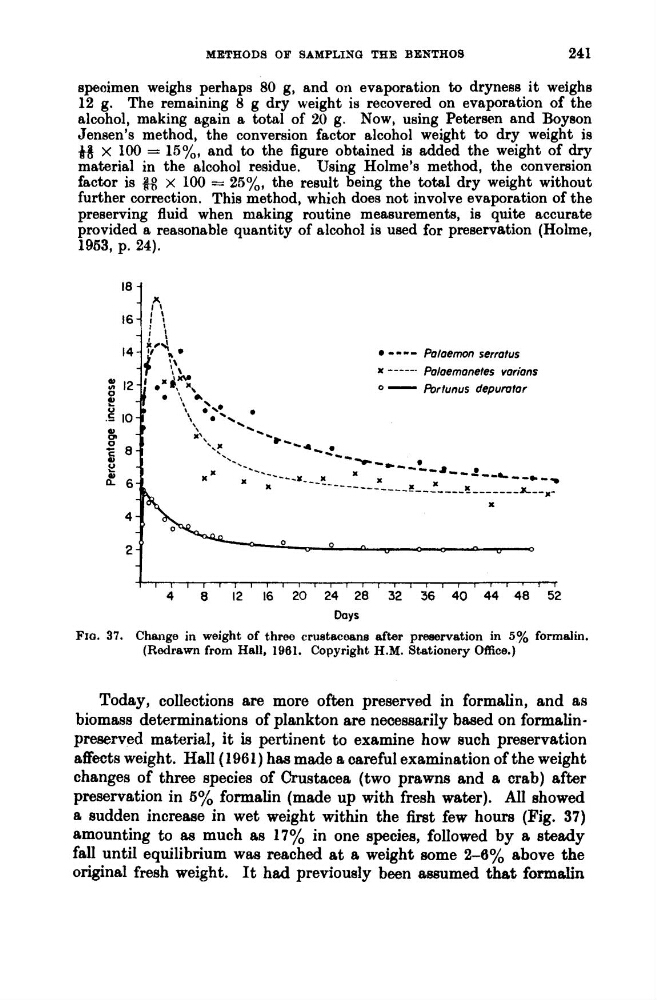
FIG. 37. Change in weight of three cruetaceens after preservation in 5% formelin.
(Redrawn from Hall, 1961. Copyright K.M. Stationery Office.)
Today, collections are more often preserved in formalin, and as
biomass determinations of plankton are necessarily based on formalinpreserved material, it is pertinent to examine how such preservation
affects weight. Hall (1961) has made a careful examination of the weight
changes of three species of Crustacea (two prawns and a crab) after
preservation in 6% formalin (made up with fresh water). All showed
a sudden increase in wet weight within the first few hours (Fig. 37)
amounting to as much as 17% in one species, followed by a steady
fall until equilibrium was reached at a weight some 2 4 % above the
original fresh weight. It had previously been assumed that formalin
241
specimen weighs perhaps 80 g, and on evaporation to dryness it weighs
12 g. The remaining 8 g dry weight is recovered on evaporation of the
alcohol, making again a total of 20 g. Now, using Petersen and Boyson
Jensen's method, the conversion factor alcohol weight to dry weight is
&j x 100 = 15%) and to the figure obtained is added the weight of dry
material in the alcohol residue. Using Holme's method, the conversion
factor is -&j x 100 = 25%, the result being the total dry weight without
further correction. This method, which does not involve evaporation of the
preserving fluid when making routine measurements, is quite accurate
provided a reasonable quantity of alcohol is used for preservation (Holme,
1963, p. 24).
*..I_ Palaemon serratus
0hrtunus depumtar
Palaemonetes varians
x -_-__.
I
1
1
1
1
1
1
1
1
1
1
1
1
I
I
I
I
I
I
I
I
r
t
.
1
7
4
8
12 16 20 24 28 32 36 40 44 48 52
Doys
FIG. 37. Change in weight of three cruetaceens after preservation in 5% formelin.
(Redrawn from Hall, 1961. Copyright K.M. Stationery Office.)
Today, collections are more often preserved in formalin, and as
biomass determinations of plankton are necessarily based on formalinpreserved material, it is pertinent to examine how such preservation
affects weight. Hall (1961) has made a careful examination of the weight
changes of three species of Crustacea (two prawns and a crab) after
preservation in 6% formalin (made up with fresh water). All showed
a sudden increase in wet weight within the first few hours (Fig. 37)
amounting to as much as 17% in one species, followed by a steady
fall until equilibrium was reached at a weight some 2 4 % above the
original fresh weight. It had previously been assumed that formalin