

METHODS OI! SAMPLING THE BENTHOS
13 1
meshed net was hooked 011 outside. The meshes of this outer net were
5 nim bctwcen knots. The boat wcnt slowly ahead, washing out the
mud. Large specimens stayed in the inner bag, smaller ones in the
outer one, while the smallest were, of course, lost.
An alternative method ig to dump the sediment on deck, and then
hose it down. This rather crude method is probably the easiest and
quickest for rough sorting, but a large part of the catch may be missed.
0
7
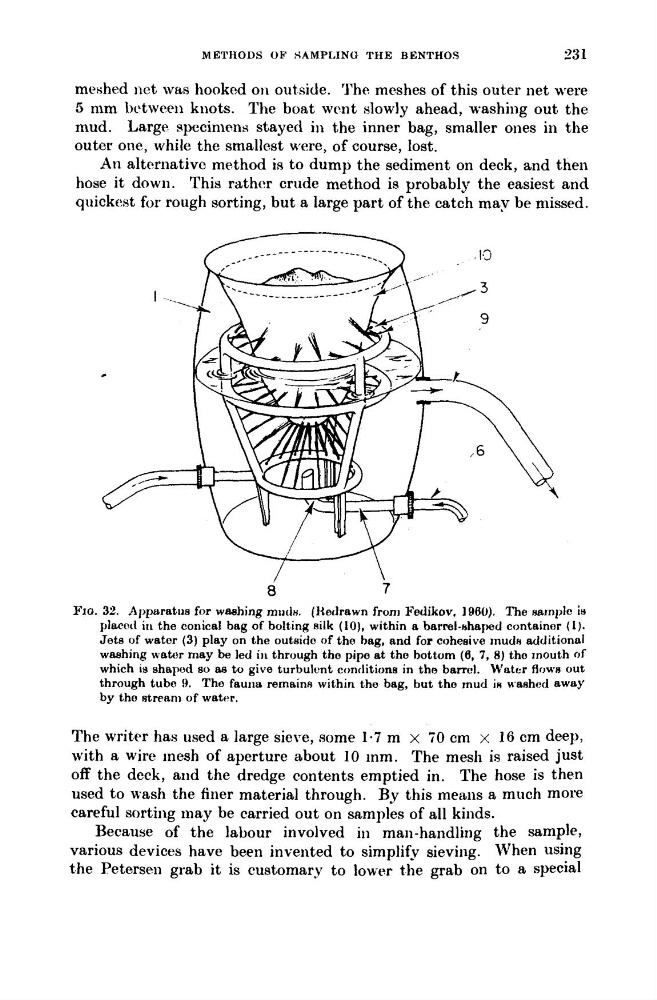
Fro. 32. Apparatus for washing mu&. (Itorlrawn from Fodikov, 1960). The mmplc ia
placod iri the conical bag of bolting Bilk (lo), within a barrel-ahaped container (1).
Jets of water (3) play on the outside of tho bag, and for cohesive rnuda additional
waahing water may be led in through tho pipe at tho bottom (6, 7, 8) tho mouth of
which IS shapud so as to give turbulent contlitions in the barrel. Water RCJWW out
through tube 9. Tho fauna remain8 within tho bag, but tho mud in washed away
by tho stream of water.
The writer has used a large sieve, some 1.7 m x 'io cm i< I 6 cm deep,
with a wire mesh of aperture about 10 mm. The mesh is raised just
off the deck, and the dredge contents emptied in. The hose is then
used to wash the finer material through. By this means a much more
careful sorting may be carried out on samples of all kinds.
Because of the labour involved in man-handling the sample,
various devices have been invented to simplify sieving. When using
the Petersen grab it is customary to lower the grab on to a special
13 1
meshed net was hooked 011 outside. The meshes of this outer net were
5 nim bctwcen knots. The boat wcnt slowly ahead, washing out the
mud. Large specimens stayed in the inner bag, smaller ones in the
outer one, while the smallest were, of course, lost.
An alternative method ig to dump the sediment on deck, and then
hose it down. This rather crude method is probably the easiest and
quickest for rough sorting, but a large part of the catch may be missed.
0
7
Fro. 32. Apparatus for washing mu&. (Itorlrawn from Fodikov, 1960). The mmplc ia
placod iri the conical bag of bolting Bilk (lo), within a barrel-ahaped container (1).
Jets of water (3) play on the outside of tho bag, and for cohesive rnuda additional
waahing water may be led in through tho pipe at tho bottom (6, 7, 8) tho mouth of
which IS shapud so as to give turbulent contlitions in the barrel. Water RCJWW out
through tube 9. Tho fauna remain8 within tho bag, but tho mud in washed away
by tho stream of water.
The writer has used a large sieve, some 1.7 m x 'io cm i< I 6 cm deep,
with a wire mesh of aperture about 10 mm. The mesh is raised just
off the deck, and the dredge contents emptied in. The hose is then
used to wash the finer material through. By this means a much more
careful sorting may be carried out on samples of all kinds.
Because of the labour involved in man-handling the sample,
various devices have been invented to simplify sieving. When using
the Petersen grab it is customary to lower the grab on to a special