

METHODS OF SAMPLING THE BENTHOS
221
Handling of grabs is not very easy under such conditions, and
Forster’s anchor-dredge is probably the best for sampling the burrowing
fauna. For similar purposes where a power hoist is not available,
Robertson’s bucket dredge might be useful.
3. Sampling in rough weather
The use of the majority of bottom-sampling instruments is dependent on reasonably calm weather, and all take a more satisfactory
sample under such conditions. Limiting conditions are usually reached
under one of two conditions
(i) When the rolling of the ship is such that it becomes dangerous
(ii) When the release mechanism operates in mid-water, due to the
Other factors such as the drift of the ship, and the consequent
risk of the grab taking oblique or otherwise unsatisfactory samples,
may operate under certain conditions (cp. Davis, 1926).
It may be misleading to speak in terms of the wind force in which
particular gear may be operated without considering local factors,
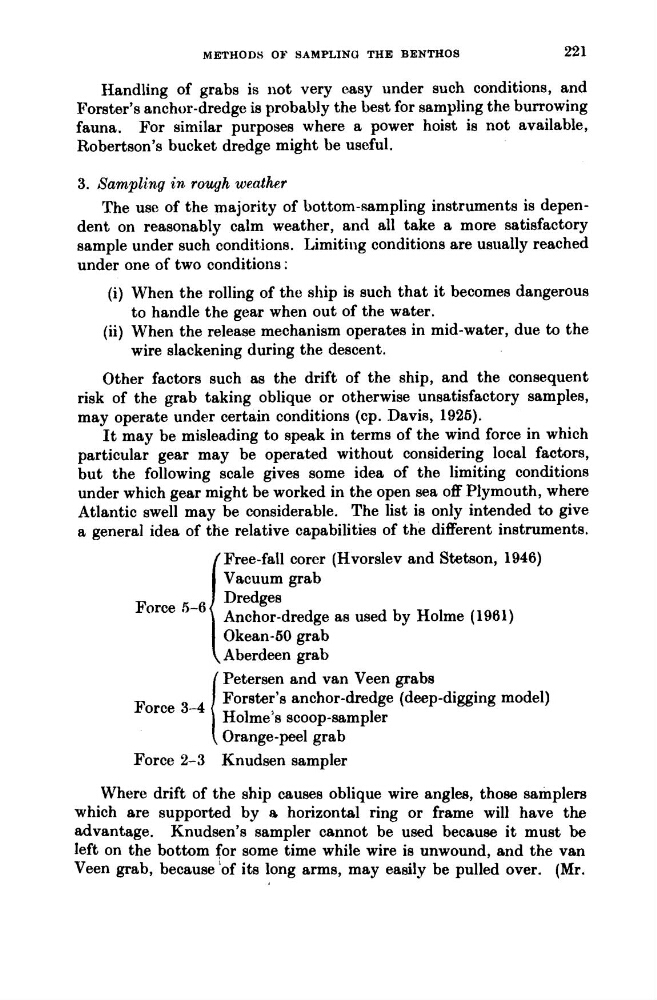
but the following scale gives some idea of the limiting conditions
under which gear might be worked in the open sea off Plymouth, where
Atlantic swell may be considerable. The list is only intended to give
a general idea of the relative capabilities of the different instruments.
to handle the gear when out of the water.
wire slackening during the descent.
Free-fall corer (Hvorslev and Stetson, 1946)
Vacuum grab -
Dredges
Anchor-dredge as used by Holme ( 196 1 )
Force 5-6
Okean-60 grab
Aberdeen grab
Petersen and van Veen grabs
Forster’s anchor-dredge (deep-digging model)
Holme’s scoop-sampler
i Orange-peel grab
Force 2-3 Knudsen sampler
Force 3-4
Where drift of the ship causes oblique wire angles, those samplers
which are supported by a horizontal ring or frame will have the
advantage. Knudsen’s sampler cannot be used because it must be
left on the bottom for some time while wire is unwound, and the van
Veen grab, because ‘of its long arms, may easily be pulled over. (Mr.
221
Handling of grabs is not very easy under such conditions, and
Forster’s anchor-dredge is probably the best for sampling the burrowing
fauna. For similar purposes where a power hoist is not available,
Robertson’s bucket dredge might be useful.
3. Sampling in rough weather
The use of the majority of bottom-sampling instruments is dependent on reasonably calm weather, and all take a more satisfactory
sample under such conditions. Limiting conditions are usually reached
under one of two conditions
(i) When the rolling of the ship is such that it becomes dangerous
(ii) When the release mechanism operates in mid-water, due to the
Other factors such as the drift of the ship, and the consequent
risk of the grab taking oblique or otherwise unsatisfactory samples,
may operate under certain conditions (cp. Davis, 1926).
It may be misleading to speak in terms of the wind force in which
particular gear may be operated without considering local factors,
but the following scale gives some idea of the limiting conditions
under which gear might be worked in the open sea off Plymouth, where
Atlantic swell may be considerable. The list is only intended to give
a general idea of the relative capabilities of the different instruments.
to handle the gear when out of the water.
wire slackening during the descent.
Free-fall corer (Hvorslev and Stetson, 1946)
Vacuum grab -
Dredges
Anchor-dredge as used by Holme ( 196 1 )
Force 5-6
Okean-60 grab
Aberdeen grab
Petersen and van Veen grabs
Forster’s anchor-dredge (deep-digging model)
Holme’s scoop-sampler
i Orange-peel grab
Force 2-3 Knudsen sampler
Force 3-4
Where drift of the ship causes oblique wire angles, those samplers
which are supported by a horizontal ring or frame will have the
advantage. Knudsen’s sampler cannot be used because it must be
left on the bottom for some time while wire is unwound, and the van
Veen grab, because ‘of its long arms, may easily be pulled over. (Mr.