

MKIYIOIW OF SAMPLING: TltE RENTIIOS
211
hIeiizi(*s c f 01. ( I N X j ) IIiLV(1 iwcntly dcscribetl a camera, attached
iiisitle the. (hml)l)dl grul) whic*li takchs :t picture of the bottom just
btktbrc it ia namplcd l)y tlic. gral). Their results bear out the conclusion
that the camera is of rather limited viilue in estimating all but the more
conspicuous members of thc epifannn.
13. Dic-iiq
Free-diving has c~volved, along wit ti underwater television and
photography, during the last 15-20 years aiid has opened up a new
realm in cxplorat,ion, particularly in rocky areas below low-tide mark
which cannot be adequately invrstigated hy the dredge or by any other
means.
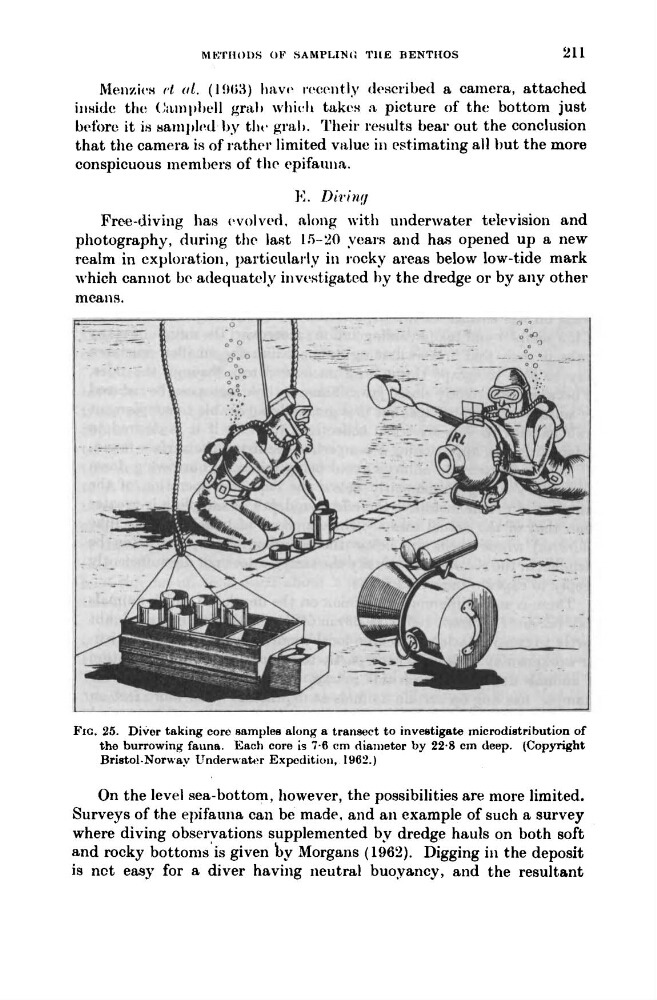
FIG. 25. Diver taking core samples along a transect to investigate microdistribution of
the burrowing fauna. Each core is 7.6 cm dianieter by 22.8 cm deep. (Copyright
Bristol-Norway Underwater Expodition, 1962.)
On the level sea-bottom, however, the possibilities are more limited.
Surveys of the epifauna can be made, and an example of such a survey
where diving observations supplemented by dredge hauls on both soft
and rocky bottoniu'is given by Morgans (1962). Digging in the deposit
is nct easy for a diver having neutral buoyancy, and the resultant
211
hIeiizi(*s c f 01. ( I N X j ) IIiLV(1 iwcntly dcscribetl a camera, attached
iiisitle the. (hml)l)dl grul) whic*li takchs :t picture of the bottom just
btktbrc it ia namplcd l)y tlic. gral). Their results bear out the conclusion
that the camera is of rather limited viilue in estimating all but the more
conspicuous members of thc epifannn.
13. Dic-iiq
Free-diving has c~volved, along wit ti underwater television and
photography, during the last 15-20 years aiid has opened up a new
realm in cxplorat,ion, particularly in rocky areas below low-tide mark
which cannot be adequately invrstigated hy the dredge or by any other
means.
FIG. 25. Diver taking core samples along a transect to investigate microdistribution of
the burrowing fauna. Each core is 7.6 cm dianieter by 22.8 cm deep. (Copyright
Bristol-Norway Underwater Expodition, 1962.)
On the level sea-bottom, however, the possibilities are more limited.
Surveys of the epifauna can be made, and an example of such a survey
where diving observations supplemented by dredge hauls on both soft
and rocky bottoniu'is given by Morgans (1962). Digging in the deposit
is nct easy for a diver having neutral buoyancy, and the resultant