

METHODS OF SAMPLING THE BENTHOS
206
many other samplers, and the depth of “bite ’’ is about equal to a
large van Veen grab. However, some workers have found it rather
cumbersome to use (Smith and McIntyre, 1964) both because of its
size and weight and because re-setting of the scoop is a little awkward.
Later models have been designed with two separate counter-rotating
scoops (Fig. 40), the largest taking two samples each of 0.1 m*.
+ -
-
-
-
-
R e l
e a s e
arm
______
. . Sediment
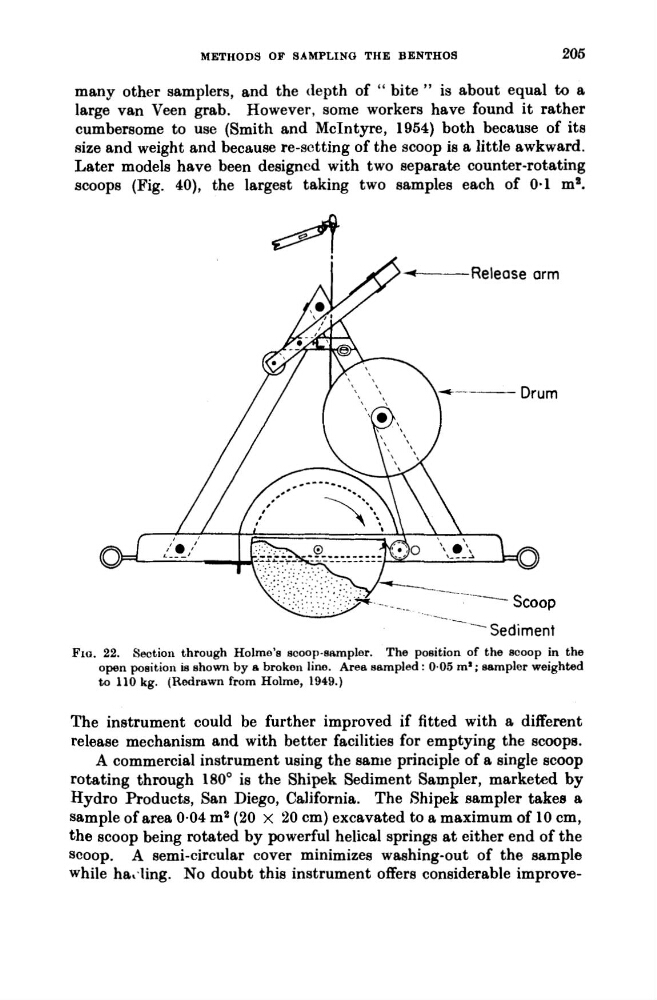
Fro. 22. Section through Holme’s scoop-ssmpler. The position of the scoop in the
open position is shown by 8 broken line. Area sampled : 0.05 m’; sampler weighted
to 110 kg. (Redrawn from Holme, 1949.)
The instrument could be further improved if fitted with a different
release mechanism and with better facilities for emptying the scoops.
A commercial instrument using the same principle of a single scoop
rotating through 180’ is the Shipek Sediment Sampler, marketed by
Hydro Products, San Diego, California. The Shipek sampler takes a
sample of area 0.04 m2 (20 x 20 cm) excavated to a maximum of 10 cm,
the scoop being rotated by powerful helical springs at either end of the
scoop. A semi-circular cover minimizes washing-out of the sample
while ha,.ling. No doubt this instrument offers considerable improve-
206
many other samplers, and the depth of “bite ’’ is about equal to a
large van Veen grab. However, some workers have found it rather
cumbersome to use (Smith and McIntyre, 1964) both because of its
size and weight and because re-setting of the scoop is a little awkward.
Later models have been designed with two separate counter-rotating
scoops (Fig. 40), the largest taking two samples each of 0.1 m*.
+ -
-
-
-
-
R e l
e a s e
arm
______
. . Sediment
Fro. 22. Section through Holme’s scoop-ssmpler. The position of the scoop in the
open position is shown by 8 broken line. Area sampled : 0.05 m’; sampler weighted
to 110 kg. (Redrawn from Holme, 1949.)
The instrument could be further improved if fitted with a different
release mechanism and with better facilities for emptying the scoops.
A commercial instrument using the same principle of a single scoop
rotating through 180’ is the Shipek Sediment Sampler, marketed by
Hydro Products, San Diego, California. The Shipek sampler takes a
sample of area 0.04 m2 (20 x 20 cm) excavated to a maximum of 10 cm,
the scoop being rotated by powerful helical springs at either end of the
scoop. A semi-circular cover minimizes washing-out of the sample
while ha,.ling. No doubt this instrument offers considerable improve-