

1 82
N. A. HOLME
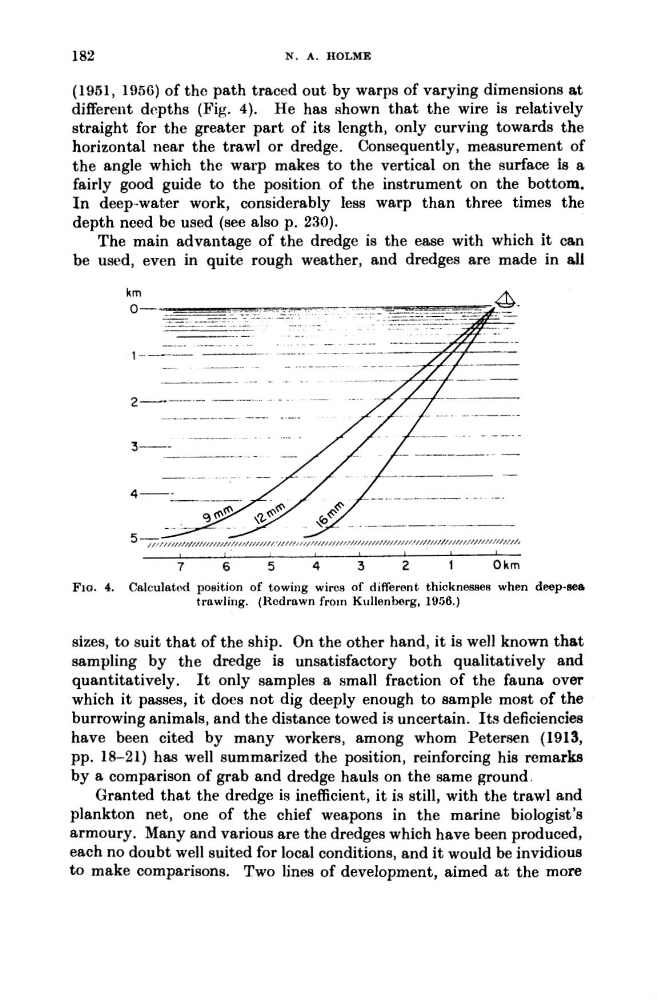
(1951, 19hG) of the path traced out by warps of varying dimensions at
different depths (Fig. 4). He has shown that the wire is relatively
straight for the greater part of its length, only curving towards the
horizontal near the trawl or dredge. Consequently, measurement of
the angle which the warp makes to the vertical on the surface is a
fairly good guide to the position of the instrument on the bottom.
I n deep.water work, considerably less warp than three times the
depth need be used (see also p. 230).
The main advantage of the dredge is the ease with which it can
be used, even in quite rough weather, and dredges are made in all
7
6
5
4
3
2
1
0 km
FIG. 4. Calculatod position of towing wires of different thicknesses when deep-sea
trawling. (Rcdrawn from Kullenkmrg, 1056.)
sizes, to suit that of the ship. On the other hand, i t is well known that
sampling by the dredge is unsatisfactory both quaIitatively and
quantitatively. It only samples a small fraction of the fauna over
which it passes, it does not dig deeply enough to sample moRt of the
burrowing animals, and the distance towed is uncertain. Its deficiencies
have been cited by many workers, among whom Petersen (1913,
pp. 18-21) has well summarized the position, reinforcing his remarks
by a comparison of grab and dredge hauls on the same ground
Granted that the dredge is inefficient, it is still, with the trawl and
plankton net, one of the chief weapons in the marine biologist's
armoury. Many and various are the dredges which have been produced,
each no doubt well suited for local conditions, and i t would be invidious
to make comparisons. Two lines of development, aimed at the more
N. A. HOLME
(1951, 19hG) of the path traced out by warps of varying dimensions at
different depths (Fig. 4). He has shown that the wire is relatively
straight for the greater part of its length, only curving towards the
horizontal near the trawl or dredge. Consequently, measurement of
the angle which the warp makes to the vertical on the surface is a
fairly good guide to the position of the instrument on the bottom.
I n deep.water work, considerably less warp than three times the
depth need be used (see also p. 230).
The main advantage of the dredge is the ease with which it can
be used, even in quite rough weather, and dredges are made in all
7
6
5
4
3
2
1
0 km
FIG. 4. Calculatod position of towing wires of different thicknesses when deep-sea
trawling. (Rcdrawn from Kullenkmrg, 1056.)
sizes, to suit that of the ship. On the other hand, i t is well known that
sampling by the dredge is unsatisfactory both quaIitatively and
quantitatively. It only samples a small fraction of the fauna over
which it passes, it does not dig deeply enough to sample moRt of the
burrowing animals, and the distance towed is uncertain. Its deficiencies
have been cited by many workers, among whom Petersen (1913,
pp. 18-21) has well summarized the position, reinforcing his remarks
by a comparison of grab and dredge hauls on the same ground
Granted that the dredge is inefficient, it is still, with the trawl and
plankton net, one of the chief weapons in the marine biologist's
armoury. Many and various are the dredges which have been produced,
each no doubt well suited for local conditions, and i t would be invidious
to make comparisons. Two lines of development, aimed at the more