

THE PRESENT STATUS OF SOME ASPECTS OF MARINE MICROBIOLOQY
163
Most luminous bacteria have been isolated from the marine habitat
and grow best in media contailling about 3% salt, the exception being
the freshwater form Vibrio albensis. Most are saprophytic, but there
are several interesting cases of luminescence in marine animals which
are due to the symbiotic growth of luminous bacteria. Thus, in the fish
Malacocepphalus, sometimes caught in the seas off Spain and Portugal,
there is a ventral gland whoso secretion is luminous due to the presence
of symbiotic luminous bacteria. The function of the gland is probably
to attract prey. The secretion is said to be used by the Portuguese
fishermen to smear their bait (Harvey, 1940).
A more striking examplo is that of the deep water fish Photoblephwon in the Banda Sea. This animal has a white organ under each eye,
which contains symbiotic luminous bacteria and which can be concealed at will by the fish drawing a fold of bIack tissue on the lower
surface over the organ like an eyelid. Again the function of the
luminous " eye " is probably to attract prey. The Banda fishermen cut
out the organ, which remains luminous for almost 7 to 8 h, and use it
as fishing bait (Harvey, 1940). Some luminous bacteria are known to be
pathogenic, e.g. for beach and sand fleas, shrimps and even midges.
Many of the known species, however, have not been fully tested in
this respect.
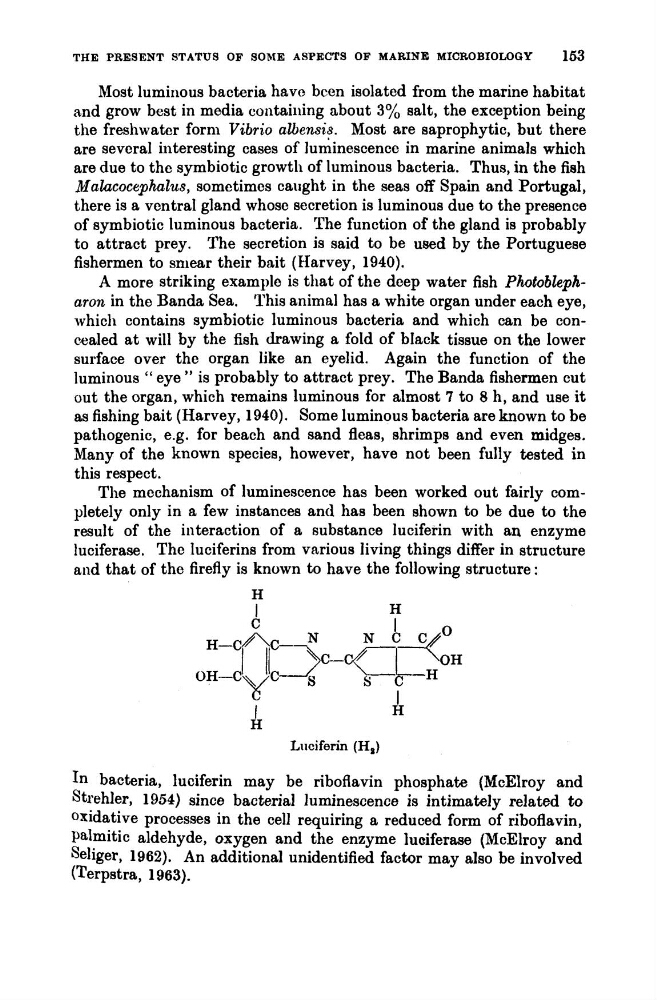
The mechanism of luminescence has been worked out fairly completely only in a few instances and has been shown to be due to the
result of the interaction of a substance luciferin with an enzyme
luciferase. The luciferins from various living things differ in structure
and that of the firefly is known to have the following structure:
H
I
H
I
H
H
Luciferin (H,)
In bacteria, luciferin may be riboflavin phosphate (McElroy and
Strehler, 1954) since bacterial luminescence is intimately related to
oxidative processes in the cell requiring a reduced form of riboflavin,
palmitic aldehyde, oxygen and the enzyme luuiferase (McElroy and
Seliger, 1962). An additional unidentified factor may also be involved
(Terpstra, 1963).
163
Most luminous bacteria have been isolated from the marine habitat
and grow best in media contailling about 3% salt, the exception being
the freshwater form Vibrio albensis. Most are saprophytic, but there
are several interesting cases of luminescence in marine animals which
are due to the symbiotic growth of luminous bacteria. Thus, in the fish
Malacocepphalus, sometimes caught in the seas off Spain and Portugal,
there is a ventral gland whoso secretion is luminous due to the presence
of symbiotic luminous bacteria. The function of the gland is probably
to attract prey. The secretion is said to be used by the Portuguese
fishermen to smear their bait (Harvey, 1940).
A more striking examplo is that of the deep water fish Photoblephwon in the Banda Sea. This animal has a white organ under each eye,
which contains symbiotic luminous bacteria and which can be concealed at will by the fish drawing a fold of bIack tissue on the lower
surface over the organ like an eyelid. Again the function of the
luminous " eye " is probably to attract prey. The Banda fishermen cut
out the organ, which remains luminous for almost 7 to 8 h, and use it
as fishing bait (Harvey, 1940). Some luminous bacteria are known to be
pathogenic, e.g. for beach and sand fleas, shrimps and even midges.
Many of the known species, however, have not been fully tested in
this respect.
The mechanism of luminescence has been worked out fairly completely only in a few instances and has been shown to be due to the
result of the interaction of a substance luciferin with an enzyme
luciferase. The luciferins from various living things differ in structure
and that of the firefly is known to have the following structure:
H
I
H
I
H
H
Luciferin (H,)
In bacteria, luciferin may be riboflavin phosphate (McElroy and
Strehler, 1954) since bacterial luminescence is intimately related to
oxidative processes in the cell requiring a reduced form of riboflavin,
palmitic aldehyde, oxygen and the enzyme luuiferase (McElroy and
Seliger, 1962). An additional unidentified factor may also be involved
(Terpstra, 1963).