

142
ROBINA B. SCHOLES AND J. M. SHEWAN
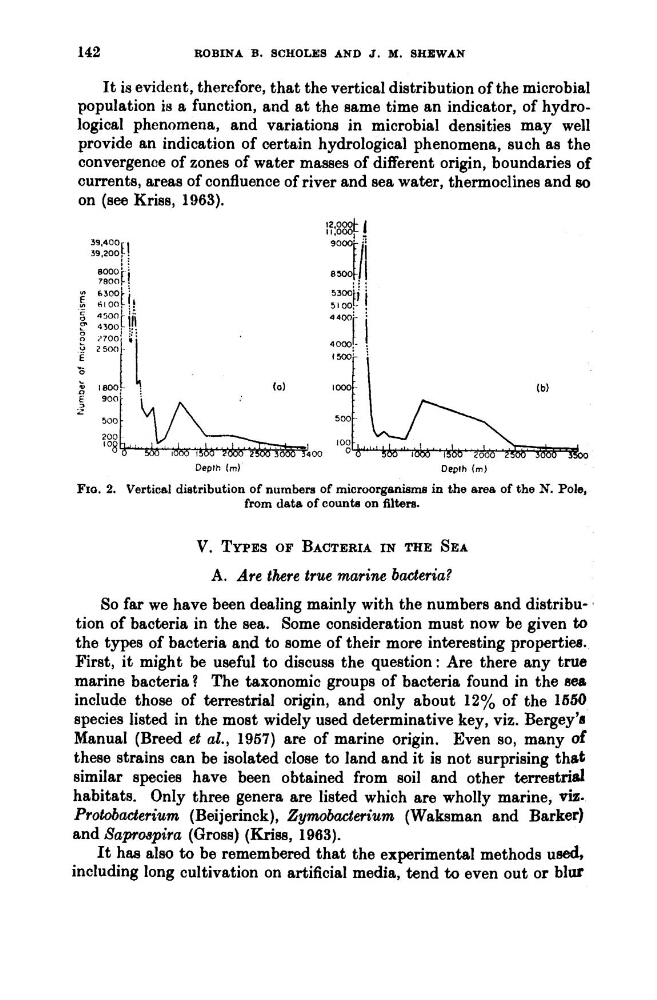
It is evident, therefore, that the vertical distribution of the microbial
population is a function, and at the same time an indicator, of hydrological phenomena, and variationa in microbial densities may well
provide an indication of certain hydrological phenomena, such as the
convergence of zones of water masses of different origin, boundaries of
currents, areas of confluence of river and sea water, thermoclines and so
on (see Kriss, 1963).
Depth (rn)
Depth (m)
FIO. 2. Vertical distribution of numbers of microorganisms in the area of the N. Pole,
from data of counts on filters.
V. TYPES OF BACTERIA IN THE SEA
A. Are there true marine bacteria?
So far we have been dealing mainly with the numbers and distribution of bacteria in the sea. Some consideration must now be given to
the types of bacteria and to some of their more interesting properties.
First, it might be useful to discuss the question: Are there any true
marine bacteria? The taxonomic groups of bacteria found in the Be&
include those of terrestrial origin, and only about 12% of the 1660
species listed in the most widely used determinative key, viz. Bergey'a
Manual (Breed et al., 1967) are of marine origin. Even so, many of
these strains can be isolated close to land and it is not surprising that
similar species have been obtained from soil and other terrestrid
habitats. Only three genera are listed which are wholly marine, viz.
Protobacterium (Beijerinck), Zymobacterium (Waksman and Barker)
and Saprmpira (Gross) (Kriss, 1963).
It has also to be remembered that the experimental methods used,
including long cultivation on artificial media, tend to even out or blur
ROBINA B. SCHOLES AND J. M. SHEWAN
It is evident, therefore, that the vertical distribution of the microbial
population is a function, and at the same time an indicator, of hydrological phenomena, and variationa in microbial densities may well
provide an indication of certain hydrological phenomena, such as the
convergence of zones of water masses of different origin, boundaries of
currents, areas of confluence of river and sea water, thermoclines and so
on (see Kriss, 1963).
Depth (rn)
Depth (m)
FIO. 2. Vertical distribution of numbers of microorganisms in the area of the N. Pole,
from data of counts on filters.
V. TYPES OF BACTERIA IN THE SEA
A. Are there true marine bacteria?
So far we have been dealing mainly with the numbers and distribution of bacteria in the sea. Some consideration must now be given to
the types of bacteria and to some of their more interesting properties.
First, it might be useful to discuss the question: Are there any true
marine bacteria? The taxonomic groups of bacteria found in the Be&
include those of terrestrial origin, and only about 12% of the 1660
species listed in the most widely used determinative key, viz. Bergey'a
Manual (Breed et al., 1967) are of marine origin. Even so, many of
these strains can be isolated close to land and it is not surprising that
similar species have been obtained from soil and other terrestrid
habitats. Only three genera are listed which are wholly marine, viz.
Protobacterium (Beijerinck), Zymobacterium (Waksman and Barker)
and Saprmpira (Gross) (Kriss, 1963).
It has also to be remembered that the experimental methods used,
including long cultivation on artificial media, tend to even out or blur