

THE PRESENT STATUS OF SOME ASPECTS OF MARINE MICROBIOLOGY
136
personal communication) and has the advantage that it can collect
several litres of water a t any desired depth without the danger of extraneous microbial contamination. Moreover, the instrument is not
adversely affected by hydrostatic pressures at extreme ocean depths at
which glass containers are inclilied to shatter; and the raising and
lowering of the sampler imparts little drag to the hydrological wire.
The frame of the sampler is made of anodized aluminium and stainless
steel and the water is collected in sterile detachable polythene bags.
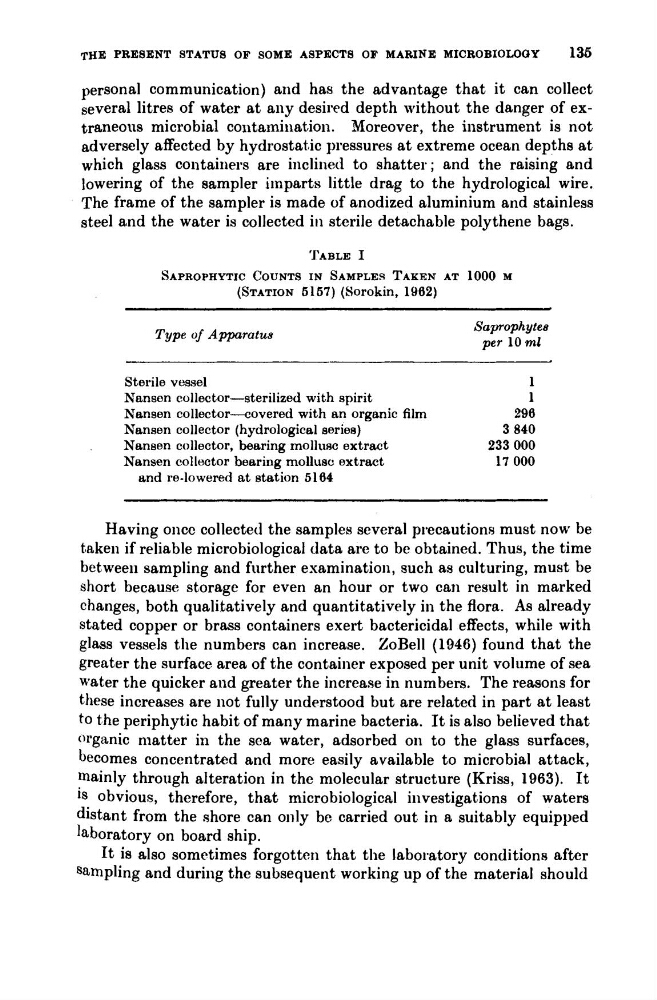
TABLE I
SAPROPHYTIC COUNTS IN SAMPLER TAKEN AT 1000 M
(STATION 6167) (Sorokin, 1962)
Type of Apparatus
Saproph ytee
per 1Oml
Sterile vessel
1
Nansen collector-eovered with an organic film
296
Nansen collector (hydrological seriee)
3 840
Nansen collector, bearing mollusc extract
233 000
Nansen collector bearing mollusc extract
17 000
Nansen collector-sterilized with spirit
1
and re-lowered at station 5104
Having once collected the samples several precautions must now be
taken if reliable microbiological data are to be obtained. Thus, the time
betweeii sampling and further examination, such as culturing, must be
short because storage for even an hour or two can result in marked
changes, both qualitatively and quantitatively in the flora. As already
stated copper or brass containers exert bactericidal effects, while with
glass vessels the numbers can increase. ZoBell (1946) found that the
greater the surface area of the container exposed per unit volume of sea
water the quicker and greater the increase in numbers. The reasons for
these increases are not fully understood but are related in part a t least
to the periphytic habit of many marine bacteria. It is also believed that
organic matter in the sea water, adsorbed on to the glass surfaces,
becomes concentrated and more easily available to microbial attack,
mainly through alteration in the molecular structure (Kriss, 1963). It
1s obvious, therefore, that microbiological investigations of waters
distant from the shore can only be carried out in a suitably equipped
laboratory on board ship.
It is also sometimes forgotten that the laboratory conditions nftcr
sampling and during the subsequent working up of the material should
136
personal communication) and has the advantage that it can collect
several litres of water a t any desired depth without the danger of extraneous microbial contamination. Moreover, the instrument is not
adversely affected by hydrostatic pressures at extreme ocean depths at
which glass containers are inclilied to shatter; and the raising and
lowering of the sampler imparts little drag to the hydrological wire.
The frame of the sampler is made of anodized aluminium and stainless
steel and the water is collected in sterile detachable polythene bags.
TABLE I
SAPROPHYTIC COUNTS IN SAMPLER TAKEN AT 1000 M
(STATION 6167) (Sorokin, 1962)
Type of Apparatus
Saproph ytee
per 1Oml
Sterile vessel
1
Nansen collector-eovered with an organic film
296
Nansen collector (hydrological seriee)
3 840
Nansen collector, bearing mollusc extract
233 000
Nansen collector bearing mollusc extract
17 000
Nansen collector-sterilized with spirit
1
and re-lowered at station 5104
Having once collected the samples several precautions must now be
taken if reliable microbiological data are to be obtained. Thus, the time
betweeii sampling and further examination, such as culturing, must be
short because storage for even an hour or two can result in marked
changes, both qualitatively and quantitatively in the flora. As already
stated copper or brass containers exert bactericidal effects, while with
glass vessels the numbers can increase. ZoBell (1946) found that the
greater the surface area of the container exposed per unit volume of sea
water the quicker and greater the increase in numbers. The reasons for
these increases are not fully understood but are related in part a t least
to the periphytic habit of many marine bacteria. It is also believed that
organic matter in the sea water, adsorbed on to the glass surfaces,
becomes concentrated and more easily available to microbial attack,
mainly through alteration in the molecular structure (Kriss, 1963). It
1s obvious, therefore, that microbiological investigations of waters
distant from the shore can only be carried out in a suitably equipped
laboratory on board ship.
It is also sometimes forgotten that the laboratory conditions nftcr
sampling and during the subsequent working up of the material should