

THE BLOOD QROUPS OF MARINE ANIMALS
101
Five California sea lions (Zabphus Cal~wnianus Lesson) appeared
to have an antigen resembling human B on their erythrocytes, as well
as an antigen with a specificity close to finback J u l (identified by
reactions with rabbit anti-Ju1 serum). In addition, serum from these
animals strongly agglutinated the cells of a Ju2-positive finback, and
failed to agglutinate the cells of seven Ju2-negative finbacks and
seven Ju2-negative humpbacks. Individual variation in erythrocyte
antigens was suggested by the observation that two out of a set of
three sea-lion serums obtained from another source isoagglutinated the
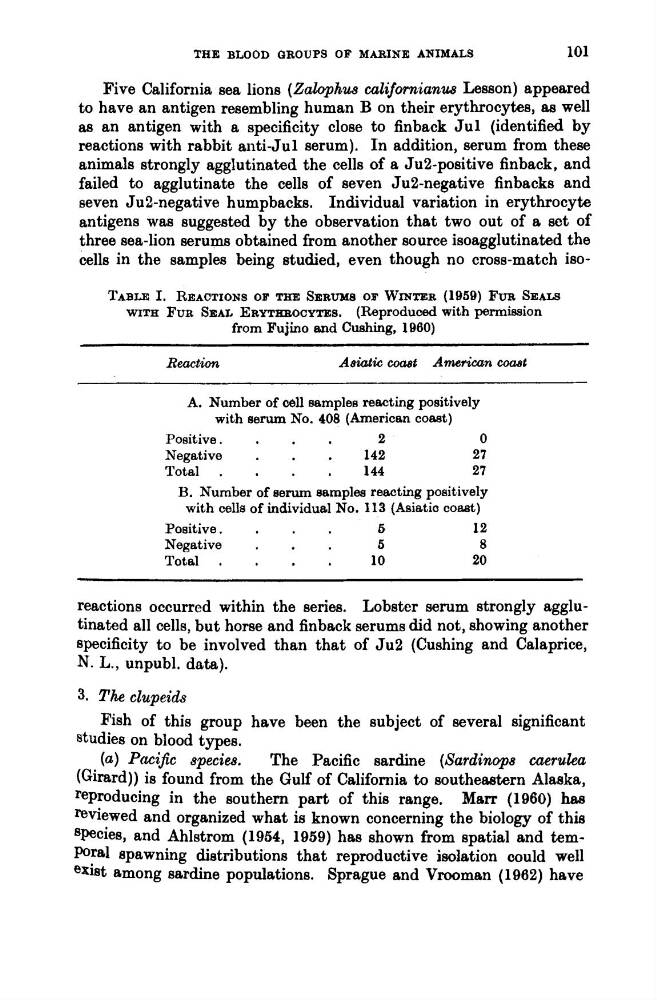
cells in the samples being studied, even though no cross-match isoTABLE I. REACTIONS OF THE SERUMS OF WINTER (1969) FUR S ~ l U n s
WITH FUR SEAL ERYTBBOCYTES. (Reproduced with permiasion
from Fujino and Cushing, 1960)
A. Number of cell samples reacting positively
with serum No. 408 (American coast)
Positive.
2
0
Negative
.
. 142
27
Total .
. 144
27
I3. Number of serum samples reacting positively
with cells of individual No. 113 (Asiatia coest)
Positive.
6
12
Negative
.
6
8
Total .
10
20
reactions occurred within the series. Lobster serum strongly agglutinated all cells, but horse and finback serums did not, showing another
specificity to be involved than that of J u 2 (Cushing and Calapnce,
N. L., unpubl. data).
3. The clupeids
Fish of this group have been the subject of several significant
studies on blood types.
(a) Pncijic species.
The Pacific sardine (Sardknopcr caeru.lea
(Girard)) is found from the Gulf of California to southeastern Alaska,
reproducing in the southern part of this range. Marr (1960) has
reviewed and organized what is known concerning the biology of this
species, and Ahlstrom (1964, 1959) has shown from spatial and temporal spawning distributions that reproductive isolation could well
exist among sardine populations. Sprague and Vrooman (1962) have
101
Five California sea lions (Zabphus Cal~wnianus Lesson) appeared
to have an antigen resembling human B on their erythrocytes, as well
as an antigen with a specificity close to finback J u l (identified by
reactions with rabbit anti-Ju1 serum). In addition, serum from these
animals strongly agglutinated the cells of a Ju2-positive finback, and
failed to agglutinate the cells of seven Ju2-negative finbacks and
seven Ju2-negative humpbacks. Individual variation in erythrocyte
antigens was suggested by the observation that two out of a set of
three sea-lion serums obtained from another source isoagglutinated the
cells in the samples being studied, even though no cross-match isoTABLE I. REACTIONS OF THE SERUMS OF WINTER (1969) FUR S ~ l U n s
WITH FUR SEAL ERYTBBOCYTES. (Reproduced with permiasion
from Fujino and Cushing, 1960)
A. Number of cell samples reacting positively
with serum No. 408 (American coast)
Positive.
2
0
Negative
.
. 142
27
Total .
. 144
27
I3. Number of serum samples reacting positively
with cells of individual No. 113 (Asiatia coest)
Positive.
6
12
Negative
.
6
8
Total .
10
20
reactions occurred within the series. Lobster serum strongly agglutinated all cells, but horse and finback serums did not, showing another
specificity to be involved than that of J u 2 (Cushing and Calapnce,
N. L., unpubl. data).
3. The clupeids
Fish of this group have been the subject of several significant
studies on blood types.
(a) Pncijic species.
The Pacific sardine (Sardknopcr caeru.lea
(Girard)) is found from the Gulf of California to southeastern Alaska,
reproducing in the southern part of this range. Marr (1960) has
reviewed and organized what is known concerning the biology of this
species, and Ahlstrom (1964, 1959) has shown from spatial and temporal spawning distributions that reproductive isolation could well
exist among sardine populations. Sprague and Vrooman (1962) have