

REARING OF BIVALVE MOLLUSKS
65
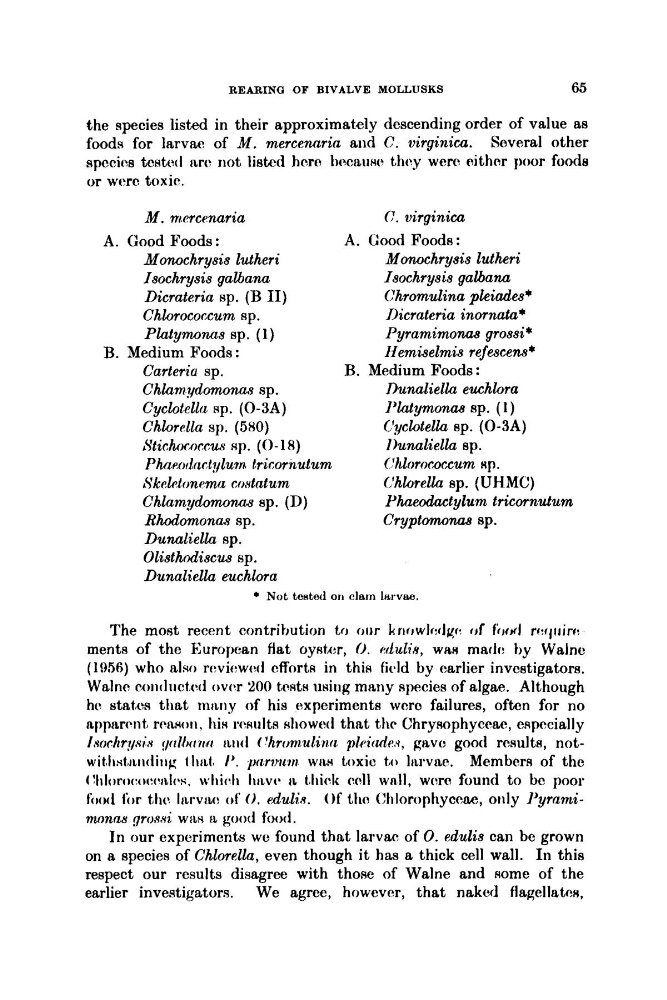
the species listed in their approximately descending order of value as
foods for larvae of M. mercennrin and G . virginica. Several other
specks tcstctl arc’ riot listcd hcm lwcau~(+ t h y were' tither poor foode
or wwc toxic.
M . m wcenaria
Nonochrysis lutheri
Isochrysis galbana
Dicrateria sp. (B 11)
Chlorococcum sp.
Platymoms sp. (1)
Carteriu sp.
Chlamydomonas sp.
Cyclotella sp. (0-3A)
Chlorclla sp. (580)
Ph~rotlac t y lum tricornutum
Skalctonrma co,ytnlum
Chlamydomonas sp. (D)
Rhodomonas sp.
Dunaliella sp.
Olisthodiscus sp.
Dumliella euchlora
A. Good Foods:
B. Medium Foods:
Stichococcus 8P. (0- 18)
C . virginica
A. Good Foods:
Monochrysis lutheri
Isochrysis galbana
Chromulinu pleiades*
Dicrateria inornata*
Pyramirnonas grossi*
Hemiselmis refesced
Dunaliella euchlora
I’latymonas sp. ( 1)
C‘yclotella sp. (0-3A)
1)unaliella sp.
Chlorella sp. (UHMC)
Phueodactylum tricornutum
Cryptomonas sp.
B. Medium Foods:
‘lilorocomu?n up.
* Not tested on clam larvae,
The most recent contribution to oiir kriclwlcclgc. of fowl rc*cjtiirv
ments of the European flat oystm, 0. P ~ u Z ~ H , WRH rnadf: hy Walne
( 1!)56) who also rcviewcvi cfforts in this fivld by earlier investigators.
Walnr contliirtc~ti o w r ‘LOO twtg wing many species of algae. Although
he statcs that rnr~riy of his experiments wero failures, often for no
appnrrnt, r(vwoii, his rr8iilts 8liowod that t h Chrysophyceac, eHpccially
lwchr,t/.si
~‘Iiloroc~cic~c~ril~~s. wliidi Iiavc- 41 t trick ( ~ 4 1 wnll, wcrc found to be poor
f0Od for t h IWVILO of‘ 0 . edulis. Of tho (%lorophyccm, only I’yrnn&
nionns p , w i W ~ L H good food.
In our experiments we found that larvae of 0. edulis can be grown
on a species of Chlorella, even though it has a thick cell wall. In this
respect our results disagree with those of Walne and Home of the
earlier investigators. We agree, howevrr, that naked flagcllrttn~,
65
the species listed in their approximately descending order of value as
foods for larvae of M. mercennrin and G . virginica. Several other
specks tcstctl arc’ riot listcd hcm lwcau~(+ t h y were' tither poor foode
or wwc toxic.
M . m wcenaria
Nonochrysis lutheri
Isochrysis galbana
Dicrateria sp. (B 11)
Chlorococcum sp.
Platymoms sp. (1)
Carteriu sp.
Chlamydomonas sp.
Cyclotella sp. (0-3A)
Chlorclla sp. (580)
Ph~rotlac t y lum tricornutum
Skalctonrma co,ytnlum
Chlamydomonas sp. (D)
Rhodomonas sp.
Dunaliella sp.
Olisthodiscus sp.
Dumliella euchlora
A. Good Foods:
B. Medium Foods:
Stichococcus 8P. (0- 18)
C . virginica
A. Good Foods:
Monochrysis lutheri
Isochrysis galbana
Chromulinu pleiades*
Dicrateria inornata*
Pyramirnonas grossi*
Hemiselmis refesced
Dunaliella euchlora
I’latymonas sp. ( 1)
C‘yclotella sp. (0-3A)
1)unaliella sp.
Chlorella sp. (UHMC)
Phueodactylum tricornutum
Cryptomonas sp.
B. Medium Foods:
‘lilorocomu?n up.
* Not tested on clam larvae,
The most recent contribution to oiir kriclwlcclgc. of fowl rc*cjtiirv
ments of the European flat oystm, 0. P ~ u Z ~ H , WRH rnadf: hy Walne
( 1!)56) who also rcviewcvi cfforts in this fivld by earlier investigators.
Walnr contliirtc~ti o w r ‘LOO twtg wing many species of algae. Although
he statcs that rnr~riy of his experiments wero failures, often for no
appnrrnt, r(vwoii, his rr8iilts 8liowod that t h Chrysophyceac, eHpccially
lwchr,t/.si
~‘Iiloroc~cic~c~ril~~s. wliidi Iiavc- 41 t trick ( ~ 4 1 wnll, wcrc found to be poor
f0Od for t h IWVILO of‘ 0 . edulis. Of tho (%lorophyccm, only I’yrnn&
nionns p , w i W ~ L H good food.
In our experiments we found that larvae of 0. edulis can be grown
on a species of Chlorella, even though it has a thick cell wall. In this
respect our results disagree with those of Walne and Home of the
earlier investigators. We agree, howevrr, that naked flagcllrttn~,