

40
VICTOR L. LOOSANOFF A N D HARRY C. DAVIS
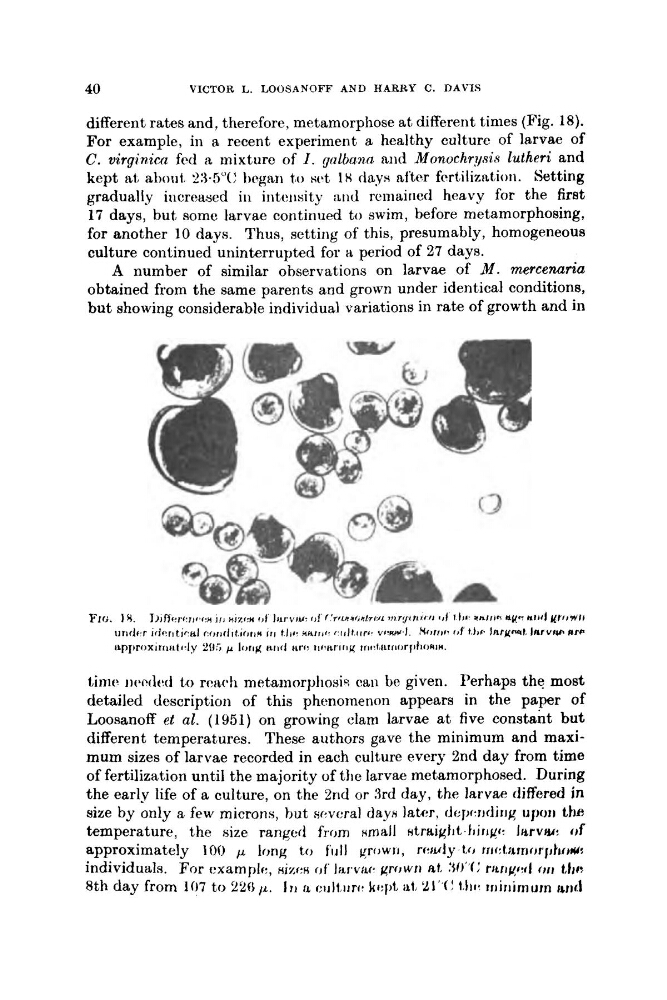
different rates and, therefore, metamorphose at different times (Fig. 18).
For example, in a recent experiment a healthy culture of larvae of
c. virginicn fed a mixture of I . p l b a z n and Monochrpis lutheri and
kept at, about ?:3.R"C hcgnn t,o set 1 H (jays af%cr f+rtilizntion. Setting
gradually increased in intcnsity :tnd remained heavy for the first
17 days, but some larvae continued to swim, before metamorphosing,
for another 10 days. Thus, setting of this, presumably, homogeneous
culture continued uninterrupted for it period of 27 days.
A number of similar observations on larvae of M . mereemria
obtained from the same parents and grown under identical conditions,
but showing considerable individual variations in rate of growth and in
tinit? 11c~ctlt!d to rcwh meta~norphoui~. can be given. Perhaps the most
detailed description of this phenomenon appears in the paper of
Loosanoff et al. (1951) on growing clam larvae at five constant but
different temperatures. These authors gave the minimum and maximum sizes of larvae recorded in each culture every 2nd day from time
of fertilization until the majority of the larvae metamorphosed. During
the early life of a culture, on the 2nd or 3rd day, the larvae differed in
size by only a few microns, but swcral day8 1atf:r. ckpf:ridirig i i p n the
temperature, the size ranged from mall Ntraight-hirip Iltrvw of
approximat.eIy 100 p long to f ' i ~ l l grown, rcrufy to r r i ( ~ t , ; ~ r r i ~ ~ r i l t i ~ ) ~ ~
individuals. For examplc, ~ j z r : ~
r ~ f ' ja,rv;w grown at. 30''f; rmigwl o r 1 thrt
8th day from 107 to 2'Lf) 11. I J J IL ClJkltJ'r! k i q h tit, 21''(; t h * rnitlirnurn ;$rid
VICTOR L. LOOSANOFF A N D HARRY C. DAVIS
different rates and, therefore, metamorphose at different times (Fig. 18).
For example, in a recent experiment a healthy culture of larvae of
c. virginicn fed a mixture of I . p l b a z n and Monochrpis lutheri and
kept at, about ?:3.R"C hcgnn t,o set 1 H (jays af%cr f+rtilizntion. Setting
gradually increased in intcnsity :tnd remained heavy for the first
17 days, but some larvae continued to swim, before metamorphosing,
for another 10 days. Thus, setting of this, presumably, homogeneous
culture continued uninterrupted for it period of 27 days.
A number of similar observations on larvae of M . mereemria
obtained from the same parents and grown under identical conditions,
but showing considerable individual variations in rate of growth and in
tinit? 11c~ctlt!d to rcwh meta~norphoui~. can be given. Perhaps the most
detailed description of this phenomenon appears in the paper of
Loosanoff et al. (1951) on growing clam larvae at five constant but
different temperatures. These authors gave the minimum and maximum sizes of larvae recorded in each culture every 2nd day from time
of fertilization until the majority of the larvae metamorphosed. During
the early life of a culture, on the 2nd or 3rd day, the larvae differed in
size by only a few microns, but swcral day8 1atf:r. ckpf:ridirig i i p n the
temperature, the size ranged from mall Ntraight-hirip Iltrvw of
approximat.eIy 100 p long to f ' i ~ l l grown, rcrufy to r r i ( ~ t , ; ~ r r i ~ ~ r i l t i ~ ) ~ ~
individuals. For examplc, ~ j z r : ~
r ~ f ' ja,rv;w grown at. 30''f; rmigwl o r 1 thrt
8th day from 107 to 2'Lf) 11. I J J IL ClJkltJ'r! k i q h tit, 21''(; t h * rnitlirnurn ;$rid