

32
VICTOR L. LOOSANOFE’ AND HARRY C. DAVIS
eggs the larvae develop more normally but are quite small, measuring
only 60 to 70 p at the 48-hr stage (Oavis, 1949). Finally, in induced
spawning of oysters late in the season after resorption of their gonads
has begun, embryonic development of eggs is frequently abnormal
and only a low percentage of them develop into healthy straight-hinge
larvae.
Subjecting eggs and spermatozoa to temperatures higher than 30°C
may injure or even kill them. Maintaining rcrcently discharged eggs
in heavy concentrations, a condition that leads to formation of a thick
layer of them on the bottom of rearing vessels, may result in a sufficient
Q
deplet’ion of oxygen and accumulation of catabolic products that will
affect the eggs and their further clevalopment. l f zygote8 and early
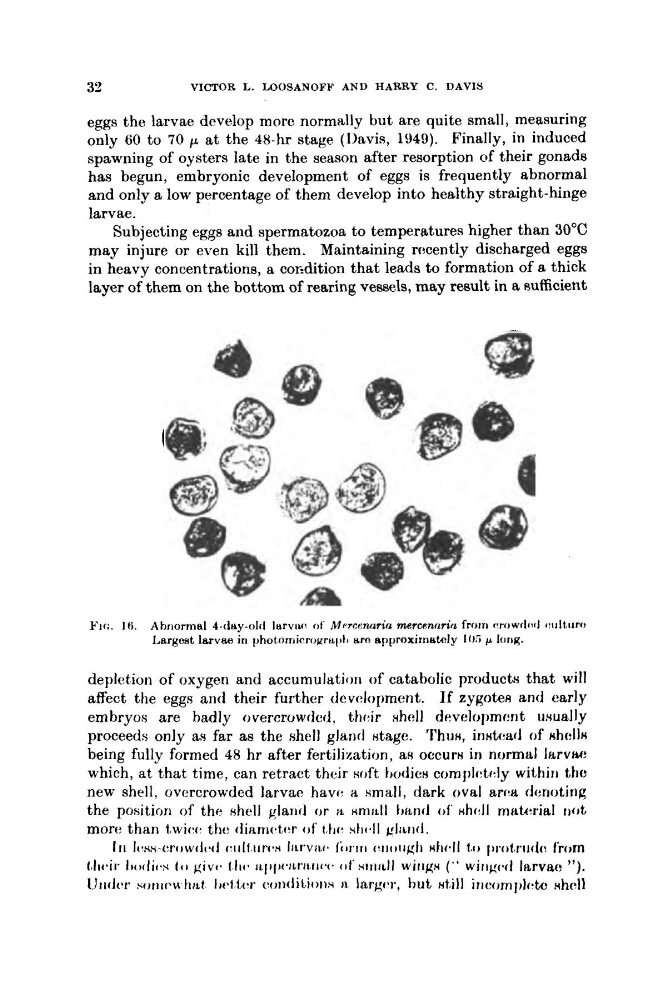
embryos are badly overcrowded, thoir shell develctpmcn t u,uually
proceeds only as far as the shell gland Htage. ‘I’hun, inntr:ad of nhelln
being fully formed 48 hr after fertilization, as owurn in normal 1arvti.e
which, at that time, can retract their soft tiotlien complc:tc:ly within t h
new shell, overcrowded larvae have a small, dark oval arc!& clsrroting
the position of the #hell gland o r ii snirtll tirtntl of’ Hhdl mcttc:rittl r i o t
more t h a n t w i w ttic clianrc.tc!r of t h : ?ihc*ll ~ I i ~ i l ( 1 .
Iii Ii~ss-criiw(h~(1 c i i I t , i i r ( b H IILrviu. iimti ( ~ t i i i i i g I i H t i v I I ti) i w ( i t r i i ~ I c from
t.lic*ir Iio(1ic-s give- t , l i c * ii.f~iii*ii,rii,iic’i. (11‘ ~ ~ i i r ~ l l
wiriKH ( ” wiriK:c-cl Irrrvao ”).
Uiidvr s o i i 1 i w h i L t t)c.i.tcr (:ot)cliLionx $1. I a r p r , h u t till iricornlileh xhcdl
VICTOR L. LOOSANOFE’ AND HARRY C. DAVIS
eggs the larvae develop more normally but are quite small, measuring
only 60 to 70 p at the 48-hr stage (Oavis, 1949). Finally, in induced
spawning of oysters late in the season after resorption of their gonads
has begun, embryonic development of eggs is frequently abnormal
and only a low percentage of them develop into healthy straight-hinge
larvae.
Subjecting eggs and spermatozoa to temperatures higher than 30°C
may injure or even kill them. Maintaining rcrcently discharged eggs
in heavy concentrations, a condition that leads to formation of a thick
layer of them on the bottom of rearing vessels, may result in a sufficient
Q
deplet’ion of oxygen and accumulation of catabolic products that will
affect the eggs and their further clevalopment. l f zygote8 and early
embryos are badly overcrowded, thoir shell develctpmcn t u,uually
proceeds only as far as the shell gland Htage. ‘I’hun, inntr:ad of nhelln
being fully formed 48 hr after fertilization, as owurn in normal 1arvti.e
which, at that time, can retract their soft tiotlien complc:tc:ly within t h
new shell, overcrowded larvae have a small, dark oval arc!& clsrroting
the position of the #hell gland o r ii snirtll tirtntl of’ Hhdl mcttc:rittl r i o t
more t h a n t w i w ttic clianrc.tc!r of t h : ?ihc*ll ~ I i ~ i l ( 1 .
Iii Ii~ss-criiw(h~(1 c i i I t , i i r ( b H IILrviu. iimti ( ~ t i i i i i g I i H t i v I I ti) i w ( i t r i i ~ I c from
t.lic*ir Iio(1ic-s give- t , l i c * ii.f~iii*ii,rii,iic’i. (11‘ ~ ~ i i r ~ l l
wiriKH ( ” wiriK:c-cl Irrrvao ”).
Uiidvr s o i i 1 i w h i L t t)c.i.tcr (:ot)cliLionx $1. I a r p r , h u t till iricornlileh xhcdl