

THE BEHAVIOUR AND w w s i o L o a Y OF HERR IN^ AND OTHER CLUPEIDS 369
Author
Tester (1937)
Teater (19384
McHugh (1942)
McHugh (quoted
by Marr, 1957)
TABLE XI-mntinued
Species
Clupea
pallasii
Clupea
pauasii
Clupea
pllasii
Sardinops
caerulea
Place
,
Jap Inlet
British Columbia
Barkley Sound
British Coiumbia
British Columbia
American west
coat
Correlation
Negative correlation between m.v.c. and air
temperature at spawning seaon; gradation in
vertebral count with
latitude
Negative correlation be -
tween m.v.c. and water
temperature during
spawning m w n
Negative correlation between m.v.c. of EBBcaught larvae and temperature at Bpawning
Latitudinal differences in
m.v.c.
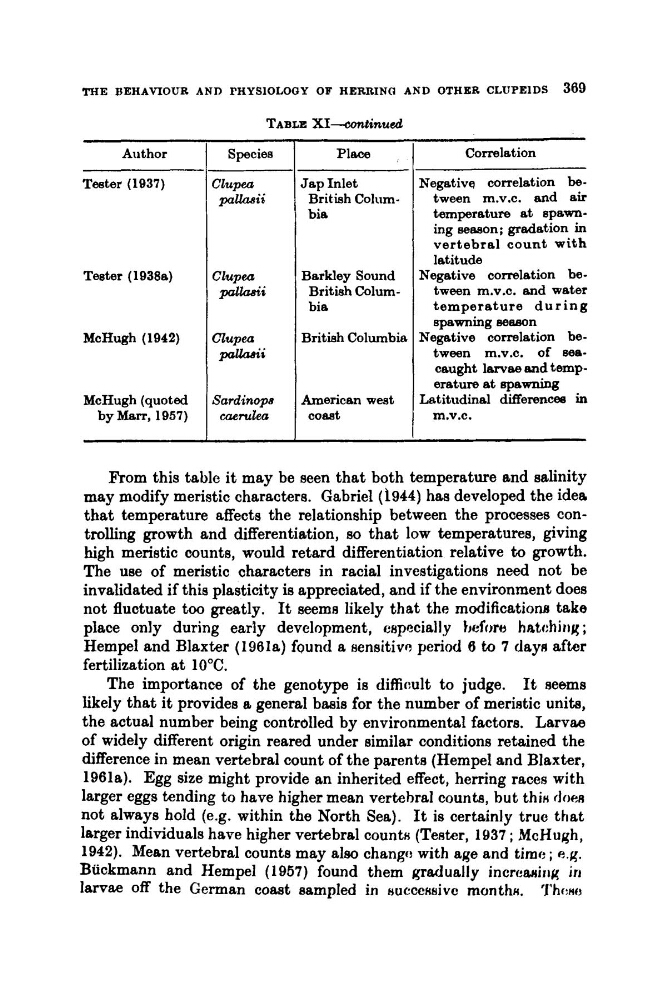
From this table it may be seen that both temperature and salinity
may modify meristic characters. Gabriel (1944) has developed the idea
that temperature affects the relationship between the processes controlling growth and differentiation, so that low temperatures, giving
high meristic counts, would retard differentiation relative to growth.
The use of meristic characters in racial investigations need not be
invalidated if this plasticity is appreciated, and if the environment does
not fluctuate too greatly. It seems likely that the modifications take
place only during early development, cepecially h ~ f ~ r e j
hatchirig ;
Hempel and Blaxter (1961s) found a sensitive period 6 to 7 daya after
fertilization at 10°C.
The importance of the genotype is difficult to judge. It seems
likely that i t provides a general basis for the number of meristic units,
the actual number being controlled by environmental factors. Larvae
of widely different origin reared under similar conditions retained the
difference in mean vertebral count of the parents (Hempel and Blaxter,
1961a). Egg size might provide an inherited effect, herring races with
larger eggs tending to have higher mean vertebral counts, but thin does
not always hold (e.g. within the North Sea). It is certainly true that
larger individuals have higher vertebral countfi (Tester, 1037 ; McHuqh,
1942). Mean vertebral counts may also changc with age and time ; e.g.
Buckmann and Hempel (1957) found them gradually increaniag in
larvae off the German coast sampled in succewivc monthn. 7'ht:ne
Author
Tester (1937)
Teater (19384
McHugh (1942)
McHugh (quoted
by Marr, 1957)
TABLE XI-mntinued
Species
Clupea
pallasii
Clupea
pauasii
Clupea
pllasii
Sardinops
caerulea
Place
,
Jap Inlet
British Columbia
Barkley Sound
British Coiumbia
British Columbia
American west
coat
Correlation
Negative correlation between m.v.c. and air
temperature at spawning seaon; gradation in
vertebral count with
latitude
Negative correlation be -
tween m.v.c. and water
temperature during
spawning m w n
Negative correlation between m.v.c. of EBBcaught larvae and temperature at Bpawning
Latitudinal differences in
m.v.c.
From this table it may be seen that both temperature and salinity
may modify meristic characters. Gabriel (1944) has developed the idea
that temperature affects the relationship between the processes controlling growth and differentiation, so that low temperatures, giving
high meristic counts, would retard differentiation relative to growth.
The use of meristic characters in racial investigations need not be
invalidated if this plasticity is appreciated, and if the environment does
not fluctuate too greatly. It seems likely that the modifications take
place only during early development, cepecially h ~ f ~ r e j
hatchirig ;
Hempel and Blaxter (1961s) found a sensitive period 6 to 7 daya after
fertilization at 10°C.
The importance of the genotype is difficult to judge. It seems
likely that i t provides a general basis for the number of meristic units,
the actual number being controlled by environmental factors. Larvae
of widely different origin reared under similar conditions retained the
difference in mean vertebral count of the parents (Hempel and Blaxter,
1961a). Egg size might provide an inherited effect, herring races with
larger eggs tending to have higher mean vertebral counts, but thin does
not always hold (e.g. within the North Sea). It is certainly true that
larger individuals have higher vertebral countfi (Tester, 1037 ; McHuqh,
1942). Mean vertebral counts may also changc with age and time ; e.g.
Buckmann and Hempel (1957) found them gradually increaniag in
larvae off the German coast sampled in succewivc monthn. 7'ht:ne