

THE BEHAVIOUB AND PHYSIOLOQY OF HEBRINQ AND OTHER CLTJPEIDS 343
Krefft and Schuler, 1961 ; and Richardson, 1960) that herring are also
caught by night on the bottom with trawls, though the catches are
usually smaller and their composition different. The extent to which
this is caused by behaviour in relation to the net by different fish in
different light intensities is not quite dear, but this is a problem of
interpretation in comparative fishing experiments.
2. Light
The following of a preferred light intensity would explain the
movements, though presumably the light intensity at night would be
much lower than the preferred intensity by day. In Polar conditions,
vertical migration of herring was not found according to Zueeer (19584.
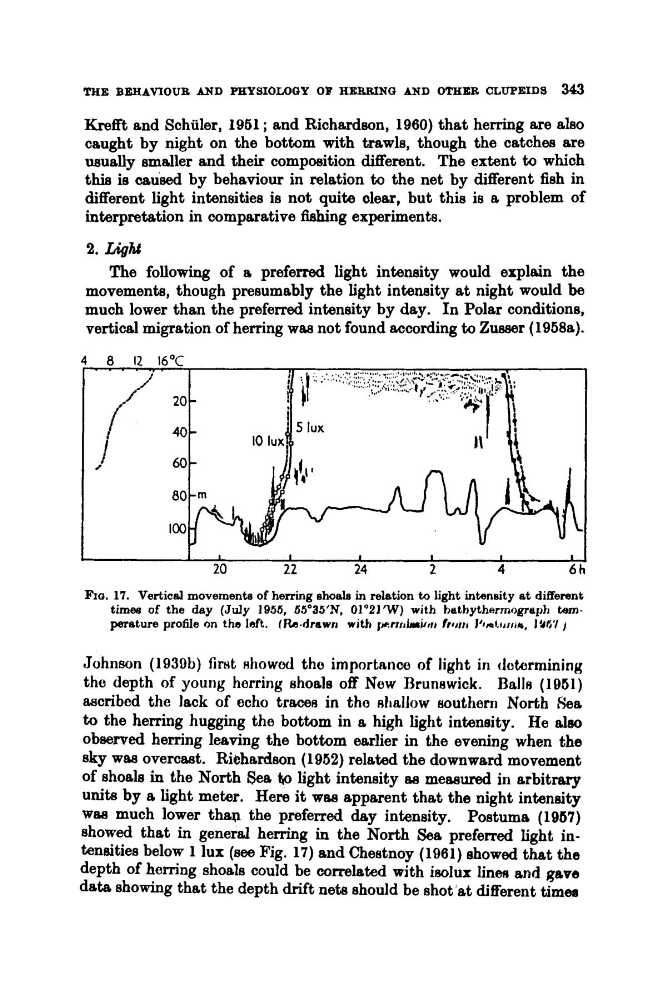
FIG. 17. Vertical movements of herring shoals in relation to light intensity at different
times of the day (July 1956, 65”35‘N, OlO2J’W) with hathytherrnogrnph ternperature profile on the left. Ilb.drawrr with perrirlYLrr) f m t r J’~dimtu, lW/ /
Johnson (1930b) firHt Hhowd tho importatico of light in dotormining
tho depth of young herring shoals off Now Brunewick. Balla (1951)
-scribed the lack of echo tracee in tho H ~ ~ I J O W
southern North Nee
to the herring hugging the bottom in a high light intensity. He elm
observed herring leaving the bottom earlier in the evening when the
sky was overcrtst. Richardson (1962) related the downward movement
of shoals in the North $ea 40 light intensity as measured in arbitrary
units by a light meter. Here it was apparent that the night intensity
was much lower thap the preferred day intensity. Poetuma (1957)
showed that in generd herring in the North Sea preferred light intensities below 1 lux (see Fig. 17) and Chestnoy (1961) showed that the
depth of herring shoals could be correlated with ieolux linen and gave
date showing that the depth drift neta should be shot at different timen
Krefft and Schuler, 1961 ; and Richardson, 1960) that herring are also
caught by night on the bottom with trawls, though the catches are
usually smaller and their composition different. The extent to which
this is caused by behaviour in relation to the net by different fish in
different light intensities is not quite dear, but this is a problem of
interpretation in comparative fishing experiments.
2. Light
The following of a preferred light intensity would explain the
movements, though presumably the light intensity at night would be
much lower than the preferred intensity by day. In Polar conditions,
vertical migration of herring was not found according to Zueeer (19584.
FIG. 17. Vertical movements of herring shoals in relation to light intensity at different
times of the day (July 1956, 65”35‘N, OlO2J’W) with hathytherrnogrnph ternperature profile on the left. Ilb.drawrr with perrirlYLrr) f m t r J’~dimtu, lW/ /
Johnson (1930b) firHt Hhowd tho importatico of light in dotormining
tho depth of young herring shoals off Now Brunewick. Balla (1951)
-scribed the lack of echo tracee in tho H ~ ~ I J O W
southern North Nee
to the herring hugging the bottom in a high light intensity. He elm
observed herring leaving the bottom earlier in the evening when the
sky was overcrtst. Richardson (1962) related the downward movement
of shoals in the North $ea 40 light intensity as measured in arbitrary
units by a light meter. Here it was apparent that the night intensity
was much lower thap the preferred day intensity. Poetuma (1957)
showed that in generd herring in the North Sea preferred light intensities below 1 lux (see Fig. 17) and Chestnoy (1961) showed that the
depth of herring shoals could be correlated with ieolux linen and gave
date showing that the depth drift neta should be shot at different timen