

324
J. H. S. BLAXTER A N D F. G . T. HOLLIDAY
also the possibility of fish used to strong currents having a very welldeveloped means of finding routes where the velocity of the current is
minimal. This might perhaps be a function of the lateral line system.
The mechanism of clupeid locomotion has not been worked on. It
is presumably little different from other groups. Recent work by
Rosen (1961) has shown that fish may progress by means of their
reaction to vortices created by the head. The whole body would then be
500
h
U
u
2 400
U
-
*++
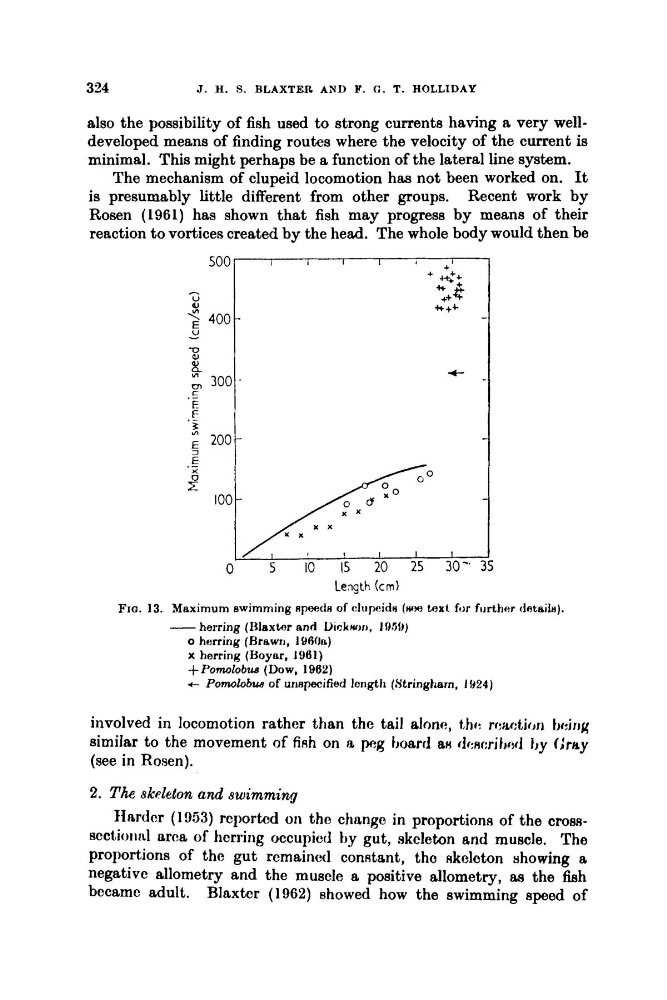
Length (cm)
FIQ. 13. Maximum swimming apeeds of dupeids
- herring (Bkxter and Dickwn, IMIJ)
M x t for further detaila).
0 herring (Hrawn, l Y 6 k )
x herring (Boyer, 1961)
+ Pomolobuu (Dow, 1902)
+ Pomolobm of urtspecified h g t h (SYtringhem, 1924)
involved in locomotion rather than the tail alone, t h r : rcmtiori bring
similar to the movement of fiRh on H, peg board af! fh:ficrihl by ( h y
(see in Rosen).
2. The skebton and swimming
Hardcr (1953) rcportod on tho chnngo in proportionR of the crossscctiotinl area of hcrring occupicd by gut, skcleton and muscle. Tho
proportions of the gut remained conRtant, tho Akcloton Yhowing a
negative allometry and the muscle a positive allometry, as the fish
bccamc adult. Blaxter (1962) showed how the swimming speed of
J. H. S. BLAXTER A N D F. G . T. HOLLIDAY
also the possibility of fish used to strong currents having a very welldeveloped means of finding routes where the velocity of the current is
minimal. This might perhaps be a function of the lateral line system.
The mechanism of clupeid locomotion has not been worked on. It
is presumably little different from other groups. Recent work by
Rosen (1961) has shown that fish may progress by means of their
reaction to vortices created by the head. The whole body would then be
500
h
U
u
2 400
U
-
*++
Length (cm)
FIQ. 13. Maximum swimming apeeds of dupeids
- herring (Bkxter and Dickwn, IMIJ)
M x t for further detaila).
0 herring (Hrawn, l Y 6 k )
x herring (Boyer, 1961)
+ Pomolobuu (Dow, 1902)
+ Pomolobm of urtspecified h g t h (SYtringhem, 1924)
involved in locomotion rather than the tail alone, t h r : rcmtiori bring
similar to the movement of fiRh on H, peg board af! fh:ficrihl by ( h y
(see in Rosen).
2. The skebton and swimming
Hardcr (1953) rcportod on tho chnngo in proportionR of the crossscctiotinl area of hcrring occupicd by gut, skcleton and muscle. Tho
proportions of the gut remained conRtant, tho Akcloton Yhowing a
negative allometry and the muscle a positive allometry, as the fish
bccamc adult. Blaxter (1962) showed how the swimming speed of