

314
J. R. 9. BLAXTER AND F. B. T. HOLLXDAY
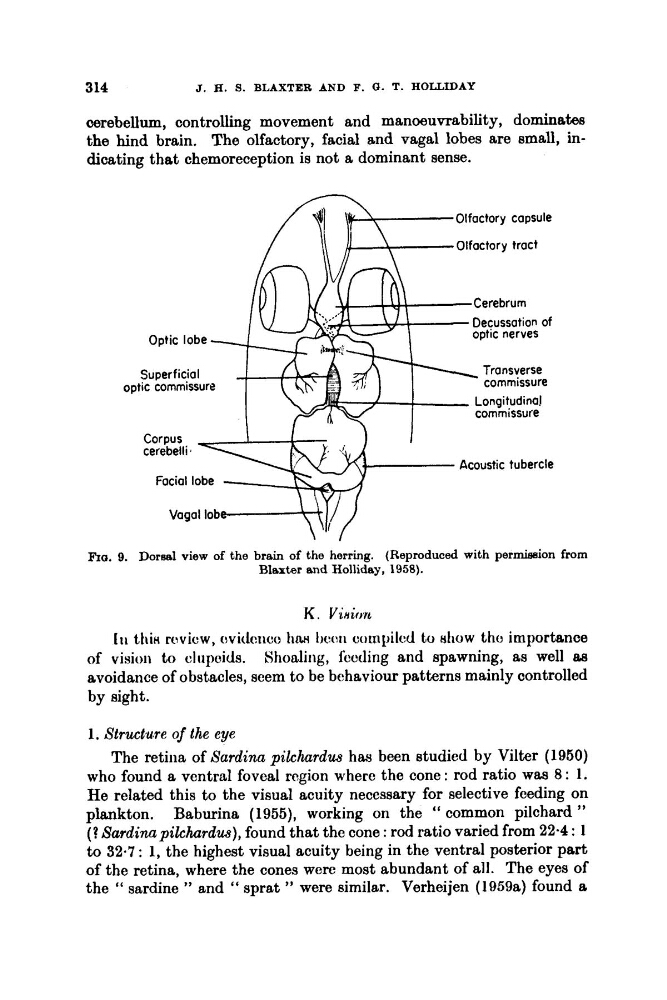
cerebellum, controlling movement and manoeuvrability, dominates
the hind brain. The olfactory, facial and vagal lobes are small, indicating that chemoreception is not a dominant sense.
Acoustic tubercle
Fro. 9. Dorm1 view of the brain of the herring. (Reproduced with p e r h i o n from
Blaxter and Holliday, 1958).
[ ~ i
t h i H roview, ovitlcrico hm 1 ~ 1 i
cotnpilcd t,o atiow tho importance
of vision to clupoids. Shoaling, feeding and spawning, as well as
avoidance of obstacles, seem to be behaviour patterns mainly controlled
by sight.
1. Structure of the eye
The retina of Sardina pilchardus has been studied by Vilter (1950)
who found a ventral fovcal ragion where the cone : rod ratio was 8 : 1.
He related this to the visual acuity necessary for selective feeding on
plankton. Baburina (1955), working on the ‘I common pilchard ”
(2 Sardinapilchurdus), found that the cone : rod ratio varied from 22.4 : 1
to 32.7 : 1, the highest visual acuity being in the ventral posterior part
of the retina, where the cones were most abundant of all. The eyes of
the sardine ’) and I ‘ sprat ” were similar. Verheijen (19594 found a
J. R. 9. BLAXTER AND F. B. T. HOLLXDAY
cerebellum, controlling movement and manoeuvrability, dominates
the hind brain. The olfactory, facial and vagal lobes are small, indicating that chemoreception is not a dominant sense.
Acoustic tubercle
Fro. 9. Dorm1 view of the brain of the herring. (Reproduced with p e r h i o n from
Blaxter and Holliday, 1958).
[ ~ i
t h i H roview, ovitlcrico hm 1 ~ 1 i
cotnpilcd t,o atiow tho importance
of vision to clupoids. Shoaling, feeding and spawning, as well as
avoidance of obstacles, seem to be behaviour patterns mainly controlled
by sight.
1. Structure of the eye
The retina of Sardina pilchardus has been studied by Vilter (1950)
who found a ventral fovcal ragion where the cone : rod ratio was 8 : 1.
He related this to the visual acuity necessary for selective feeding on
plankton. Baburina (1955), working on the ‘I common pilchard ”
(2 Sardinapilchurdus), found that the cone : rod ratio varied from 22.4 : 1
to 32.7 : 1, the highest visual acuity being in the ventral posterior part
of the retina, where the cones were most abundant of all. The eyes of
the sardine ’) and I ‘ sprat ” were similar. Verheijen (19594 found a