

310
J. H. S. BLAXTER AND F. a. T. HOLLIDAY
Tramfor SinliriiOy
3P/,
.
Oo/oo 3 hr .
3 hr .
24 hr . .
16°/00 3 hr .
16°/m 24 hr . .
50"/m 3 hr .
juvenile, or to spawn (see Sections 111, C ; IV, H). The herring of the
Baltic sea spend almost their entire life in brackish water. Massman
(1 954) recorded young Brevoortia tyrannue and Anchova mitchilli in
completely fresh water.
The salinity tolerance of the herring was determined by Brawn
(19GOd) and Holliday and Blaxtcr (1901). The lowor level lay between
5 and 6%,, the uppcr level between 40 and 45%,. Tagatz (1961) determined the tolerance of Alosa to abrupt changes of salinity. The juvenile
form tolerated changes from sea water to fresh water, but not the
reverse. The adult survived a transfer from fresh water to sea water,
but not the reverse. This difference between juvenile and adult probably indicates differences in the physiological capabilities of regulation.
2. Regulation
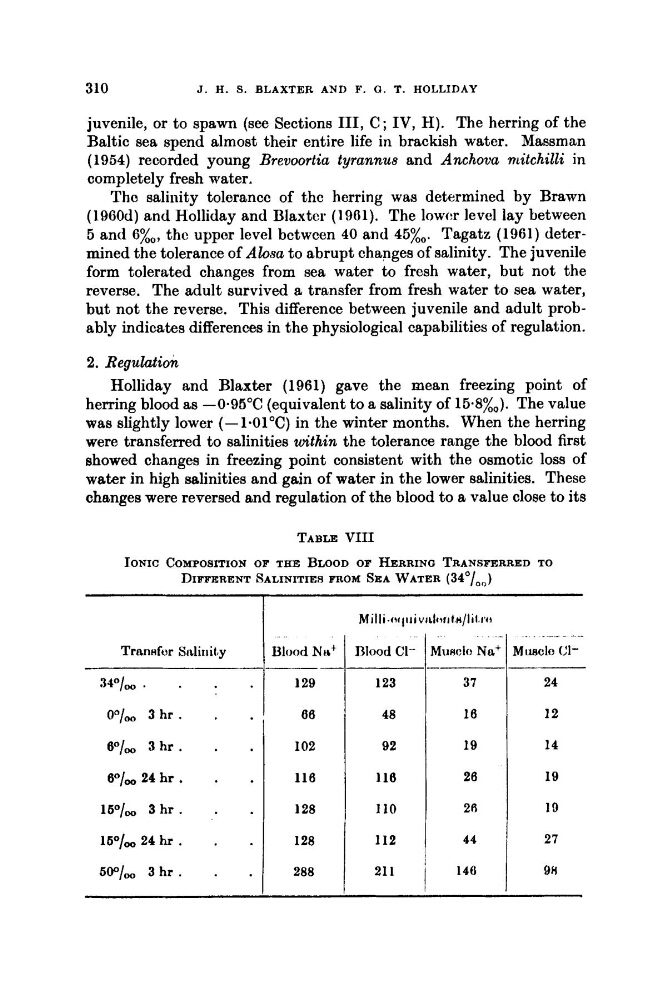
Holliday and Blaxter (1961) gave the mean freezing point of
herring blood as -0-95°C (equivalent to a salinity of 15.8%,). The value
was slightly lower (- 1.Ol"C) in the winter months. When the herring
were transferred to salinities within the tolerance range the blood first
showed changes in freezing point consistent with the osmotic loss of
water in high salinities and gain of water in the lower salinities. These
changes were reversed and regulation of the blood to a value close to its
Blood Ntr'
129
66
102
116
128
128
288
--__TABLE VIII
IONIC COMPOSITION OF THE BLOOD OF HERRING TRANSFERRED TO
DIFFERENT SALINITIES BROM SEA WATER (34°/,0)
M illi .ocliii viLltirit.H/Iil.iw
I3lood c1123
48
92
116
I10
112
21 1
Musclo NaC
37
16
19
26
26
44
146
_- ~
Musclo C124
12
14
19
19
21
9U
J. H. S. BLAXTER AND F. a. T. HOLLIDAY
Tramfor SinliriiOy
3P/,
.
Oo/oo 3 hr .
3 hr .
24 hr . .
16°/00 3 hr .
16°/m 24 hr . .
50"/m 3 hr .
juvenile, or to spawn (see Sections 111, C ; IV, H). The herring of the
Baltic sea spend almost their entire life in brackish water. Massman
(1 954) recorded young Brevoortia tyrannue and Anchova mitchilli in
completely fresh water.
The salinity tolerance of the herring was determined by Brawn
(19GOd) and Holliday and Blaxtcr (1901). The lowor level lay between
5 and 6%,, the uppcr level between 40 and 45%,. Tagatz (1961) determined the tolerance of Alosa to abrupt changes of salinity. The juvenile
form tolerated changes from sea water to fresh water, but not the
reverse. The adult survived a transfer from fresh water to sea water,
but not the reverse. This difference between juvenile and adult probably indicates differences in the physiological capabilities of regulation.
2. Regulation
Holliday and Blaxter (1961) gave the mean freezing point of
herring blood as -0-95°C (equivalent to a salinity of 15.8%,). The value
was slightly lower (- 1.Ol"C) in the winter months. When the herring
were transferred to salinities within the tolerance range the blood first
showed changes in freezing point consistent with the osmotic loss of
water in high salinities and gain of water in the lower salinities. These
changes were reversed and regulation of the blood to a value close to its
Blood Ntr'
129
66
102
116
128
128
288
--__TABLE VIII
IONIC COMPOSITION OF THE BLOOD OF HERRING TRANSFERRED TO
DIFFERENT SALINITIES BROM SEA WATER (34°/,0)
M illi .ocliii viLltirit.H/Iil.iw
I3lood c1123
48
92
116
I10
112
21 1
Musclo NaC
37
16
19
26
26
44
146
_- ~
Musclo C124
12
14
19
19
21
9U