

THE BEEAVIOIJR AND PEYSIOLOGY OF HERRING AND OTHER C L U P ~ S 303
Author
dculating the growth rate.of older fish from the s d e s (11, 1J. The
growth constants Loo (the asymptotic length of the herring) and k
(the growth constant) can then be obtained by fitting the growth
equations of B e r t a l a q (1938, 1949) to the back calculabd lengths.
Calculations of maintenance rations, conversioE rates, etc., are best
made en herring kept in the laboratory, where feeding rate, temperature and interval changes in size can be meaeured. Savage (1931),
however, correlated the increase in length of North Sea herring with
the amount of food taken.
Remlukll
Maintenance ration
wet weight
Species
2. bdaintemnce, growth and feeding rater,
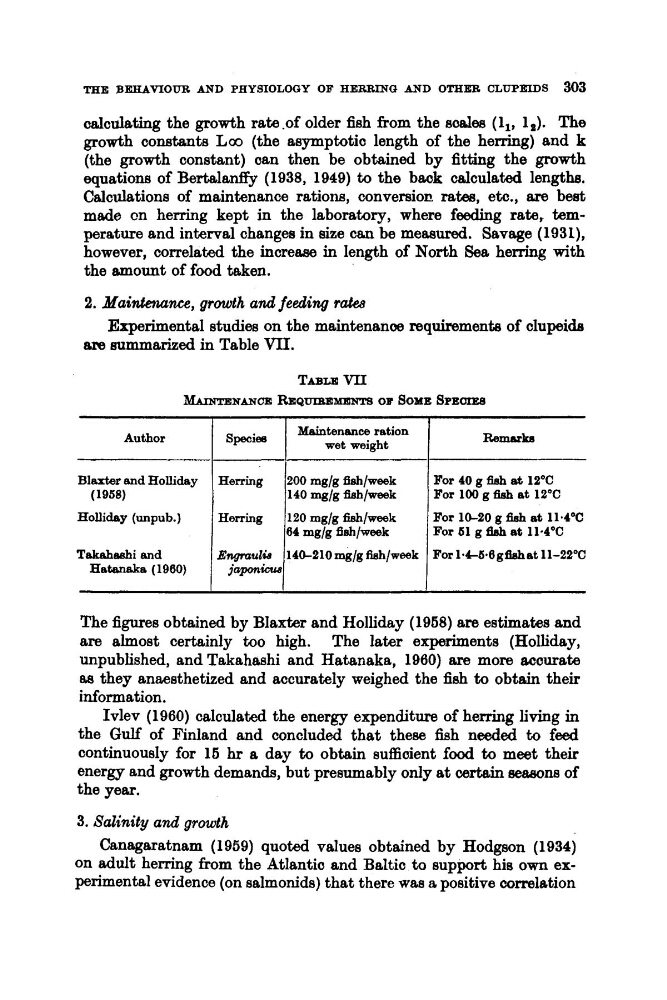
am e u m m ~ e d in Table VII.
Experimental studies on the maintenanoe requirementa of clupeida
Blaxter and Holliday
Holliday (unpub.)
Takabeehi and
(1958)
Hataneka (1900)
TABLE VII
MAINTENANCE REQK!lBEMENTS OF SOXB SPBOIE8
Herring
200 mg/g fhh/week
For 40 g fish at 12OC
Herring
120 mg/g fbh/week
For 10-20 g
at 11.4°C
Engrau2ia 14&210mg/gfiah/week For 14-64gfiahat ll-22°C
140 mg/g f%h/week
64 mg/g @/week
For 100 g fish at 12°C
For 61 g fbh at ll,4'C
j w w n h
The figures obtained by Blaxter and Holliday (1958) are estimates and
are almost certainly too high. The later experiments (Holliday,
unpublished, and Takahashi and Hatanaka, 1960) are more acclurate
as they anaesthetized and accurately weighed the fish to obtain their
information.
Ivlev (1960) calculated the energy expenditure of herring living in
the Gulf of Finland and concluded that these fish needed to feed
continuously for 15 hr a day to obtain sufficient food to meet their
energy and growth demands, but presumably only at certain seasons of
the year.
3. Salinity and growth
Canagaratnam (1959) quoted values obtained by Hodgson (1934)
on adult herring from the Atlantic and Baltic to support his own experimental evidence (on salmonids) that there was a positive correlation
Author
dculating the growth rate.of older fish from the s d e s (11, 1J. The
growth constants Loo (the asymptotic length of the herring) and k
(the growth constant) can then be obtained by fitting the growth
equations of B e r t a l a q (1938, 1949) to the back calculabd lengths.
Calculations of maintenance rations, conversioE rates, etc., are best
made en herring kept in the laboratory, where feeding rate, temperature and interval changes in size can be meaeured. Savage (1931),
however, correlated the increase in length of North Sea herring with
the amount of food taken.
Remlukll
Maintenance ration
wet weight
Species
2. bdaintemnce, growth and feeding rater,
am e u m m ~ e d in Table VII.
Experimental studies on the maintenanoe requirementa of clupeida
Blaxter and Holliday
Holliday (unpub.)
Takabeehi and
(1958)
Hataneka (1900)
TABLE VII
MAINTENANCE REQK!lBEMENTS OF SOXB SPBOIE8
Herring
200 mg/g fhh/week
For 40 g fish at 12OC
Herring
120 mg/g fbh/week
For 10-20 g
at 11.4°C
Engrau2ia 14&210mg/gfiah/week For 14-64gfiahat ll-22°C
140 mg/g f%h/week
64 mg/g @/week
For 100 g fish at 12°C
For 61 g fbh at ll,4'C
j w w n h
The figures obtained by Blaxter and Holliday (1958) are estimates and
are almost certainly too high. The later experiments (Holliday,
unpublished, and Takahashi and Hatanaka, 1960) are more acclurate
as they anaesthetized and accurately weighed the fish to obtain their
information.
Ivlev (1960) calculated the energy expenditure of herring living in
the Gulf of Finland and concluded that these fish needed to feed
continuously for 15 hr a day to obtain sufficient food to meet their
energy and growth demands, but presumably only at certain seasons of
the year.
3. Salinity and growth
Canagaratnam (1959) quoted values obtained by Hodgson (1934)
on adult herring from the Atlantic and Baltic to support his own experimental evidence (on salmonids) that there was a positive correlation