

clupeid species a d forty-two engraulids. He gave details of the
different proportions of the gut at different stages of development in
some of the species. There were population differences in gut length in
herring, Clupea pallasii, Sardina pilchardus, Sdrdinops cuerulea and
some engraulid species. I n particular he mentioned the very long guts
of ths diatom-eating clupeid Brevoortia and the engraulid Cetengraulia.
Stirling (1884) described the histology of parts of the gut of the
herring. Both the oesophagus and stomach had thick muscular coats
lined with glandular epithelium, the stomach having both simple and
compound glands. All parts of the gut were innervated by the sympathetic system, the stomach being also supplied by the vague nerve.
2. Digestive enzymes
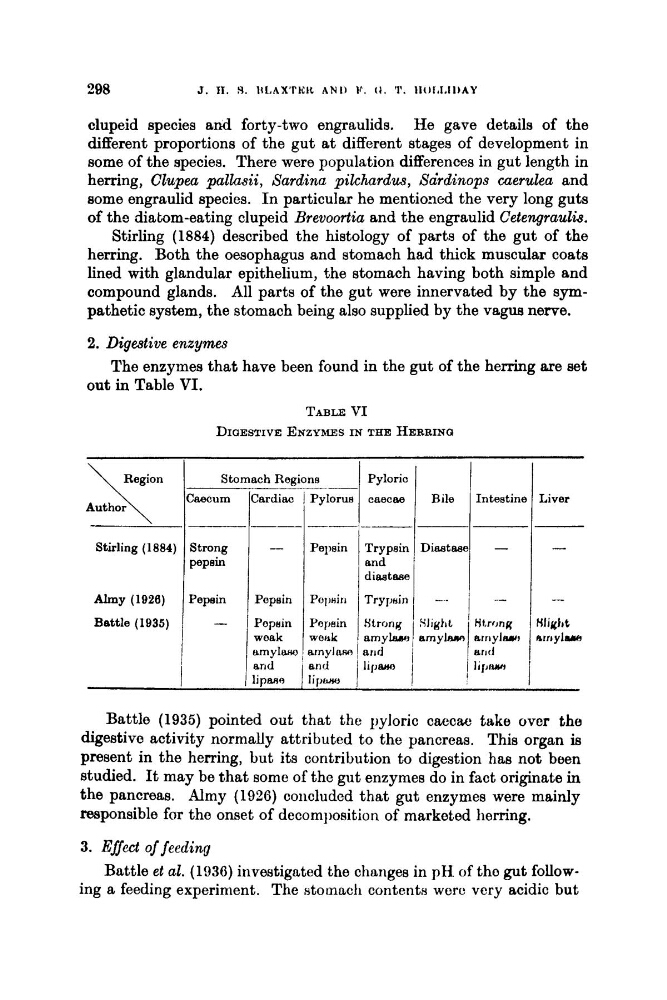
out in Table VI.
The enzymes that have been found in the gut of the herring are set
TABLE VI
DIGESTIVE ENZYMES IN THE HERRING
Pyloric
caecae
Bile
Stomach Reg
Caecum Cardiac
-
Region
Author \
Intestine Liver
' I
I
- -
Stirling (1884)
Almy (1926)
Battle (1935)
Strong
-
pepsin
Pepsin
Pepein
- Pepsin
weak
Pepsin
PUr)HiYl
Popnin
wonk
arnylaru,
anti
l i 1 J f M
1
i
amylase
and
lipam
I -
Battle (1935) pointed out that the pyloric caecae take ovcr the
digestive activity normally attributed to the pancreas. This organ is
present in the herring, but its contribution to digestion has not been
studied. It may be that some of the gut enzymes do in fact originate in
the pancreas. Almy (1926) concluded that gut enzymes were mainly
responsible for the onset of dacomposition of marketed herring.
3. Eflect of feeding
Battle et a,?. (1936) investigated the changes in pH of tho gut following a feeding experiment. The stomach contents werc very acidic but
different proportions of the gut at different stages of development in
some of the species. There were population differences in gut length in
herring, Clupea pallasii, Sardina pilchardus, Sdrdinops cuerulea and
some engraulid species. I n particular he mentioned the very long guts
of ths diatom-eating clupeid Brevoortia and the engraulid Cetengraulia.
Stirling (1884) described the histology of parts of the gut of the
herring. Both the oesophagus and stomach had thick muscular coats
lined with glandular epithelium, the stomach having both simple and
compound glands. All parts of the gut were innervated by the sympathetic system, the stomach being also supplied by the vague nerve.
2. Digestive enzymes
out in Table VI.
The enzymes that have been found in the gut of the herring are set
TABLE VI
DIGESTIVE ENZYMES IN THE HERRING
Pyloric
caecae
Bile
Stomach Reg
Caecum Cardiac
-
Region
Author \
Intestine Liver
' I
I
- -
Stirling (1884)
Almy (1926)
Battle (1935)
Strong
-
pepsin
Pepsin
Pepein
- Pepsin
weak
Pepsin
PUr)HiYl
Popnin
wonk
arnylaru,
anti
l i 1 J f M
1
i
amylase
and
lipam
I -
Battle (1935) pointed out that the pyloric caecae take ovcr the
digestive activity normally attributed to the pancreas. This organ is
present in the herring, but its contribution to digestion has not been
studied. It may be that some of the gut enzymes do in fact originate in
the pancreas. Almy (1926) concluded that gut enzymes were mainly
responsible for the onset of dacomposition of marketed herring.
3. Eflect of feeding
Battle et a,?. (1936) investigated the changes in pH of tho gut following a feeding experiment. The stomach contents werc very acidic but