

THE IIEHAVIOUlt AND PlIYYIOLOOY OF HERRING AND OTHER CLUPEIDS 265
Milli-cquivalents/litre
C1Na+
K+
Barnes (personal com204
166
633
munication) .
Holliday (unpublishod) . 215
112
549
long (20p) filamentous tail, with a pronounced axial filament running
throughout its length and projecting as an " end piece " from the tip
of the tail.
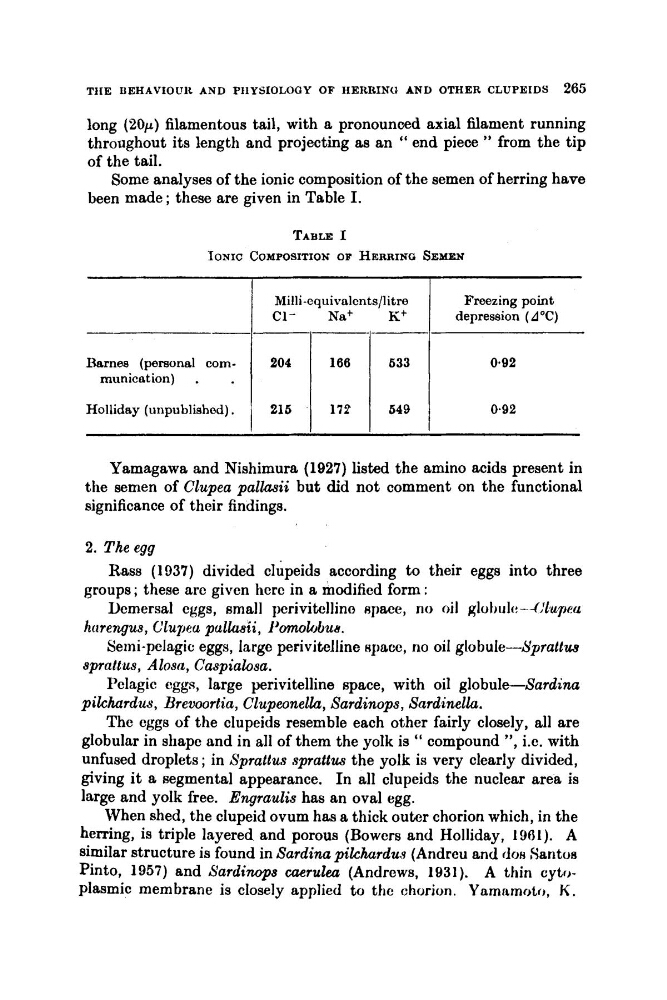
Some analyses of the ionic composition of the semen of herring have
been made ; these are given in Table I.
Freezing point
depression ( d "C)
0.92
0.92
Yamagawa and Nishimura (1927) listed the amino acids present in
the semen of Clupea pallasii but did not comment on the functional
significance of their findings.
2. The egg
Rass (1937) divided clupeids according to their eggs into three
groups ; these are givcn here in a modified form :
Dcmersal eggs, small perivitcllino upacc, no oil globule - 4,'lupea
hurengus, Clupeu pullusii, Pomolobucv.
Serni-pelagic eggs, large perivitelline Npace, no oil globule-Sprullus
spratt us, Alosa, Caspiaha.
Pelagic eggs, large perivitelline space, with oil globule-Sardinu
pilchardus, Brevoortia, Clupeonellu, Sardinops, Sardinellu.
The eggs of the clupcids resemble each other fairly closely, all are
globular in shape and in all of them the yolk is " compound ", i.e. with
unfused droplets ; in Sprattus sprattus the yolk is very clearly divided,
giving it a segmental appearance. In all clupeids the nuclear area is
large and yolk free. Engraulis has an oval egg.
When shed, the clupeid ovum has a thick outer chorion which, in the
herring, is triple layered and porous (Bowers and Holliday, 1Yfl1). A
similar structure is found in Sardina pilchardua (Andreu and d o u , 9 antos
Pinto, 1957) and Sardinops caerulea (Andrews, 1931). A thin cytoplasmic membrane is closely applied to thc chorion. Yamnmoto, K.
Milli-cquivalents/litre
C1Na+
K+
Barnes (personal com204
166
633
munication) .
Holliday (unpublishod) . 215
112
549
long (20p) filamentous tail, with a pronounced axial filament running
throughout its length and projecting as an " end piece " from the tip
of the tail.
Some analyses of the ionic composition of the semen of herring have
been made ; these are given in Table I.
Freezing point
depression ( d "C)
0.92
0.92
Yamagawa and Nishimura (1927) listed the amino acids present in
the semen of Clupea pallasii but did not comment on the functional
significance of their findings.
2. The egg
Rass (1937) divided clupeids according to their eggs into three
groups ; these are givcn here in a modified form :
Dcmersal eggs, small perivitcllino upacc, no oil globule - 4,'lupea
hurengus, Clupeu pullusii, Pomolobucv.
Serni-pelagic eggs, large perivitelline Npace, no oil globule-Sprullus
spratt us, Alosa, Caspiaha.
Pelagic eggs, large perivitelline space, with oil globule-Sardinu
pilchardus, Brevoortia, Clupeonellu, Sardinops, Sardinellu.
The eggs of the clupcids resemble each other fairly closely, all are
globular in shape and in all of them the yolk is " compound ", i.e. with
unfused droplets ; in Sprattus sprattus the yolk is very clearly divided,
giving it a segmental appearance. In all clupeids the nuclear area is
large and yolk free. Engraulis has an oval egg.
When shed, the clupeid ovum has a thick outer chorion which, in the
herring, is triple layered and porous (Bowers and Holliday, 1Yfl1). A
similar structure is found in Sardina pilchardua (Andreu and d o u , 9 antos
Pinto, 1957) and Sardinops caerulea (Andrews, 1931). A thin cytoplasmic membrane is closely applied to thc chorion. Yamnmoto, K.