

THE BIOLOGY OF CORAL REEFS
25 1
counter-clockwise in the northern portions." Measurements of water
flow into and out of Bikini lagoon indicated that the total volume of
water (approximately 28 x los m3) is completely replaced every 39
days during the trade wind season and in about double this time during
the summer. Thus there is retention with continuous replenishment.
The same picture emerges from the study of the plankton by
Johnson (1954). Certain species are found in both open ocean and
lagoon but four times more abundantly in the latter owing to retention
of water within it. There are also endemic lagoon species able to pass
the entire life history there. They live almost entirely in the deeper
slowly moving levels whic'h represent up to 90% of the water in the
lagoons. Even upward migration at night may not take them out of
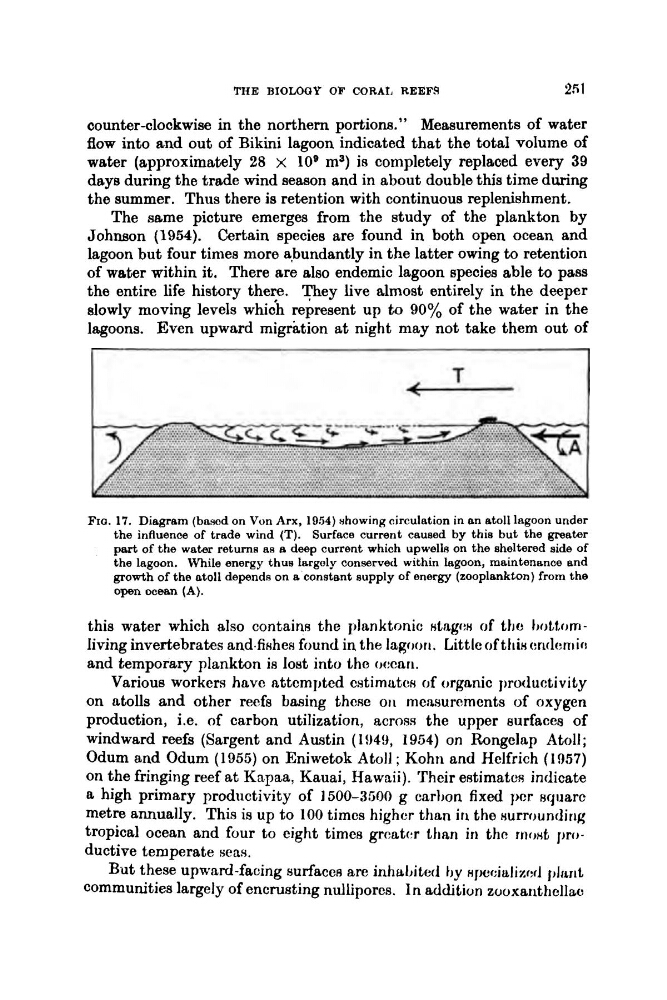
FIG. 17. Diagram (based on Von Arx, 1954) showing circulation in an atoll lagoon under
the influence of trade wind (T). Surface current caused by this but the greater
past of the water returns a8 a deep current which upwells on the sheltered side of
the lagoon. While energy thus largely conserved within lagoon, maintenance and
growth of the atoll depends on a constant supply of energy (zooplankton) from the
open ocean (A).
this water which also contains the jdanktonic H t a p (if thc: liot~tomliving invertebrates and.fishes found in the lagoori. Little of t t h c!ntlorn if!
and temporary plankton is loat into the ooeari.
Various workers have attempted cstimutos of organic productivity
on atolls and other recfs basing thwe on measurements of oxygen
production, i.e. of carbon utilization, across the upper surfaces of
windward reefs (Sargent and Austin (1!)4!j, 1954) on Rongelap Atoll;
Odum and Odum (1956) on Eniwetok Atoll; Kohn and Helfrich (1957)
on the fringing reef at Kapaa, Kauai, Hawaii). Their eRtimatcs indicate
a high primary productivity of 1500-3500 g carlton fixed per ~qiiare
metre annually. This is up to 100 times highcr than in the nurroundirig
tropical ocean and four to eight times groatw than in tho rnod productive temperate seas.
But these upward-facing surfaces are inhabited hy spwirtlixc:d plant
communities largely of encrusting nullipores. I n addition zooxarlthclleo
25 1
counter-clockwise in the northern portions." Measurements of water
flow into and out of Bikini lagoon indicated that the total volume of
water (approximately 28 x los m3) is completely replaced every 39
days during the trade wind season and in about double this time during
the summer. Thus there is retention with continuous replenishment.
The same picture emerges from the study of the plankton by
Johnson (1954). Certain species are found in both open ocean and
lagoon but four times more abundantly in the latter owing to retention
of water within it. There are also endemic lagoon species able to pass
the entire life history there. They live almost entirely in the deeper
slowly moving levels whic'h represent up to 90% of the water in the
lagoons. Even upward migration at night may not take them out of
FIG. 17. Diagram (based on Von Arx, 1954) showing circulation in an atoll lagoon under
the influence of trade wind (T). Surface current caused by this but the greater
past of the water returns a8 a deep current which upwells on the sheltered side of
the lagoon. While energy thus largely conserved within lagoon, maintenance and
growth of the atoll depends on a constant supply of energy (zooplankton) from the
open ocean (A).
this water which also contains the jdanktonic H t a p (if thc: liot~tomliving invertebrates and.fishes found in the lagoori. Little of t t h c!ntlorn if!
and temporary plankton is loat into the ooeari.
Various workers have attempted cstimutos of organic productivity
on atolls and other recfs basing thwe on measurements of oxygen
production, i.e. of carbon utilization, across the upper surfaces of
windward reefs (Sargent and Austin (1!)4!j, 1954) on Rongelap Atoll;
Odum and Odum (1956) on Eniwetok Atoll; Kohn and Helfrich (1957)
on the fringing reef at Kapaa, Kauai, Hawaii). Their eRtimatcs indicate
a high primary productivity of 1500-3500 g carlton fixed per ~qiiare
metre annually. This is up to 100 times highcr than in the nurroundirig
tropical ocean and four to eight times groatw than in tho rnod productive temperate seas.
But these upward-facing surfaces are inhabited hy spwirtlixc:d plant
communities largely of encrusting nullipores. I n addition zooxarlthclleo