

THE BIOLOQY OF CORAL RBEFS
249
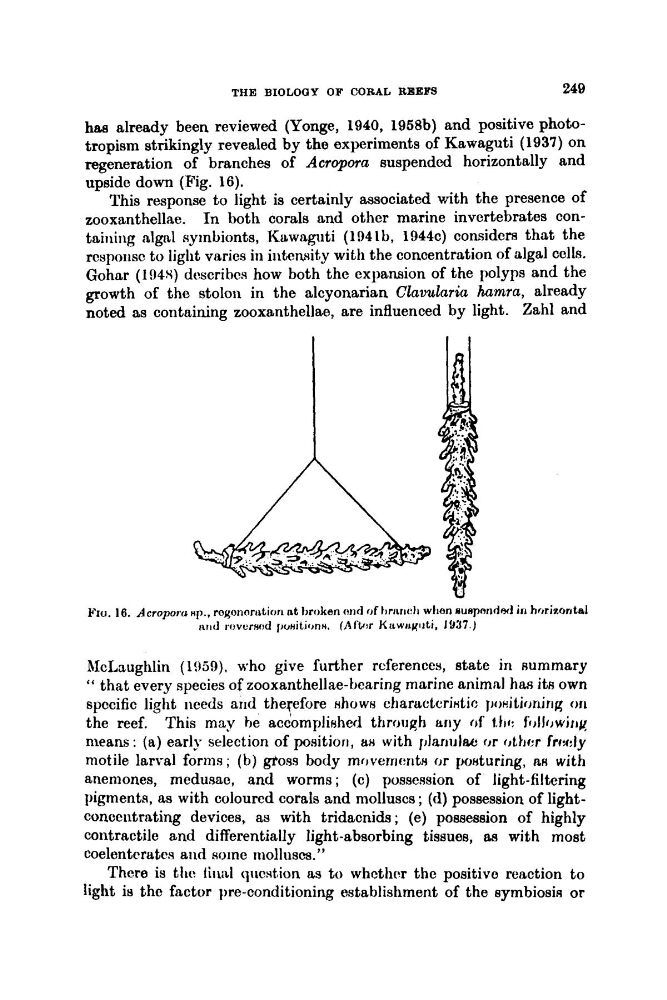
has already been reviewed (Yonge, 1940, 1958b) and positive phototropism strikingly revealed by the experiments of Kawaguti (1937) on
regeneration of branches of Acropora suspended horizontally and
upside down (Fig. 16).
This response to light is certainly associated with the presence of
zooxanthellae. I n both corals and other marine invertebrates containing dgsl syinbionts, Knwaguti (1941b, 1944c) considers that the
respouse to light varies in intensity with the concentration of algal cells.
Gohar (194%) dcscribcs how both the cxpansion of the polyps and the
growth of the stolon in the alcyonarian Clavularia hamra, already
noted as containing zooxanthellae, are influenced by light. Zahl and
RIcLeughlin (1!)50), who give further references, state in summary
" that every species of zooxanthellae-bearing marine animal has its own
spccific light needs and therefore tihows characterintic pAitirming on
the reef. This may he acc'omplished through m y of I h f g Altjwjrbg
means : (a) early selection of position, ( t ~ with plani~~rtc! fjr d h c r frcdy
motile larval forms ; (b) gross body movemantH or poduring, a~ with
anemones, medusae, and worms ; (c) posseasion of light-filtering
pigments, as with coloured corals and molluscs ; (d) possession of lightconccntrating devices, as with tridacnids ; (e) possession of highly
contractile and differentially light-absorbing tissues, aa with most
coelentcratcs atid some molluscs."
Thcre iu tlia liiuil qiicNtion as to whcthc*r the positivo reaction to
light is the factor pre-conditioning establishment of the symbiosis or
249
has already been reviewed (Yonge, 1940, 1958b) and positive phototropism strikingly revealed by the experiments of Kawaguti (1937) on
regeneration of branches of Acropora suspended horizontally and
upside down (Fig. 16).
This response to light is certainly associated with the presence of
zooxanthellae. I n both corals and other marine invertebrates containing dgsl syinbionts, Knwaguti (1941b, 1944c) considers that the
respouse to light varies in intensity with the concentration of algal cells.
Gohar (194%) dcscribcs how both the cxpansion of the polyps and the
growth of the stolon in the alcyonarian Clavularia hamra, already
noted as containing zooxanthellae, are influenced by light. Zahl and
RIcLeughlin (1!)50), who give further references, state in summary
" that every species of zooxanthellae-bearing marine animal has its own
spccific light needs and therefore tihows characterintic pAitirming on
the reef. This may he acc'omplished through m y of I h f g Altjwjrbg
means : (a) early selection of position, ( t ~ with plani~~rtc! fjr d h c r frcdy
motile larval forms ; (b) gross body movemantH or poduring, a~ with
anemones, medusae, and worms ; (c) posseasion of light-filtering
pigments, as with coloured corals and molluscs ; (d) possession of lightconccntrating devices, as with tridacnids ; (e) possession of highly
contractile and differentially light-absorbing tissues, aa with most
coelentcratcs atid some molluscs."
Thcre iu tlia liiuil qiicNtion as to whcthc*r the positivo reaction to
light is the factor pre-conditioning establishment of the symbiosis or