

246
C . M . YONOE
Motoda thinks this may be due to physiological senescence although
admitting it could also be associated with decrease in the surface/
volume ratio as the colony changed from t,he first flattened plate into
the final massive hemispherical form. As shown by Kawaguti (1941a),
during growth in these rounded colonies the volume increases in
proportion to the cube of the radius whereas the surface area increases
in proportion to the square of this. Thus in colonies with fifteen or less
polyps he found the weight per polyp to be around 0.15 g, with about
40 polyps around 0.40 g and with between 468 and 486 polyps about
0.80 g. This means, of course, that the needs of calcification increase at
a far higher rate than does the surface area of living tissue which
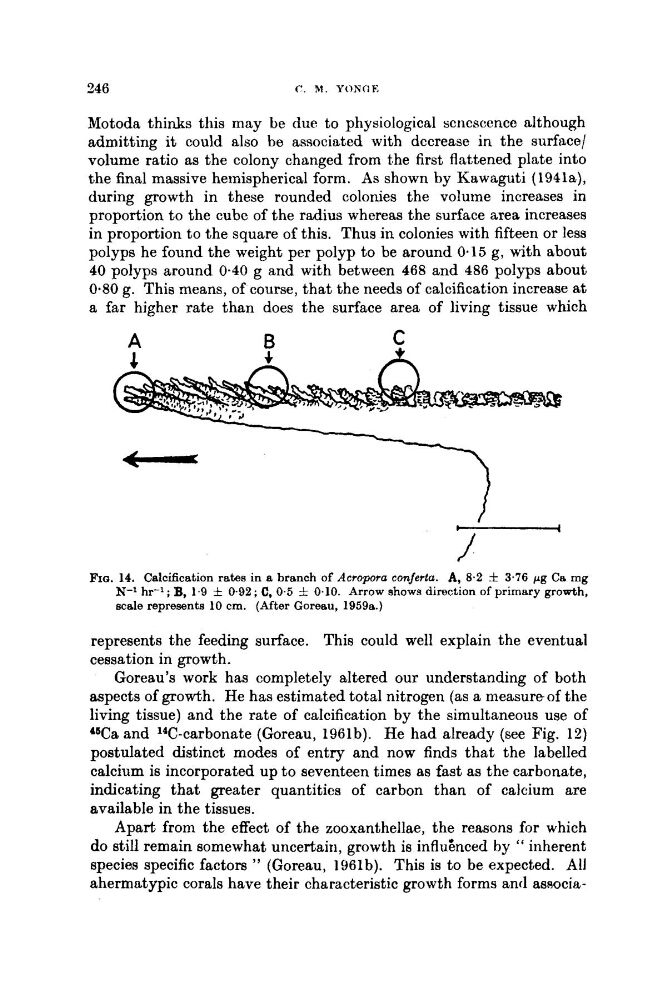
FIQ. 14. Calcification rates in a branch of Acropora conferfu. A, 8.2 i 3.76 p g Ce mg
N-* hr-' ; B, 1.9 f 0.92 ; C. 0.5 3~ 0.10. Arrow shows direction of primary growth,
scale represents 10 cm. (After Goreau, 1959a.)
represents the feeding surface. This could well explain the eventual
cessation in growth.
Goreau's work has completely altered our understanding of both
tupects of growth. He has estimated total nitrogen (as a measureof the
living tissue) and the rate of calcification by the simultaneous use of
'5Ca and W-carbonate (Goreau, 196lb). He had already (see Fig. 12)
postulated distinct modes of entry and now finds that the labelled
calcium is incorporated up to seventeen times as fast as the carbonate,
indicating that greater quantities of carbon than of calcium are
available in the tissues.
Apart from the effect of the zooxanthellae, the reasons for which
do still remain somewhat uncertain, growth is influ'enced by " inherent
species specific factors " (Goreau, 196lb). This is to be expected. All
ahermatypic corals have their characteristic growth forms and asRocia-
C . M . YONOE
Motoda thinks this may be due to physiological senescence although
admitting it could also be associated with decrease in the surface/
volume ratio as the colony changed from t,he first flattened plate into
the final massive hemispherical form. As shown by Kawaguti (1941a),
during growth in these rounded colonies the volume increases in
proportion to the cube of the radius whereas the surface area increases
in proportion to the square of this. Thus in colonies with fifteen or less
polyps he found the weight per polyp to be around 0.15 g, with about
40 polyps around 0.40 g and with between 468 and 486 polyps about
0.80 g. This means, of course, that the needs of calcification increase at
a far higher rate than does the surface area of living tissue which
FIQ. 14. Calcification rates in a branch of Acropora conferfu. A, 8.2 i 3.76 p g Ce mg
N-* hr-' ; B, 1.9 f 0.92 ; C. 0.5 3~ 0.10. Arrow shows direction of primary growth,
scale represents 10 cm. (After Goreau, 1959a.)
represents the feeding surface. This could well explain the eventual
cessation in growth.
Goreau's work has completely altered our understanding of both
tupects of growth. He has estimated total nitrogen (as a measureof the
living tissue) and the rate of calcification by the simultaneous use of
'5Ca and W-carbonate (Goreau, 196lb). He had already (see Fig. 12)
postulated distinct modes of entry and now finds that the labelled
calcium is incorporated up to seventeen times as fast as the carbonate,
indicating that greater quantities of carbon than of calcium are
available in the tissues.
Apart from the effect of the zooxanthellae, the reasons for which
do still remain somewhat uncertain, growth is influ'enced by " inherent
species specific factors " (Goreau, 196lb). This is to be expected. All
ahermatypic corals have their characteristic growth forms and asRocia-