

228
C. M. YONQE
zom down to a depth of 3 m which has a mixed population of corals,
including the most hardy species. (2) A channel or lugoon zone which is
between 100 and 300 m wide and from 2 to 15 m deep. The bottom is
sandy and, apart from the sand-dwelling Hanicinu areolata, commonest
amongst eel grass, corals are sparse although gcrgonids, molluscs and
echinoderm3 are common. ( 3 ) A rear zone which represents the inner
slope of the reef crest and over a depth of 2 to 3 m carries a rich
population of corals including both solid and branching colonies, with
the former the more numerous. (4) The reef flat or Zoanthus zone, most
of which is covered by no more than half a metre of water and is about
40 m wide ; it consists almost entirely of the unconsolidated skeletons of
Acropora palmata on which there is a characteristic green growth of the
zoanthid Zoanthus sociatzls with a few corals largely confined to the
shallow channel and pools. ( 5 ) The palmata zone which is the upper pert
510
20
30
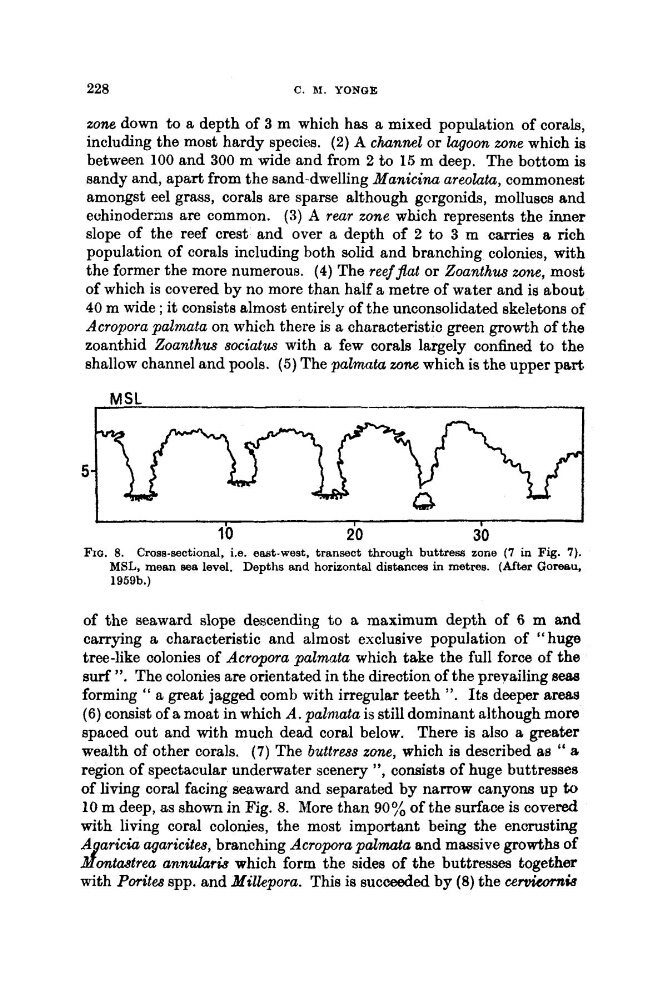
FIQ. 8. Cross-sectional, i.e. east-west, transect through buttress zone (7 in Fig. 7).
MSL, mean m a level. Depths and horizontal distances in metres. (After Goremu.
1959b.l
of the seaward slope descending t o a maximum depth of 6 m and
carrying a characteristic and almost exclusive population of “huge
tree-like colonies of Acropora palmata which take the full force of the
surf ”. The colonies are orientated in the direction of the prevailing seaa
forming ‘ I a great jagged comb with irregular teeth ”. Its deeper areas
(6) consist of a moat in which A . palntata is still dominant although more
spaced out and with much dead coral below. There is also a greater
wealth of other corals. (7) The buttress zone, which is described as ‘‘ a
region of spectacular underwater scenery l’, consists of huge buttresses
of living coral facing seaward and separated by narrow canyons up to
10 m deep, as shown in Fig. 8. More than 90% of the surface is covered
with living coral colonies, the most important being the encrusting
A arick ugaricites, branching Acropora palmata and massive growths of
with Porites spp. and Milkpora. This is succeeded by ( 8 ) the ce7vicom&
a9 ontastreu annuEaris which form the sides of the buttresses together
C. M. YONQE
zom down to a depth of 3 m which has a mixed population of corals,
including the most hardy species. (2) A channel or lugoon zone which is
between 100 and 300 m wide and from 2 to 15 m deep. The bottom is
sandy and, apart from the sand-dwelling Hanicinu areolata, commonest
amongst eel grass, corals are sparse although gcrgonids, molluscs and
echinoderm3 are common. ( 3 ) A rear zone which represents the inner
slope of the reef crest and over a depth of 2 to 3 m carries a rich
population of corals including both solid and branching colonies, with
the former the more numerous. (4) The reef flat or Zoanthus zone, most
of which is covered by no more than half a metre of water and is about
40 m wide ; it consists almost entirely of the unconsolidated skeletons of
Acropora palmata on which there is a characteristic green growth of the
zoanthid Zoanthus sociatzls with a few corals largely confined to the
shallow channel and pools. ( 5 ) The palmata zone which is the upper pert
510
20
30
FIQ. 8. Cross-sectional, i.e. east-west, transect through buttress zone (7 in Fig. 7).
MSL, mean m a level. Depths and horizontal distances in metres. (After Goremu.
1959b.l
of the seaward slope descending t o a maximum depth of 6 m and
carrying a characteristic and almost exclusive population of “huge
tree-like colonies of Acropora palmata which take the full force of the
surf ”. The colonies are orientated in the direction of the prevailing seaa
forming ‘ I a great jagged comb with irregular teeth ”. Its deeper areas
(6) consist of a moat in which A . palntata is still dominant although more
spaced out and with much dead coral below. There is also a greater
wealth of other corals. (7) The buttress zone, which is described as ‘‘ a
region of spectacular underwater scenery l’, consists of huge buttresses
of living coral facing seaward and separated by narrow canyons up to
10 m deep, as shown in Fig. 8. More than 90% of the surface is covered
with living coral colonies, the most important being the encrusting
A arick ugaricites, branching Acropora palmata and massive growths of
with Porites spp. and Milkpora. This is succeeded by ( 8 ) the ce7vicom&
a9 ontastreu annuEaris which form the sides of the buttresses together