

TEE BIOLOGY OF CYORAL REEFS
223
channels may become overarohed by the upward growth of mushroomtopped masses of calcareous algae which then fuse with one another
leaving channels below. Wahr entering along the surge channels is
violently expelled through a series of blow holes on the reef surf-.
Details of these “ room-and-pillar ” structures are given in Fig. 4. As
described in detail by Munk and Saqent (1964), the effect of the surge
channel8 is to counter the force of entering sew. They are, aa shown
very clearly at Bikini, confined to the windward surfaoes of the reef and
play a clearly essential role in the maintenance of the reef mass against
the f d force of the oceanic surf.
-
- -
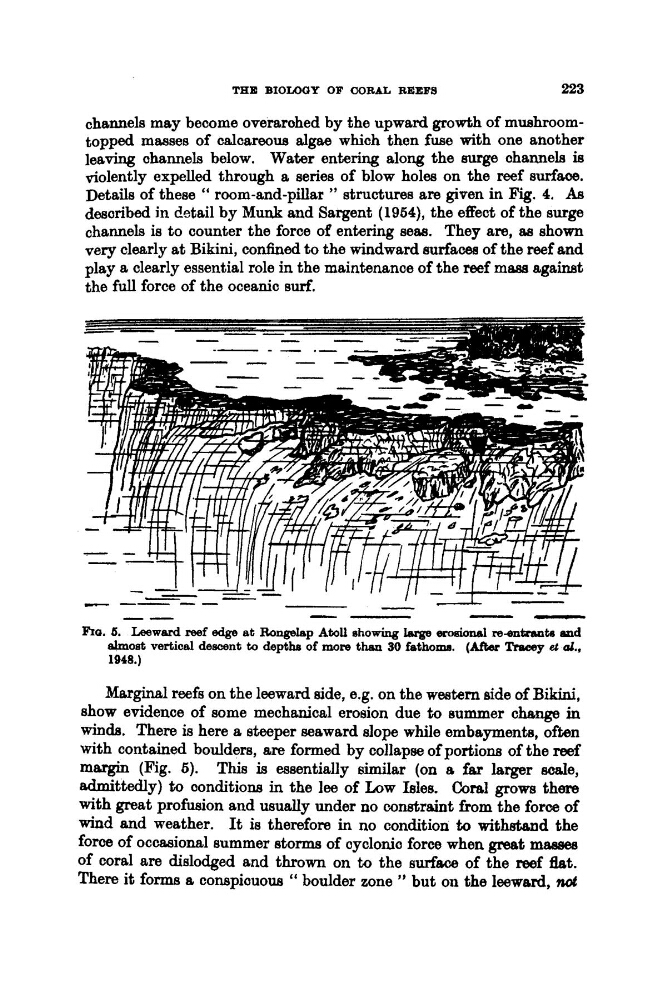
FIG. 6. Leeward reef edge at Rongelep Atoll showing lerge dd re-tmfrsnta and
almost vertioal descent to depth of more than 30 fathoms. (After ‘Jhxiy eL d.,
1948.)
Marginal reefs on the leeward aide, e.g. on the western side of Bikini,
show evidence of some mechanical erosion due to summer change in
winds. There is here a steeper seaward slope while embayments, often
with contained boulders, are formed by collapse of portions of the reef
margin (Fig. 6). This is essentially similar (on a far larger scale,
admittedly) to conditions in the lee of Low Isles. Coral grows there
with great profusion and usually under no constraint from the force of
wind and weather. It is therefore in no condition to withatcrad the
force of occaaional summer storms of cyclonic force when greet II~&BB~B
of coral are dislodged and thrown on to the surface of the reef fiat.
There it forms a conspicuous “ boulder zone ” but on the leeward, not
223
channels may become overarohed by the upward growth of mushroomtopped masses of calcareous algae which then fuse with one another
leaving channels below. Wahr entering along the surge channels is
violently expelled through a series of blow holes on the reef surf-.
Details of these “ room-and-pillar ” structures are given in Fig. 4. As
described in detail by Munk and Saqent (1964), the effect of the surge
channel8 is to counter the force of entering sew. They are, aa shown
very clearly at Bikini, confined to the windward surfaoes of the reef and
play a clearly essential role in the maintenance of the reef mass against
the f d force of the oceanic surf.
-
- -
FIG. 6. Leeward reef edge at Rongelep Atoll showing lerge dd re-tmfrsnta and
almost vertioal descent to depth of more than 30 fathoms. (After ‘Jhxiy eL d.,
1948.)
Marginal reefs on the leeward aide, e.g. on the western side of Bikini,
show evidence of some mechanical erosion due to summer change in
winds. There is here a steeper seaward slope while embayments, often
with contained boulders, are formed by collapse of portions of the reef
margin (Fig. 6). This is essentially similar (on a far larger scale,
admittedly) to conditions in the lee of Low Isles. Coral grows there
with great profusion and usually under no constraint from the force of
wind and weather. It is therefore in no condition to withatcrad the
force of occaaional summer storms of cyclonic force when greet II~&BB~B
of coral are dislodged and thrown on to the surface of the reef fiat.
There it forms a conspicuous “ boulder zone ” but on the leeward, not