

188
J. A. C. NIOOL
found that smolt (from sea water) and an adult wlmon that ww
migrating upstream had purple-coloured retime reeembling those of
freshwater fish, i.e. they retained the predominantly porphyropeia
system also discovered in freshwater phases of salmonids. The eel
(AnguiEla) in its immature freshwater phaae has a purple-coloured
retina (dhiefly rhodopsin, vide supra). But when the eel beoornm
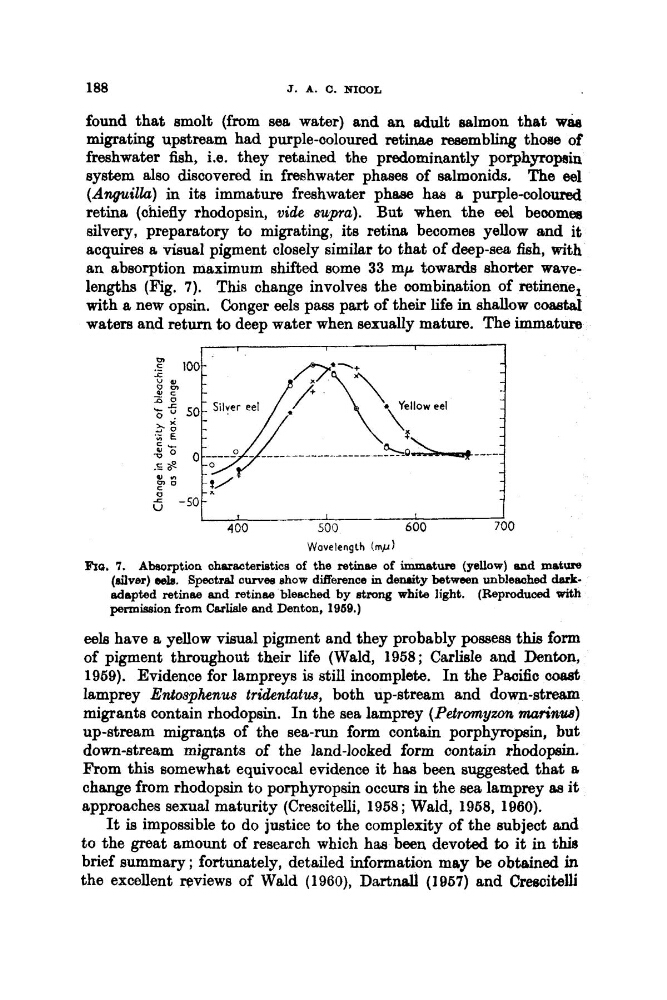
silvery, preparatory to migrating, its retina, becomes yellow and it
acquires a visual pigment closely similar to that of deep-sea f%h, with
an absorption maximum shifted some 33 mp towards shorter wavelengths (Fig. 7). This change involves the combination of mthene,
with a new opsin. Conger eels pass part of their life in shallow coastal
waters and return to deep water when sexually mature. The immature
I
I
I
L - L -
400
500
600
700
Wavelength (mp)
FIG, 7. Absorption characteristics of the retinae of immature (yellow) end mature
(silver) eels. Spectral curves ehow difference in denaity between unbleached darkadapted retinee and retinee bleached by strong white light. (Reproduced with
permission from CmMe and Denton, 1969.)
eels have a yellow visual pigment and they probably possess this form
of pigment throughout their life (Wald, 1958; Carlisle and Denton,
1969). Evidence for lampreys is still incomplete. In the Pacific c&
lamprey Entosphnus tridentatus, both up-stream and down-stream
migrants contain rhodopsin. In the sea lamprey (Petromyzon wrinua)
up-stream migrants of the sea-run form contain porphyropsin, but
down-stream migrants of the land-locked form contain rhodopsin.
From this somewhat equivocal evidence it has been suggested that a
change from rhodopsin to porphyropsin occurs in the ma lamprey aa it
approaches sexual maturity (Crescitelli, 1958 ; Wald, 1958, 1960).
It is impossible t o do justice to the complexity of the subject and
to the great amount of research which has been devoted to it in thi6
brief summary ; fortunately, detailed information may be obtained in
the excellent reviews of Wald (1960), D a r t d (1967) and Creecitelli
J. A. C. NIOOL
found that smolt (from sea water) and an adult wlmon that ww
migrating upstream had purple-coloured retime reeembling those of
freshwater fish, i.e. they retained the predominantly porphyropeia
system also discovered in freshwater phases of salmonids. The eel
(AnguiEla) in its immature freshwater phaae has a purple-coloured
retina (dhiefly rhodopsin, vide supra). But when the eel beoornm
silvery, preparatory to migrating, its retina, becomes yellow and it
acquires a visual pigment closely similar to that of deep-sea f%h, with
an absorption maximum shifted some 33 mp towards shorter wavelengths (Fig. 7). This change involves the combination of mthene,
with a new opsin. Conger eels pass part of their life in shallow coastal
waters and return to deep water when sexually mature. The immature
I
I
I
L - L -
400
500
600
700
Wavelength (mp)
FIG, 7. Absorption characteristics of the retinae of immature (yellow) end mature
(silver) eels. Spectral curves ehow difference in denaity between unbleached darkadapted retinee and retinee bleached by strong white light. (Reproduced with
permission from CmMe and Denton, 1969.)
eels have a yellow visual pigment and they probably possess this form
of pigment throughout their life (Wald, 1958; Carlisle and Denton,
1969). Evidence for lampreys is still incomplete. In the Pacific c&
lamprey Entosphnus tridentatus, both up-stream and down-stream
migrants contain rhodopsin. In the sea lamprey (Petromyzon wrinua)
up-stream migrants of the sea-run form contain porphyropsin, but
down-stream migrants of the land-locked form contain rhodopsin.
From this somewhat equivocal evidence it has been suggested that a
change from rhodopsin to porphyropsin occurs in the ma lamprey aa it
approaches sexual maturity (Crescitelli, 1958 ; Wald, 1958, 1960).
It is impossible t o do justice to the complexity of the subject and
to the great amount of research which has been devoted to it in thi6
brief summary ; fortunately, detailed information may be obtained in
the excellent reviews of Wald (1960), D a r t d (1967) and Creecitelli