

180
J. A. C. NICOL
./*--.-.--.-.
-
brama) was partially retracted and cones were shortened. The threshold
for movement of the cones was obviously below this level sinoe they
were still partially contracted in rather dimmer light (Garten, 1907).
In A. chrywleucas the pigment was fully retracted or partially expanded
and cones showed signs of incipient movement a t a light-level jnst
permitting colom to be distinguished. When the light wm bright
enough to permit reading, the oones of A. chryaokum.9 shortened
greatly, but not to their minimal extent, and the rods of Ameium
nebuhus began to elongate ( k e y , 1919). The light-level at which
colour vision begins lies between 0.01 and 0.001 ft c* (produohg a
brightness on a screen of about 0.0176 and 0.00176millil8jmbert,
0.80
60U
.E
v
-
U
Y)
k 40E
t
20
Pigment
0 Cones
0 Retinal index
c
d
.2
- 0.40
-
I
1
1
I
I
I
I
1
0.20
i
0-60 2
* - 1 .I
s
Light intensity (ft-c)
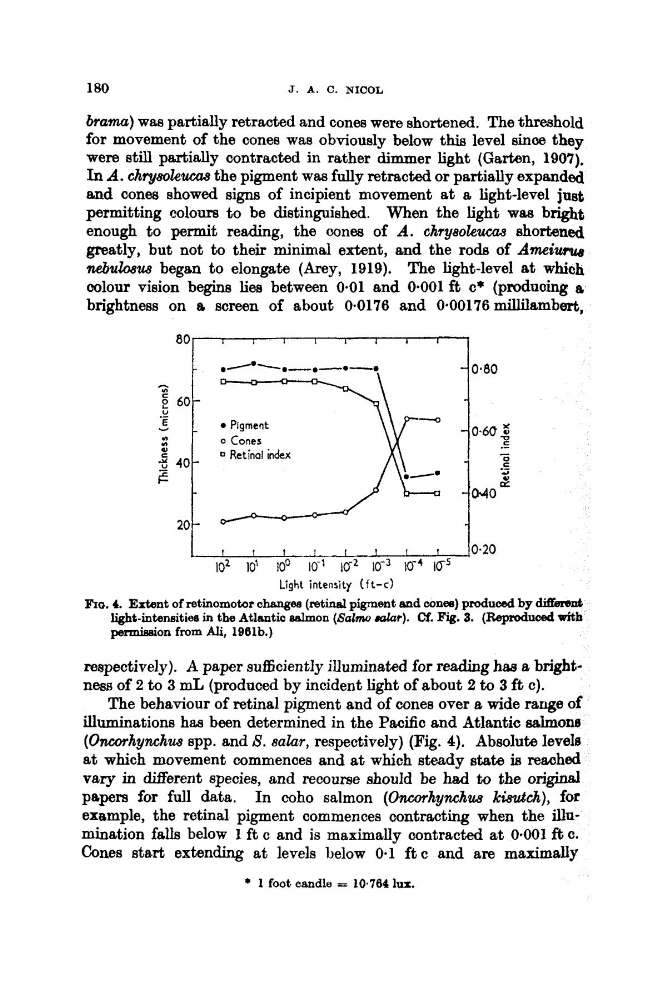
FIG. 4. Extent of retinomotor ohengee (retinal pigment and con-) produced by diSmr&
light-intensities in the Atlantic &on
(Scrlmo &r). Cf. Fig. 3. (Reproduced with
permhion from Ali, 1961b.)
reepectively). A paper su%kiently illuminated for reading has a. brightness of 2 to 3 mL (produced by incident light of about 2 to 3 f t c).
The behaviour of retinal pigment and of cones over a wide range of
iUuminations has been determined in the Pacific and Atlantic aalmonn
(Oncot.hynchus spp. and S. salar, respectively) (Fig. 4). Absolute levels
at which movement commences and at which steady state is maohed
vary in Merent species, end recoume should be had to the ori@
papers for full data. In coho salmon (Oncorhynchus kimtch), for
example, the retinal pigment commences contracting when the illumination falls below 1 ft c and is maximally contracted a t 0.001 ft c.
Cones sta.rt extendmg at levels below 0.1 ft c and are maximally
* 1 foot candle = 10.764 lux.
J. A. C. NICOL
./*--.-.--.-.
-
brama) was partially retracted and cones were shortened. The threshold
for movement of the cones was obviously below this level sinoe they
were still partially contracted in rather dimmer light (Garten, 1907).
In A. chrywleucas the pigment was fully retracted or partially expanded
and cones showed signs of incipient movement a t a light-level jnst
permitting colom to be distinguished. When the light wm bright
enough to permit reading, the oones of A. chryaokum.9 shortened
greatly, but not to their minimal extent, and the rods of Ameium
nebuhus began to elongate ( k e y , 1919). The light-level at which
colour vision begins lies between 0.01 and 0.001 ft c* (produohg a
brightness on a screen of about 0.0176 and 0.00176millil8jmbert,
0.80
60U
.E
v
-
U
Y)
k 40E
t
20
Pigment
0 Cones
0 Retinal index
c
d
.2
- 0.40
-
I
1
1
I
I
I
I
1
0.20
i
0-60 2
* - 1 .I
s
Light intensity (ft-c)
FIG. 4. Extent of retinomotor ohengee (retinal pigment and con-) produced by diSmr&
light-intensities in the Atlantic &on
(Scrlmo &r). Cf. Fig. 3. (Reproduced with
permhion from Ali, 1961b.)
reepectively). A paper su%kiently illuminated for reading has a. brightness of 2 to 3 mL (produced by incident light of about 2 to 3 f t c).
The behaviour of retinal pigment and of cones over a wide range of
iUuminations has been determined in the Pacific and Atlantic aalmonn
(Oncot.hynchus spp. and S. salar, respectively) (Fig. 4). Absolute levels
at which movement commences and at which steady state is maohed
vary in Merent species, end recoume should be had to the ori@
papers for full data. In coho salmon (Oncorhynchus kimtch), for
example, the retinal pigment commences contracting when the illumination falls below 1 ft c and is maximally contracted a t 0.001 ft c.
Cones sta.rt extendmg at levels below 0.1 ft c and are maximally
* 1 foot candle = 10.764 lux.