

176
J. A. C. NICOL
(a pelagic ray) and Selache (a basking shark). Some of these statemente
stem from the early work of Briicke (1845). Nevertheless, a tapetum
lucidum does exist in the Greenland shark, Sonmiosus microcephub,
and in another bathypelagic shark, Spinax spinax (Etmopterus s p i m )
(Franz, 1905; Berland, 1961).
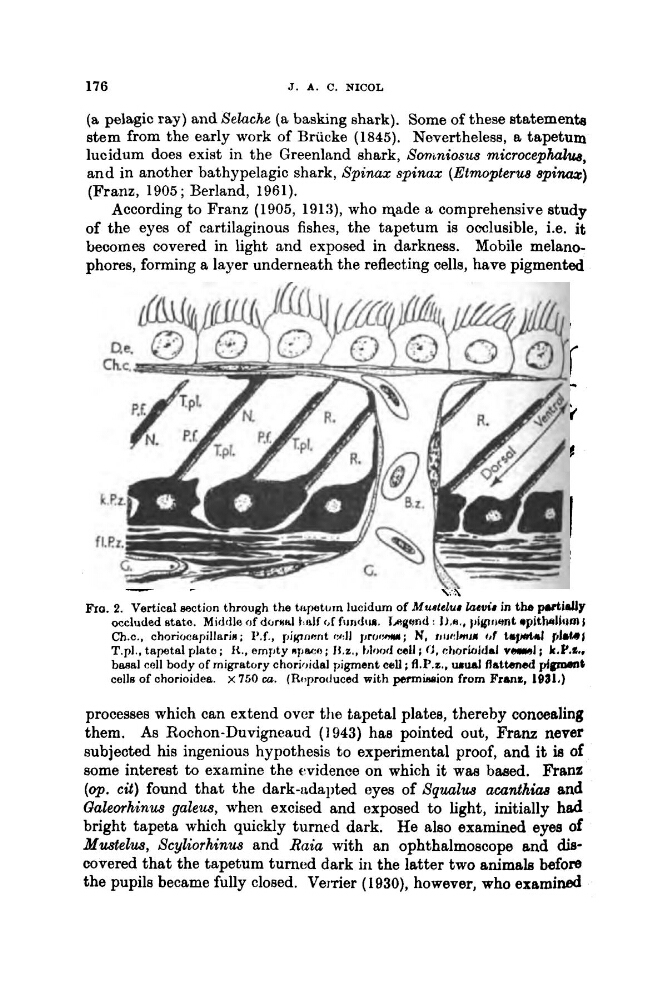
According to Franz (1905, 1913), who made a comprehensive study
of the eyes of cartilaginous fishes, the tapetum is occlusible, i.e. it
becomes covered in light and exposed in darkness. Mobile melanophores, forming a layer underneath the reflecting cells, have pigmented
Fro. 2. Vertical section through the tripetliin lucidum of Muatelur bevie in the putidy
occluded atata. Middle
~ J T tayd*l plat&#
T.pl., tapetal plato; It., empty spaat; H z . , blood cell ; (1, atrorbidal veml; L.P.C.,
baaal cell body of migratory choriaidal pigment cell ; fl.P,z., wusl fisttuned pirfgmrmt
cells of chorioidea. x 760 cu. (Roproduced with permhion from Frsnz, l@al.)
processes which can extend over the tapetal plates, thereby concealing
them. As Rochon-Duvigneaud (1943) has pointed out, Frau never
subjected his ingenious hypothesis to experimental proof, and it ie of
some interest to examine the evidence on which it was based. Franz
(op. cit) found that the dark-adapted eyes of Squalus acunthiaa and
Galeorhinus galeus, when excised and exposed to light, initially had
bright tapeta which quickly turned dark. He also examined eyes of
Mustelus, Scyliorhinus and Raia with an ophthalmoscope and discovered that the tapetum turned dark in the latter two animals before
the pupils became fully closed. VerTier (1930), however, who examined
J. A. C. NICOL
(a pelagic ray) and Selache (a basking shark). Some of these statemente
stem from the early work of Briicke (1845). Nevertheless, a tapetum
lucidum does exist in the Greenland shark, Sonmiosus microcephub,
and in another bathypelagic shark, Spinax spinax (Etmopterus s p i m )
(Franz, 1905; Berland, 1961).
According to Franz (1905, 1913), who made a comprehensive study
of the eyes of cartilaginous fishes, the tapetum is occlusible, i.e. it
becomes covered in light and exposed in darkness. Mobile melanophores, forming a layer underneath the reflecting cells, have pigmented
Fro. 2. Vertical section through the tripetliin lucidum of Muatelur bevie in the putidy
occluded atata. Middle
~ J T tayd*l plat&#
T.pl., tapetal plato; It., empty spaat; H z . , blood cell ; (1, atrorbidal veml; L.P.C.,
baaal cell body of migratory choriaidal pigment cell ; fl.P,z., wusl fisttuned pirfgmrmt
cells of chorioidea. x 760 cu. (Roproduced with permhion from Frsnz, l@al.)
processes which can extend over the tapetal plates, thereby concealing
them. As Rochon-Duvigneaud (1943) has pointed out, Frau never
subjected his ingenious hypothesis to experimental proof, and it ie of
some interest to examine the evidence on which it was based. Franz
(op. cit) found that the dark-adapted eyes of Squalus acunthiaa and
Galeorhinus galeus, when excised and exposed to light, initially had
bright tapeta which quickly turned dark. He also examined eyes of
Mustelus, Scyliorhinus and Raia with an ophthalmoscope and discovered that the tapetum turned dark in the latter two animals before
the pupils became fully closed. VerTier (1930), however, who examined