

THE BREEDING OF THE NORTH ATLANTIC FJEESHWATER-EEI,S
163
partly overlapping distributions. Both species breed in the Sargasso
Sea close to the West Indies; the parallelism to the two AnguiUa
species is found in the maximum size of the unmetamorphosed leptacephali, being about 90 mm in the western species, S. infernalis, and
about 120 mm in the eastern species, 8. kaupi. Furthermore the
duration of the leptocephalus stage is about 8 months in 8. infernalis
and about 20 months in S. kaupi. The number of myomeres counted in
40 S. infernalis was 131-140 and in 262 S. kaupi 143-154.
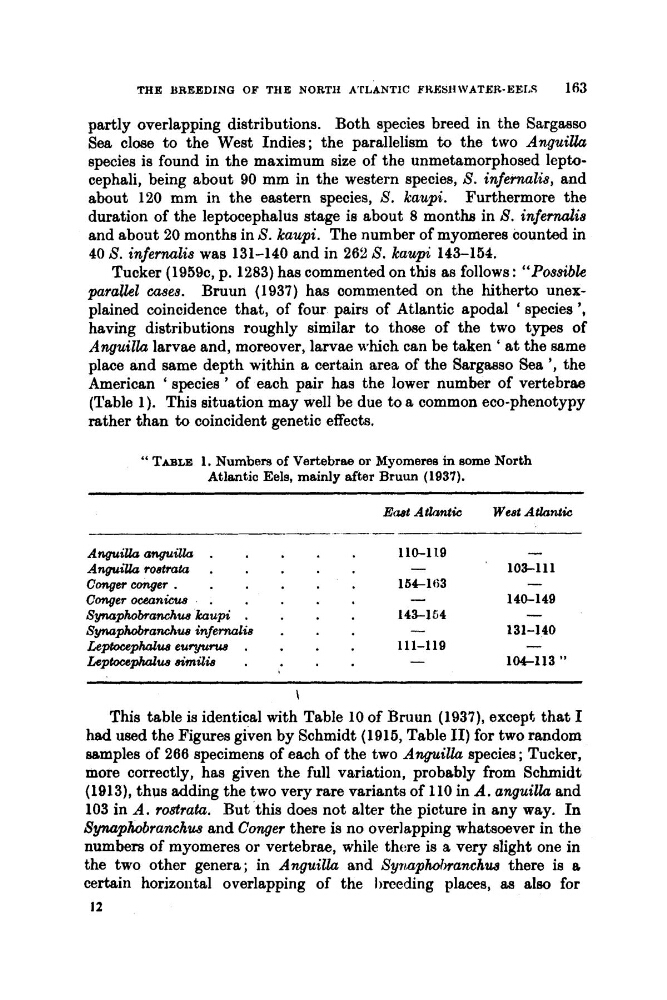
Tucker (1959c, p. 1283) has commented on this as follows : “Possibk
parallel cases. Bruun (1937) has commented on the hitherto unexplained coincidence that, of four pair8 of Atlantic apodal ‘ species ’,
having distributions roughly similar to those of the two types of
Anguilla larvae and, moreover, larvae which can be taken ‘ at the same
place and same depth within a certain area of the Sargasso Sea ’, the
American ‘ species ’ of each pair has the lower number of vertebrae
(Table 1). This situation may well be due to a common eco-phenotypy
rather than to coincident genetic effects.
“ TABLE 1. Numbers of Vertebrae or Myomeree in some North
Atlantic Eels, mainly after Bruun (1937).
AnpiUaanguillu .
AnguiUa rostrata .
Conger conger .
Congeroceanicue .
Synaphobranchue kaupi .
Synaphobranchw infernalis
Leptocepholue euryunu, .
Leptocephalua similie
.
Ewt Attantic
110-119
164-163
143-164
111-1 19
-
-
-
-
West Atlantic
-
’
103-111
140-149
-
-
131-140
-
1CM-113 ”
This table is identical with Table 10 of Bruun (1937), except that I
had used the Figures given by Schmidt (1 916, Table 11) for two random
samples of 266 specimens of each of the two Anguilla species ; Tucker,
more correctly, has given the full variation, probably from Schmidt
(1913), thus adding the two very rare variants of 110 in A. anguiUa and
103 in A. roslrata. But this does not alter the picture in any way. In
Synuphobranchw and Conger there is no overlapping whatsoever in the
numbers of myomeres or vertebrae, while thwe is a very slight one in
the two other genera; in Anguilla and Syri.phol~ranchw there is a
certain horizontal overlapping of the Imeding places, as also for
12
163
partly overlapping distributions. Both species breed in the Sargasso
Sea close to the West Indies; the parallelism to the two AnguiUa
species is found in the maximum size of the unmetamorphosed leptacephali, being about 90 mm in the western species, S. infernalis, and
about 120 mm in the eastern species, 8. kaupi. Furthermore the
duration of the leptocephalus stage is about 8 months in 8. infernalis
and about 20 months in S. kaupi. The number of myomeres counted in
40 S. infernalis was 131-140 and in 262 S. kaupi 143-154.
Tucker (1959c, p. 1283) has commented on this as follows : “Possibk
parallel cases. Bruun (1937) has commented on the hitherto unexplained coincidence that, of four pair8 of Atlantic apodal ‘ species ’,
having distributions roughly similar to those of the two types of
Anguilla larvae and, moreover, larvae which can be taken ‘ at the same
place and same depth within a certain area of the Sargasso Sea ’, the
American ‘ species ’ of each pair has the lower number of vertebrae
(Table 1). This situation may well be due to a common eco-phenotypy
rather than to coincident genetic effects.
“ TABLE 1. Numbers of Vertebrae or Myomeree in some North
Atlantic Eels, mainly after Bruun (1937).
AnpiUaanguillu .
AnguiUa rostrata .
Conger conger .
Congeroceanicue .
Synaphobranchue kaupi .
Synaphobranchw infernalis
Leptocepholue euryunu, .
Leptocephalua similie
.
Ewt Attantic
110-119
164-163
143-164
111-1 19
-
-
-
-
West Atlantic
-
’
103-111
140-149
-
-
131-140
-
1CM-113 ”
This table is identical with Table 10 of Bruun (1937), except that I
had used the Figures given by Schmidt (1 916, Table 11) for two random
samples of 266 specimens of each of the two Anguilla species ; Tucker,
more correctly, has given the full variation, probably from Schmidt
(1913), thus adding the two very rare variants of 110 in A. anguiUa and
103 in A. roslrata. But this does not alter the picture in any way. In
Synuphobranchw and Conger there is no overlapping whatsoever in the
numbers of myomeres or vertebrae, while thwe is a very slight one in
the two other genera; in Anguilla and Syri.phol~ranchw there is a
certain horizontal overlapping of the Imeding places, as also for
12